
INTRODUCTION
Sepsis is a potentially fatal clinical syndrome caused by the unregulated response to an infectious agent that promotes organ dysfunction and puts the patient's life at risk, therefore it is considered an important cause of morbidity and mortality among hospitalized individuals1,2,3.4. Both community infections, 40%, and those associated with health care, 60%, can progress to sepsis, thus, it is also responsible for prolonging the hospitalization time and consequently increasing the cost of expenses5,6,7.
Notoriously, it is the main cause of death in non-cardiological ICUs, with high lethality rates that vary according to the country's socioeconomic characteristics8. The same pathophysiological process can present different clinical stages, which leads to a disastrous result in the treatment of sepsis in Brazilian ICUs7.8. Factors such as delay in seeking medical attention, late diagnosis, lack of access to ICUs, inadequate treatment, lack of hygiene, and lack of resources directly interfere with the patient's prognosis and quality of life7.
In Brazil, a study showed that about 420 thousand cases of sepsis are treated per year and it is estimated that more than 230 thousand (54.7%) culminate in deaths
In the United States, population studies suggest an incidence of 240 cases of sepsis per 100,000 people per year and 300 cases of severe sepsis per 100,000 people per year9,10. Another study by the Global Burden of Disease points out that sepsis causes the death of more than 10 million people per year, with 3 to 10 cases per 1,000 people11. The increase in life expectancy has increased along with the proportion of elderly people hospitalized for an infection, followed by sepsis and subsequent death12.
Bearing in mind that the number of sepsis cases in Brazil is still poorly known due to the scarcity of studies in this area, it would be opportune to start investigating the prevalence of cases in the regions and especially in the federal units. Therefore, the aim of the present study was to analyze the prevalence of elderly people who died of sepsis in Minas Gerais according to gender, to compare the mortality rate proportional to the population with the other states in the Southeast region, to evaluate the average length of stay and average value of hospitalizations.
METHODS
This is a descriptive epidemiological study, whose data were obtained through the database of the Department of Informatics of the Brazilian Unified Health System - DATASUS. As the main focus, an analysis was performed of the evolution of mortality in the elderly caused by sepsis in the state of Minas Gerais, located in the Southeast region of Brazil, which covers an area of approximately 586,521 km2, with a population of 19,597,330 inhabitants (according to the last census - 2010), with 2,310,565 elderly people 13. A general survey of data from other federative units in the Southeast region was also performed.
The study population consisted of individuals of both genders, aged ≥ 60 years who died of sepsis in the last ten years (2009-2018). In order to avoid late notification errors, data were analyzed up to the last year with complete contents.
RESULTS
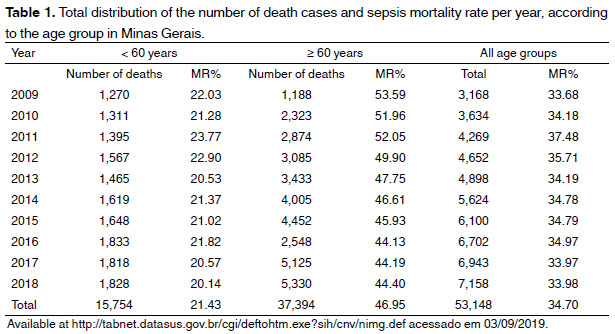
Based on the database analyzed14, between 2009 and 2018, 53,148 deaths from sepsis in Minas Gerais were totaled, with a mortality rate of 34.70%. Of these, 15,734 deaths (21.43%) were from individuals under the age of 60 and 37,394 (46.95%) were from individuals over 60 years of age, as shown in Table 1. It is observed that over time the number of deaths of the elderly (≥60) and the mortality rate had a relatively greater increase in relation to non-elderly individuals (<60), data that are worrying, since this elderly population is smaller.
Among the 37,394 reported cases of death from sepsis in the elderly, 18,391 (46.33%) were male and 19,003 (47.58%) were female. Over the years it was possible to notice that the number of deaths is inversely proportional to the mortality rate, since one increases as and the other decreases respectively, as seen in Table 2.
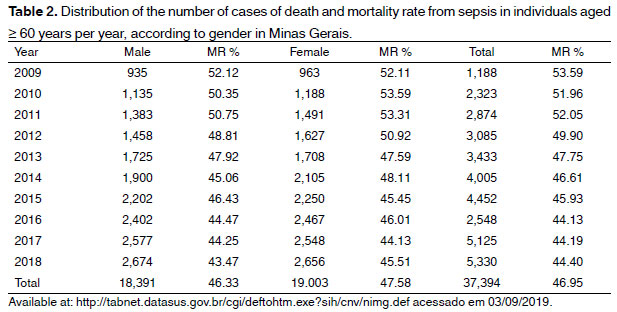
This fact is consistent with the current situation, considering that life expectancy has increased and the number of elderly people has been growing more and more every day. According to a survey performed by IBGE, the state of Minas Gerais in 2060 will have the largest number of elderly people in the country, so the profile of the number of deaths and mortality rates should continue to increase. Although the variation in the female mortality rate (6.60%) is smaller when compared to the male gender (8.65%), it has a higher number of deaths and mortality rate, since the proportion of elderly women (1,270,952) is higher than that of elderly men (1,039,613)13,15.
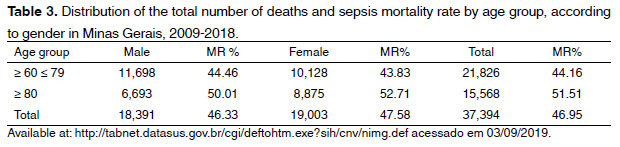
Based on Table 3, 21,826 cases of deaths from sepsis in individuals aged 60 to 79 years were reported from 2009 to 2018, where the mortality rate was higher in males (44.46%). In individuals aged ≥ 80 years, 15,568 cases were reported, with a predominance of females (47.58%). Although the number of deaths was lower when compared to the previous age group, older individuals have a higher mortality rate (51.51%).
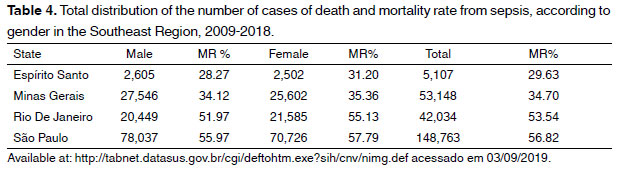
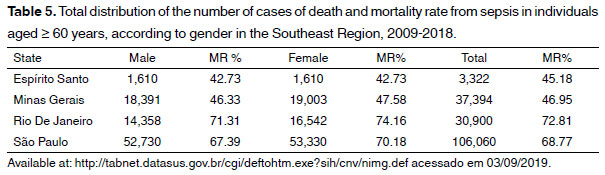
Analyzing the total number of deaths from sepsis reported in the last ten years in the Southeast, according to Table 4, the state of São Paulo is the one with the highest mortality rate (56.82%), followed by Rio de Janeiro (53.53%), Minas Gerais (34.70%) and Espírito Santo (29.63%). Based on Table 5, it was observed that Rio de Janeiro had a higher mortality rate of individuals aged ≥ 60 years (72.81%), followed by São Paulo (68.77%), Minas Gerais (46.95%) and Espírito Santo (45.18%). The highest numbers of lethalities in both cases remain in females.
According to Graph 1, the total average stay between 2009 and 2018, ranged from 11.7 to 13.8 days, with the state of Rio de Janeiro having the highest number of days. The longer the hospital stay, the greater the cost generated. Minas Gerais was the state that had the highest average total amount of expenses per day of hospitalization in the analyzed period, about 4,120 reais, as shown in Graph 2. However, when multiplying the total average value with the total number of deaths, São Paulo would total about 566 million spent in the last ten years, the state with the most spending on hospitalizations for sepsis.
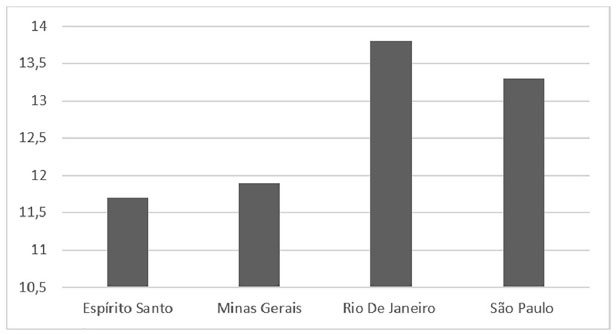
Graph 1. Total distribution of the average permanence of hospitalizations for only the federative units of the Southeast Region, 2009-2018
Source: Available at http://tabnet.datasus.gov.br/cgi/deftohtm.exe?sih/cnv/nimg.def accessed on 03/09/2019.
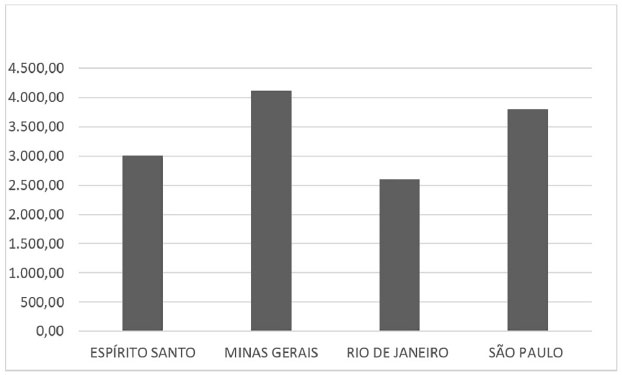
Graph 2. Total distribution of the number of hospitalizations by september federative units in the Southeast, 2009- 2018
Source: Available at http://tabnet.datasus.gov.br/cgi/deftohtm.exe?sih/cnv/nimg.def accessed on 03/09/2019.
DISCUSSION
Sepsis is a serious public health problem, with a higher incidence in low and middle-income countries and affects more than 20 million people annually, causing more than 5 million deaths17. In Brazil, about 13% of hospitalizations in ICUs are performed for suspected sepsis, where data show that the mortality rate related to this condition in private and public hospitals varies from 30 to 70%, respectively8,12,17.
In Minas Gerais, in the last ten years (2019-2018), there was a significant increase in deaths and mortality rate from sepsis in individuals of all age groups, however, these numbers were extremely higher in people aged ≥ 60 years. According to a study performed, it was observed that this age group had about 140 times more chances of death when compared to younger individuals18. As a justification for the described fact, elderly patients tend to have an immunological impairment due to age, which makes them more susceptible to developing some type of infection, also taking into account the presence of comorbidities.
As previously mentioned, the present study showed an increase in the number of deaths and mortality from sepsis in patients aged ≥ 60 years, in both genders in Minas Gerais. However, such an increase was predominant in females, representing a total of about 50.8% of deaths against 49.2% males, with a varied mortality rate of 1.25%. This same profile was also observed in the other federative units in the Southeast region. Brazilian data showed an increase in deaths related to sepsis of up to 40%, mostly in older patients, yet another study demonstrated that the occurrence is higher in elderly females12,17.
It was evidenced that individuals aged ≥ 60 and ≤ 79 years have a higher number of deaths and a lower mortality rate when compared to individuals aged ≥ 80 years. Other findings showed that there was an increase in the incidence of sepsis in the elderly population (60 to 84 years) of 135% in the oldest (over 85 years) of 205.8%19.
As already explained, the longer the length of hospital stay, the greater the costs. In the Southeast region, the total average expenditure in the last ten years was about 3,380 Brazilian Reais per hospitalization, with a total average stay of approximately 13 days. In Argentina, it is estimated to spend almost 4 thousand dollars per case of sepsis, and in the United States 3 thousand dollars20. Data indicate that patients who died with a shorter hospital stay, had late access to the ICU, presenting a rate of 40% mortality. Still, according to the same study, the mortality rate from sepsis is also high in older patients and with a longer hospitalization time in ICUs21. Both cases are extremely worrying, so it is very important to identify disparities that lead to delay in diagnosis and perfecting the therapeutic approach in cases of suspicion and/or confirmation of sepsis, in order to optimize care and consequently the cost.
In Brazil, few epidemiological studies have been performed, so the extent and impact of lethality caused by septicemia is still poorly understood. Public policies must be developed to encourage further research into this disease, as well as to identify the causative agents and campaigns must be conducted focusing on biosafety, both for employees and patients. It is up to health professionals to identify the characteristics of the disease, to know how to apply the diagnostic and therapy protocols, aiming at the comfort and well-being of the patient, in order to reduce mortality from this and other diseases.
CONCLUSION
The findings of the present study showed that in the last ten years, Minas Gerais had a significant increase in the number of deaths and mortality rate among the elderly proportional to the increase in the population, where the predominance was female. The other federative units, when compared to the total number of these two items, also presented the same profile as Minas Gerais.
The total average stay is a factor linked to the increase in costs generated with hospitalizations for sepsis. The Southeast region presented similar values of expenses with studies performed in other locations.
The actual number of septicemia in Brazil is still poorly known, it is necessary to perform further studies on this condition, as well as to determine the epidemiology of the most common pathogens, work on increasing the diagnostic and therapy protocols, in addition to training more specific with intensive care teams with a focus on biosafety for both involved in the process, reducing the lethality rate and increasing the quality of life of patients after hospitalization.
REFERENCES
1. Seymour CV, Liu VX, Iwashyna TJ, Brunkhorste FM, Rea TD, Scherag A et al. Assessment of Clinical Criteria for Sepsis for the Third International Consensus Definitions for Sepsis and Septic Shock (Sepsis-3). Jama 2016; 315(8):762-74
2. Singer M, Deutschman CS, Seymour CW, Shankar-Hari W, Annane D, Bauer M et al. The Third International Consensus Definitions for Sepsis and Septic Shock (Sepsis-3). Jama 2016;315(8):801-810.
3. Rhodes A, Evans LE, Alhazzani W, Levy MM, Antonelli M, Ferrer R et al. Campanha Sobrevivendo à Sepse: Diretrizes internacionais para a gestão de sepse e choque séptico: 2016. Critical Care Medicine 2016; 45(3):486-556.
4. Thomas BS, Jafarzadeh SR, Warren DK, McCormick S, Fraser VJ, Marschall J. Temporal trends in the systemic inflammatory response syndrome, sepsis, and medical coding of sepsis. BMC anesthesiology 2015; 15(1):169.
5. All-Rawajfah OM, Hewitt JB, Stetzer F, Cheema J. Length of stay and charges associated with health care-acquired bloodstream infections. Am J Infect Control, 2012; 40(3):227-32.
6. Kim JS, Holtom P, Vigen C. Reduction of catheter-related bloodstream infections through the use of a central venous line bundle: epidemiologic and economic consequences. American journal of infection control 2011; 39(8): 640-646.
7. Machado FR, Cavalcanti AB, Bozza, FA, Ferreira EM, Carrara FSA, Sousa JL, et al. The epidemiology of sepsis in Brazilian intensive care units (the Sepsis Prevalence Assessment Database, SPREAD): an observational study. The Lancet Infectious Diseases 2017, 17(11):1180-89.
8. Instituto Latino Americano para Estudos da Sepse. Sepse: Um problema de saúde pública. Conselho Federal de Medicina 2016.
9. Martin GS, Mannino DM, Eaton S, Moss M. A epidemiologia de sepse nos Estados Unidos de 1979 a 2000. N Engl J Med 2003; 348:1546-54.
10. Linde-Zwirble WT, Lidicker J, L Clermont, Carcillo J, Pinsky MR. Epidemiology of severe sepsis in the United States: analysis of incidence, outcome, and associated costs of care. Critical care medicine 2001; 29(7):1303-10.
11. Traebert, J. Global, regional, and national life expectancy, all-cause mortality, and cause-specific mortality for 249 causes of death, 1980-2015: a systematic analysis for the Global Burden of Disease Study 2015. Lancet 2016; 388: 1459-544.
12. Taniguchi LU, Bierrenbach AL, Toscano CM, Schettino GP, Azevedo LC. Sepsis-related deaths in Brazil: an analysis of the national mortality registry from 2002 to 2010. Critical Care 2014; 18(6):608.
13. Instituto Brasileiro de Geografia IBEGE. Avalaibe from: URL: https://www.ibge.gov.br/cidades-e-estados/mg.html. Accessed October 1, 2019.
14. Portal da Saúde do SUS. Departamento de Informática do SUS. Avalaibe from: URL: http://tabnet.datasus.gov.br/cgi/deftohtm.exe?sih/cnv/nimg.def. Accessed September 3, 2019.
15. Riani JLR, Marinho KRL, Camargos MCS. Perfil da população idosa de Minas Gerais. Boletim PAD-MG 2014; 3(6):1-85.
16. Rocha NPM, Maneschy RB, Xavier LSM, Xavir LC, Pontes CDN, Holanda LS, et al. Impacto sobre a evolução de pacientes sépticos após implementação de um protocolo institucional de sepse em um hospital público em Belém-PA. REAS/EJCH 2019; 1(3).
17. Angus DC, Linde-Zwirble WT, Lidicker J, Clermont G, Carcillo J, Pinsky MR. Epidemiology of severe sepsis in the United States: analysis of incidence, outcome, and associated costs of care. Crit Care Med. 2001; 29(7):1303-10.
18. Vasconcelos JHL. Fatores relacionados ao óbito de pacientes sépticos na Unidade de Terapia Intensiva. Biblioteca Virtual em Saúde 2018; 72.
19. Neira RAQ, Hamacher S, Japiassu AM. Epidemiology of sepsis in Brazil: Incidence, lethality, costs, and other indicators for Brazilian Unified Health System hospitalizations from 2006 to 2015. Plos one 2018.
20. Sogayar AM, Machado FR, Rea-Neto A, Dornas A, Grion CM, Lobo SM, et al. A multicentre, prospective study to evaluate costs of septic patients in Brazilian intensive care units. Pharmacoeconomics 2008; 26(5):425-34.
21. Morello LG, Dalla-Costa LM, Fontana RM, Oliveira Netto ACS, Petterle DC, Conte D, et al. Avaliação das características clínicas e epidemiológicas de pacientes com e sem sepse nas unidades de terapia intensiva de um hospital terciário. Einstein 2019; 17(2):1-8.
Table 1. Total distribution of the number of death cases and sepsis mortality rate per year, according to the age group in Minas Gerais.
Available at http://tabnet.datasus.gov.br/cgi/deftohtm.exe?sih/cnv/nimg.def acessado em 03/09/2019.
Table 2. Distribution of the number of cases of death and mortality rate from sepsis in individuals aged ≥ 60 years per year, according to gender in Minas Gerais.
Available at: http://tabnet.datasus.gov.br/cgi/deftohtm.exe?sih/cnv/nimg.def acessado em 03/09/2019.
Table 3. Distribution of the total number of deaths and sepsis mortality rate by age group, according to gender in Minas Gerais, 2009-2018.
Available at: http://tabnet.datasus.gov.br/cgi/deftohtm.exe?sih/cnv/nimg.def acessado em 03/09/2019.
Table 4. Total distribution of the number of cases of death and mortality rate from sepsis, according to gender in the Southeast Region, 2009-2018.
Available at: http://tabnet.datasus.gov.br/cgi/deftohtm.exe?sih/cnv/nimg.def acessado em 03/09/2019.
Table 5. Total distribution of the number of cases of death and mortality rate from sepsis in individuals aged ≥ 60 years, according to gender in the Southeast Region, 2009-2018.
Available at: http://tabnet.datasus.gov.br/cgi/deftohtm.exe?sih/cnv/nimg.def acessado em 03/09/2019.