
INTRODUCTION
Lower urinary tract infection (UTI) is a common disease among women. Drekonja et al. (2008) show that urinary tract infection is responsible for five million consultations/year in the United States of America in the North. Rahn (2008) reports that gender prevalence is higher in women in all age groups, except in the first year of life, which is more common in boys. The author also states that the prevalence of bacteriuria in adult women increases with age, ranging from 10% to 15% in the elderly. Recurrent urinary tract infection (rUTI) is relatively common in women, treating 80% of cases of reinfection by bacteria from the rectal and vaginal reservoirs (self-infection) and not recurring. According to Mazzulli (2002) the UTI is responsible for 15% of the antibiotics prescribed in outpatient clinics.
Of those university-aged women who had UTI, 27% had one more episode of UTI within the subsequent six months and 3% had a second episode of the infection (Foxman, 2001). Foxman et al. (2000) performed the research with healthy women between the ages of 18 and 39, noting that at six months the risk of recurrence after a first UTI is 24%. Data point approximately 20% to 30% of women will have rUTI (Albert et al., 2004).
UTI is an infection that affects the lower urinary tract and 85% of them are caused by E. coli infection (Rahn, 2008). rUTI is characterized by three or more UTI episodes per year or every two months documented by uroculture (Rahn, 2008).
More than five thousand years ago (3,000 years of written records and more than 2,000 with archaeological findings) the Chinese use Traditional Chinese Medicine TCM as a means to cure and treat various diseases. The technique consists in finding the harmony of body and mind through channels, known as "energy meridians", that run through the whole body. The TCM is based on a systematic and comprehensive theoretical structure of a philosophical nature. There are seven main methods of treatment of traditional Chinese medicine: Tui Na or Tuiná (推拿), Acupuncture (針疚), Moxibustion (艾炙), Ventosa therapy (拔罐), Chinese Phytotherapy (中药), Chinese Food Therapy Chinese (食療) or Chinese Diet Therapy and Physical Practices: exercises integrated to meditation practice related to breathing and energy circulation, such as qi gong (氣), Taijiquan (太極拳) and other internal Chinese martial arts that can contribute to the rebalancing of Organism (Maciocia, 1996).
The principles of acupuncture are based on the vital energy, Qi (and the sensation caused by the needle is called DeQi), which is distributed throughout the body, and its antagonistic aspects: the negative Yin and the positive Yang. The Chinese believe that any small imbalances that occur in these forces would provoke physical and psychological disturbances. It includes among its principles the study of the relation of yin/yang, the theory of the five elements and the system of circulation of energy by the meridians of the human body. In acupuncture the treatment is performed by inserting very thin needles into certain points of the channels, which are called “acupuncture points”. The stimulation of these points allows the activation or sedation of the energy that circulates along this meridian. With the introduction of the needles into specific points of the body, harmony is restored, ending diseases (Maciocia, 1996).
In CTM's view the symptoms related to urinary tract infections fit into the category known as painful urinary dysfunction. This syndrome is attributed to the accumulation of Damp-Heat in the Lower Heater. These are classified into three types: Damp - Heat accumulation, Liver Qi stagnation and Spleen Qi deficiency (Jirui et al., 2007).
The aim of this study is to determine by means of a systematized review the energetic pattern of lower urinary tract infection and the effect of acupuncture in the prophylactic treatment of recurrent urinary infections.
METHODS
We analyzed studies originally published in English using the PUBMED and PEDro databases. We included the controlled clinical trials and the systematic reviews that have involved acupuncture. The search strategy used the following keyword combinations: Acupuncture AND "Recurrent UTI Acupuncture" AND "urinary infection".
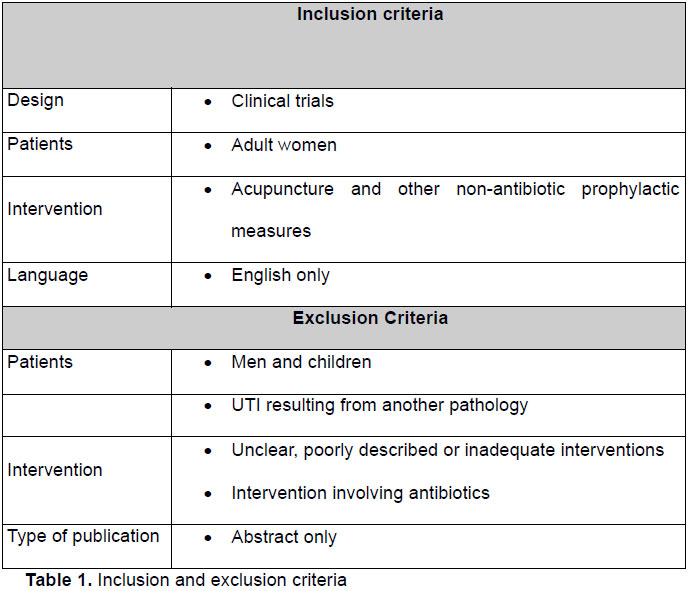
The criteria for inclusion and non-inclusion of the articles were applied based on the points raised in each item exposed (Table 1).
RESULTS
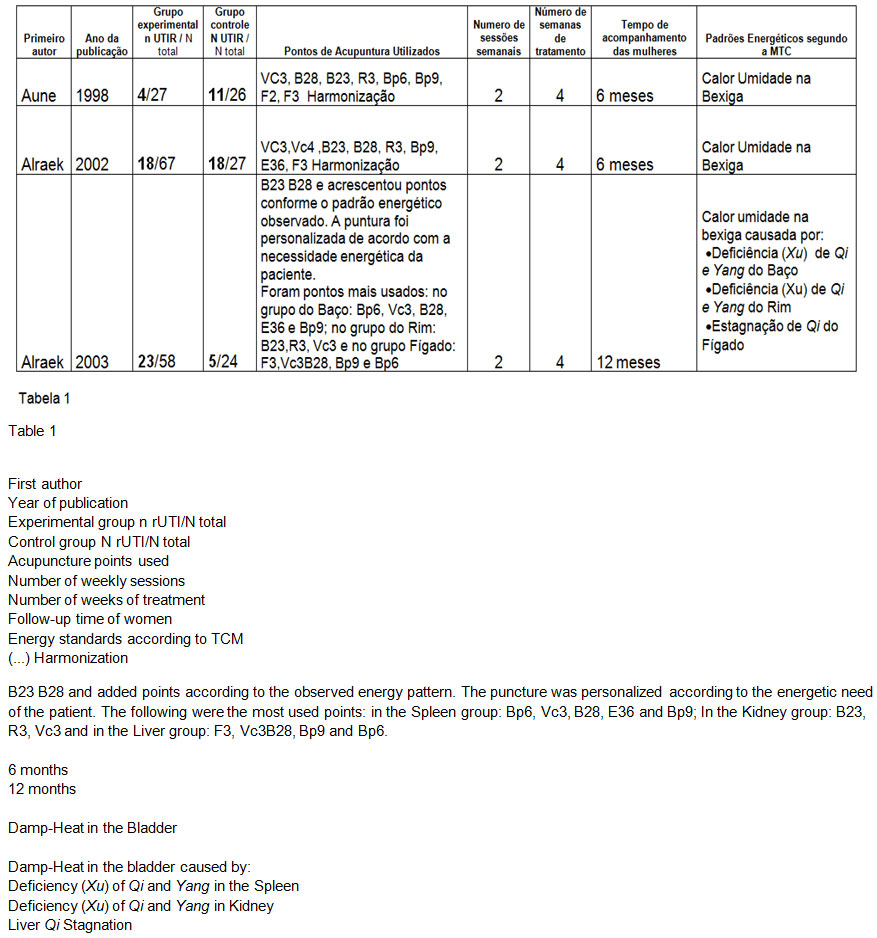
Initially, 796 studies involving rUTI treatment were identified. After submitting to the inclusion and exclusion criteria, 3 clinical trials remained. (Figure 1). The findings of the studies will be better described in Table 1.
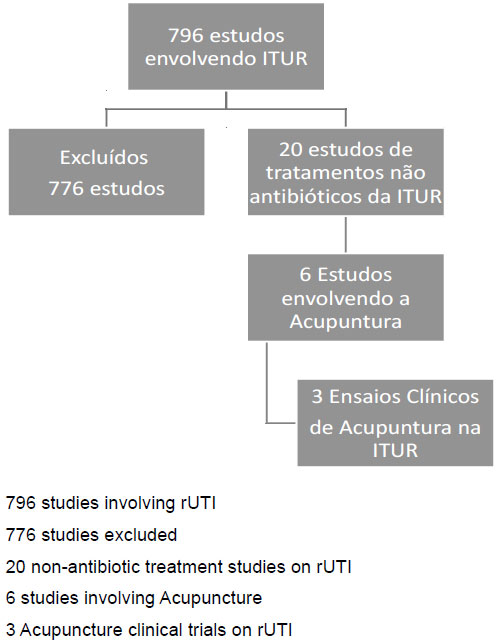 Figure 1 - Inclusion and non-inclusion of articles
DISCUSSION
Enteropathogens are usually found in the distal urethra. Nicholle et al. (2005) report that asymptomatic bacteriuria is found in 1:5 women after 65 years. UTI occurs when virulent strains of these colonies ascend through the urethra and attach to the urothelium, 95% of which are due to E. coli infestation and the other 15% to Staphilococcus saphophyticus, Enterobacter sp., Proteus sp. and Klebsiella sp. (Nicholle et al., 2005).
It is a disease with a relevant incidence: one in five women will have an episode of UTI before age 24, one in two women will present UTI during their lifetime and one in four will have reinfection of the urinary tract within one year (Dielubaza et al., 2011).
One of the main and most common forms of UTI treatment is the administration of antibiotics, but there is a possibility of developing resistance not only to the causative microorganism as well as to the alteration of the vaginal flora (Beerepoot et al., 2012). There is a major economic impact for the treatment of multiresistant microorganisms and in the US an estimated annual expenditure of $ 2.5 million is estimated (Frumenzio et al., 2013).
From the perspective of TCM, diseases of the urinary tract are classified into three categories: a) Liver Qi Stagnation; B) Spleen Qi Deficient; C) Spleen and Kidney Qi Deficiency.
Macciocia (1996) considers UTI a Painful Urination Syndrome and classifies it into two categories: Heat and Blood types. In the Heat type, this usually manifests itself in the form of Damp-Heat, which originates externally or internally, from a deficiency of the Spleen/ Pancreas. When Damp persists for a long period of time, it tends to become Damp-Heat and Damp obstructs the Waterway and causes dysuria. Heat causes burning in urination (Maciocia, 1996). In the Blood-type syndrome, the precursor will be a Heat or Empty Heat, pushing the Blood out of the vessels. Heat in the Blood is usually related to Fire of the Liver; Empty Heat affecting Blood is derived from Kidney Yin deficiency. In this case there is blood in the urine and burning in the urination (Maciocia, 1996).
According to TCM the kidneys regulate water metabolism. They function as a door that opens and closes to regulate the flow of body fluids. Usually, when the opening and closing functions are intact the Bladder will receive Kidney Qi for the transport and excretion of fluids. Lack of Yang or Qi in the kidneys may give rise to symptoms such as incontinence, enuresis, and lack of power for urine excretion (Clavey,1995). The deficiency can also be triggered by the advancing age associated with efforts or when prolonged accumulation of Damp-Heat dominates the true Qi. In this case there will be dribbling urination (Maciocia, 1996).
There is also accumulation of Damp-Heat that occurs due to excessive intake of pungent, fatty, spicy and savoury foods in addition to alcohol intake. This Damp-Heat is poured into the Lower Heater and interferes with normal functions. If Xue is involved, there will be hematuria (Jirui et al., 2007).
The Liver in TCM is responsible for the free flow of Qi in the lower Jiao. The Liver meridian has an intersection in CV3 with the urinary system and bladder. Thus, stagnation of Liver Qi can lead to Heat or Damp, giving rise to different urinary symptoms (e.g., urinary obstruction and polyuria). Often, these symptoms are associated and are aggravated by stress and emotional tension such as anger (Clavey, 1995). The stagnant rage that turns into Fire that, accumulated in the Lower Heater breaks with the normal function of the Bladder (Maciocia, 1996).
Acupuncture has traditionally been used in the treatment and prevention of many clinical conditions. We have identified three clinical trials of investigators using acupuncture as an rUTI prevention in women (Alraek et al., 2002, Aune et al., 1998, Alraek et al., 2003).
Aune et al., (1998), used in the treatment the points: VC 3; B 28, B 23, R 3, Bp 6, Bp 9, F 2 or F 3. Eventually, another point was added according to the individuality of the patient. The group consisted of 67 non-pregnant women, aged between 18 and 60 years. These were randomized into three groups: acupuncture, placebo acupuncture and control. In the group where acupuncture was placed in the correct points according to TCM, the sensation of the Qi (Deqi) and hand-manipulated needles were obtained. In the group that received placebo acupuncture, no Qi (Deqi) was obtained nor the needles were manipulated. They were only inserted superficially. Subjects were followed-up for six months. 85% of the acupuncture group were free of rUTI, compared to 58% of the placebo group (p <0.05 vs. acupuncture group) and 36% of the control group (p <0.001 vs. acupuncture group).
In the study by Alraek et al. (2002), 100 women aged 18-60 years were recruited. Of these, 6 women did not participate or did not meet all the criteria for the research. Sixty-seven women participated in the acupuncture group and 27 did not undergo treatment - being the control group. Women underwent assessments after two, four and six months. The points used were VC 3 or VC 4, B 23 or B 28, R 3, Bp 6, Bp 9, E 36, F 3. After treatment, 73% of the women in the acupuncture group and 52% in the control group were free of rUTI symptoms (p=.08). In the evaluation of residual urinary volume after six months, 50% of the women in the acupuncture group had a reduction whereas in the control group there were no significant changes (p<.05).
Alreek et al. (2003) recruited for their study 94 women aged 18-60 years with rUTI. Of these, 27 were in the control group and the others were separated according to the syndrome according to the TCM: 22 women were in the group diagnosed as Spleen Qi and Yang deficiency; 18 women with Qi and Yang Kidney deficiency and 18 with Liver Qi Stagnation. From the first group (Spleen), women had a higher body mass index (BMI) compared to the other groups. This can be explained by the failure to transform and transport the Yang/Qi of the Spleen. The Spleen is sensitive to Damp and the lack of Yang favors the accumulation of this Damp. The study noted an expressive increase in the residual volume of these women and suggests that herbal products should be used with a diuretic effect. In this group there were six episodes of UTI in 12 months.
In the Kidney group, patients reported having problems initiating urination and even using extra pressure to help with such function. With the treatment of the Yang/Qi of the kidney there was favor in emptying of the bladder helping in the reduction of the residual urine volume. Consequently, it acts on a risk factor and decreases rUTI. In this group, seven rUTI episodes were documented in 12 months.
In the liver group, women showed an immediate response to residual urine volume after acupuncture treatment. However, it was observed that the results would be better if the emotions were treated, since the emotions interfere in the free flow of Qi. In this group, five rUTI episodes were observed in 12 months.
The researchers decided to keep the control group without any type of placebo procedure, since in previous studies it was found that even with placebo acupuncture there is an induction of improvement. In this group five episodes of rUTI were observed.
The groups were treated for four weeks, two weekly sessions. The needles were inserted until obtaining Qi (Deqi). They were manipulated in rotation and then left for twenty to thirty minutes. The researchers used as a first puncture protocol B23 and B28. The points beyond these were chosen according to the pathophysiology according to TCM and the most used were: patients in the kidney group - B23, R3, VC3, Bp6; in the Spleen group patients - Bp6, VC3, B28, E36 and Bp 9 and in the Liver group - F3, VC3, B28, Bp9 and Bp6.
The adverse effects reported in both groups were minimal and reported gastrointestinal discomfort, loose stools, hot legs sensation, cold hands and feet, and anxiety.
The points chosen by the authors of the mentioned studies have the following energetic function: VC 3 and B28 are points Mu Frontal (alarm) and back Shu (assent) of the Bladder. Its function is to lighten the heat and drain the Damp of the Bladder; F2 drains the Fire from the Liver; Bp 9 drains the Heat and Damp from the Lower Triple Heater; Bp 6 clears the Heat and refreshes the Blood, drains the Damp from the Lower Triple Heater, and calms the Mind (MACCIOCIA, 1996). VC4 expands and restores Qi source, regulates menstruation and promotes urination, B23 Kidney Shu point - protects kidney, enriches Yin, promotes urination, R3 strengthens Yin and replenishes kidney, calms liver and decreases Yang, decongests and activates the meridian in the kidneys: E36 strengthens the body and spleen, restores the balance of Qi (CHEN et al., 2005).
In two articles the principles of treatments and the choice of points were not explained, except the study by Alraek et al. (2003) in which it is mentioned that the choice was based on the experience of clinical practice. Macciocia (1996) recommends as principles of treatment to clear the Heat, drain the Damp and open the Waterway. They suggest the points: VC 3, B 28, B22, Bp9, B66, B63, Ig11 used in sedation method. They do not recommend the use of moxa. For Fire in the Liver, they add F2 and Bp6 points.
Ross (2003) states that Exterior or Interior Damp should be dispersed and associated stagnation should be encouraged to move. When the Interior Damp is based on deficiency of the Spleen and Kidneys, they should be toned. If Cystitis comes from a Heat in the Bladder, Ross (2003) recommends the combination of points: B17, B28, R2 and C8 in sedation and Bp6 in harmonization; if cystitis comes with restlessness at night and hematuria, the recommended is Id2, C8, Vc3, Bp6 in harmonization. Id2 is an interesting point to remove heat and wind-heat, relieving the burning symptom during urination, especially if the Heart's fire movement is downward (Ross, 2003).
CONCLUSION
The studies presented herein show an effective effect of acupuncture in women with recurrent cystitis. This has practical implications and highlights the need for research in acupuncture considering the different diagnostic categories within TCM. The patterns found were Damp-Heat in the bladder caused by: Deficiency (Xu) of Qi and Yang of the Spleen; Deficiency (Xu) of Qi and Yang of the Kidney and Liver Qi Stagnation. Further studies may be performed with a possible prophylactic treatment for women prone to cystitis attacks such as: acupuncture for women diagnosed as having kidney problems, treatment with associated phytotherapy for those diagnosed with Spleen problems and also acupuncture associated with therapies focused on relaxation and stress management in patients with Liver stagnation. We can conclude that more research is needed to answer these questions.
REFERENCES
1. Albert X, Huertas I, Pereiró II, Sanfélix J, Gosalbes V, Perrota C. Antibiotics for preventing recurrent urinary tract infection in non-pregnant women. Cochrane Database Syst Ver 2004;(3):CD001209.
2. Alraek T, Baerheim A. The effect of prophylactic acupuncture treatment in women with recurrent cystitis: kidney patients fare better. J Altern Complement Med 2003; 9: 651.
3. Alraek T, Soedal LIF, Fagerheim SU, Digranes A, Baerheim A. Acupuncture treatment in the prevention of uncomplicated recurrent lower urinary tract infections in adult women. Am J Public Health 2002; 92: 1609.
4. Aune A, Alraek T, LiHua H, Baerheim A. Acupuncture inthe prophylaxis of recurrent lower urinary tract infection in adult women. Scand J Prim Health Care 1998; 16: 37.
5. Beerepoot MA, Ter Riet G, Nys S, Van der Wal WM, De Borgie CA, De Reijke TM et al. Lactobacilli vs antibiotics to prevent urinary tract infections: a randomized double-blind, noninferiority trial in postmenopausal women. Arch Intern Med 2012; 172: 704.
6. Chen, Chun-yanLian, Yu-lianMichael, Kosters. Atlas Gráfico de Acupuntura. São Paulo: Konemann, 2005.
7. Clavey S. Fluid Physiology and Pathology in Traditional Chinese Medicine. Melbourne: Churchill Livingstone,1995.
8. Dielubanza EJ,Schaeffer AJ. Urinary tract infections in women. Med Clin North Am. 2011 Jan;95(1):27-41.
9. Drekonja DM, Johnson JR. Urinary tract infections. Prim Care Clin Office Prat 2008;35:345-67.
10. Foxman B, Riley L. Molecular epidemiology: focus on infection. American Journal of Epidemiology 153: 1135-114, 2001
11. Foxman B. Epidemiology of urinary tract infections: Incidence, morbidity, and economic costs. Am J Med 2002; 113(Suppl 1A):5S-13S.
12. Frumenzio E, Maglia D, Salvini E, Giovannozzi S, Di Biase M, Bini V et al. Role of phytotherapy associated with antibiotic prophylaxis in female patients with recurrent urinary tract infections. Arch Ital Urol Androl. 2013 31;85:197-9.
13. Jirui C , Wang N. Casos clínicos de Acupuntura da China. Trad Rinaldo Koester. São Paulo: Roca, 2007.
14. Maciocia, Giovanni 1996 A prática da medicina chinesa: tratamento de doenças com acupuntura e ervas chinesas, Trad. Tânia Camargo Leite. São Paulo: Roca.
15. Mazzulli T. Resistance trends in urinary tract pathogens and impact on management. J Urol 2002;168(4):1720-2.
16. Nicholle LE, Bradley S, Colgan R, Rice JC, Schaeffer A, Hooton TM. Infectious Disease Society of America guidelines for the diagnosis and treatment of asymptomatic bacteriuria in adults. Clin Infect Dis. 2005;40:643-654
17. Rahn DD (2008) Urinary tract infections: contemporary management. Urol Nurs 28(5):333-341
18. ROSS, J. Combinação de Pontos: a chave para o êxito clínico. Rio de Janeiro: Roca, 2003.
Professor and coordinator of internship of Physiotherapy course at Faculty of Medical Sciences and Health - SUPREMA
Endereço para correspondência: Patrícia Cardoso Rua Eduardo Weiss, 286/201 Juiz de Fora , MG Telefone: (32) 991220399patríciacardosojf@gmail.com