
INTRODUCTION
Stroke is the third leading cause of death in the world and may result in permanent disability or lead to death1. The neurovascular involvement experienced by stroke survivors generates various neurological, motor, sensory and cognitive deficiencies2. Such deficiencies can lead to limitations of tasks related mainly to mobility and personal care, resulting in different degrees of dependence1,3,4.
The hemiparesis or muscle weakness in a hemibody affects more than 80% of these individuals, with consequent impairment of the functionality2,5. In these cases, there is a greater risk of inactivity or a drastic reduction of exercise, if an adequate exercise program is not adopted early6.
The physiotherapeutic approach of individuals affected by stroke should be made considering the biopsychosocial aspect advocated by the World Health Organization (WHO), which proposes a broader analysis of disabilities and inabilities, environmental and personal factors and their impacts, both positive and negative on functionality. In this context, the use of the International Classification of Functionality (ICF), which considers not only the deficiencies of body functions and structures that arise after injury or illness, such as following a stroke, is of fundamental importance, but also the possible limitations of tasks present in that individual and that may or may not contribute to restriction of participation7,8.
Although ICF is essential for the classification of functionality after injury or disease, it does not replace the classic instruments of physical therapy evaluation, basically composed by anamnesis and physical examination, but expanded for the various tests, scales and questionnaires proposed to investigate the different areas of the ICF9,10. These evaluation tools allow a more detailed investigation of the motor, posture, balance, functionality, among other aspects9,10. Finally, it is important to highlight the importance of these evaluation instruments in the treatment protocols prescribed by physical therapy, which also allows the careful monitoring of the evolution of individuals throughout the treatment proposal10.
Among the main limitations of tasks commonly observed in individuals affected by stroke are those that limit the basic activities of daily life, which are divided into Basic Activities of Daily Living (BADL) and Activities of Daily Living (ADL)5,11. The BADL represent activities such as dressing, bathing, feeding, moving about, among others6. The BADLs represent daily activities that reflect the individual's ability to manage the environment he lives in and include activities such as preparing his meals, doing household chores, washing clothes, using the telephone, handling money, taking medications, among others5.
Among the various instruments to evaluate the level of functional capacity of individuals, the Functional Independence Measure (FIM) stands out. FIM is widely used worldwide and evaluates motor and cognitive functionalities. It is composed of 18 items grouped into six functions: self-care, sphincter control, moving about, locomotion, communication and social cognition. The total score obtained by individual results from the sum of the scores obtained in each item evaluated with a variation ranging from one to seven, in which the value one corresponds to the total dependence and the value seven corresponds to the complete independence12. Another instrument aimed to investigate the functional independence is the Katz Scale or the Index of Independence in Activities of Daily Living (ADL), which was developed for the evaluation of functional capacity in the elderly. It is composed of six items that measure the individual's performance in self-care activities, considering feeding, sphincter control, moving about, personal hygiene, dressing and bathing abilities13. Considering the ease of use of the Katz scale and the fact that individuals affected by stroke are generally elderly after 60 years, its use in the evaluation of this population may be an alternative to identify levels of dependence or independence14.
In this way, the present study aimed to identify the functional capacity initially observed in individuals affected by stroke and who were attended by the outpatient Physiotherapy service of the HMTJ School Clinic, in the period of April 2015, using the Katz Scale.
METHODS Sample
The present study was approved by the Research Ethics Committee under registration number 39732614900005103 and all the volunteers who participated in this research read and signed the free and written informed consent form, following the ethical recommendations in research. The convenience sample consisted of men and women, aged 40 years or older, who sought physiotherapeutic treatment at the Physiotherapy School of the Hospital Maternidade Terezinha de Jesus, in April 2015. The study approached only individuals who presented the clinical diagnosis of stroke, regardless of etiology, hemorrhage or ischemia, with consequent neurological deficits and who were initiating the physiotherapy intervention protocol in the aforementioned service. Individuals with severe cognitive deficits or unaccompanied were excluded from the study, which made it impossible to obtain the necessary information for the evaluation of functional independence based on the Katz Scale.
Evaluation
Initially, an anamnesis was performed, in which the demographic data of the patient were collected for the study, such as age, type of stroke and time after the event. Soon after, the Katz Scale was used in a supervised manner, accompanied by the detailed explanation made by the researcher for the volunteer and/or his companion. The volunteer or his supervisor was advised of the importance of veracity in answering each item on the scale.
The Katz Scale has a score that is identified by the researcher, based on the answer of each item that composes it13, as follows, zero) Independent in all functions, one) Dependent on a function and independent on five functions, two) Dependent on two functions and independent in four functions, three) Dependent on three functions and independent on three functions, four) Dependent on four functions and independent on two functions, five) Dependent on five functions and independent on one function and six) Dependent on all Functions.
Statistical analysis
After data collection, they were submitted to the descriptive analysis considering the mean and the standard deviation of the data.
RESULTS
We evaluated 14 individuals with the clinical diagnosis of stroke, the majority of them were male (78.5%). The mean age of the participants was 59.8 ± 12.2 years, with the minimum age of 47 years and the maximum of 72 years. The majority of patients were affected by ischemic neurovascular damage (71.42%). Only two volunteers presented a time after the event of less than 12 months, which characterizes that the sample was predominantly of individuals in the chronic phase after the stroke. The mean score of the Katz Scale was 0.93 ± 1.49, with a 95% Confidence Interval (CI95%) of 0.06 to 1.80 (Figure 1), with a standard error of 0.40.
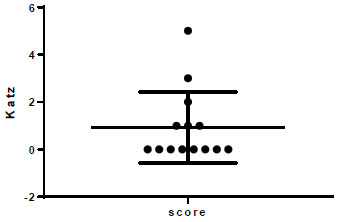 Figure 1 - Score obtained by the volunteer in the Katz Scale.
The most limited functional task according to the Katz Scale was dressing (28.57%) and continence (28.57%), followed by the ability to move (14.28%) and using the toilet (14.28%) (Figure 2).
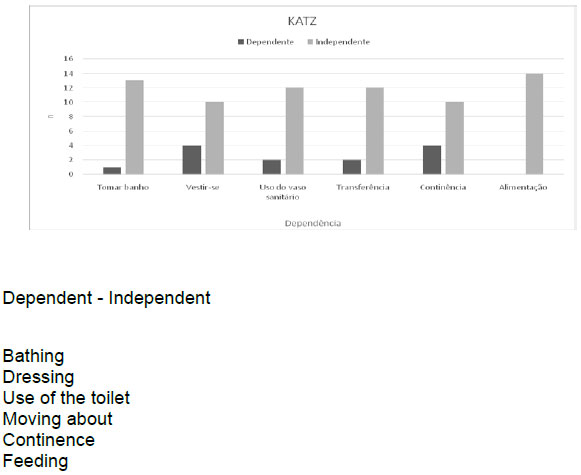 Figure 2: Functional capacity of the volunteers considering the items of Katz Scale.
DISCUSSION
Considering the aim of the present study to identify the functional capacity of individuals affected by stroke assisted at a school clinic through the Katz Scale, the main finding was that the sample was composed mainly of individuals considered independent according the scale. In addition, another relevant finding was that the sample consisted of individuals present in the chronic phase after the stroke, which is established in the literature as the one after six months of neurovascular damage.
The degree of functional dependence suffers greater variation mainly in the first year after stroke, with an influence of the magnitude of the deficiencies and the treatment performed in this period5,7,15. Approximately 30% to 40% of survivors are unable to perform their work activities and require some type of assistance in the performance of BADL7. Approximately 10% are unable to live in society in a dependent manner, requiring care of others, presenting mood changes and a modification in social interaction with friends and in the family, with a negative impact on the quality of life8.
According to WHO, quality of life is defined as “individuals’ perception of their position in life in the context of the culture and value systems in which they live and in relation to their goals, expectations, standards and concerns", this can be assessed through various instruments such as the Quality of Life Questionnaire of the World Health Organization (WHOQOL)16. Although quality of life has not been assessed in the present study, many of the deficiencies resulting from stroke compromise functional independence with a consequent reduction in quality of life.
Among the main objectives of the approach to Physiotherapy after a stroke, we highlight the promotion of functional independence with the maximum incentive to use the affected body segments. In this sense, although some individuals become functional after stroke, great concern and attention should be considered around disuse learned. The compensation with the use of the sound side and the inactivity in the affected segments must be combated, aiming at functionality with less compensations and possible complications.
The greater functional dependence observed in the volunteers was related to dressing and sphincter control. The limitation of the task of dressing correlates to the tasks of personal care. This task limitation has already been mentioned in other studies such as by Lucena et al. 2011, and appears to be directly related to upper limb motor deficiency as pointed out by Teles et al., 2012, who highlight that the movements of flexion, abduction of the shoulder and supination of the arm are usually the most limited1.
Although the limitation of dressing may be related to the deficiency of muscle activation after stroke, justifying the dependence of volunteers on this task, the loss of urinary continence involves other concepts. In this case, some authors such as Polese et al., 2008, justify the problem considering the reduction in bladder filling sensation, which can occur due to reduction in the global perfusion of the cortex after neurovascular damage5. For other authors such as Murayama et al. 1991, about 80% of individuals with cortical lesions had overactive bladder, resulting in loss of continence17. Limitation of mobility for toilet use in association with deficiency in the storage and bladder emptying capacity of these patients justifies the need of a voiding routine. This routine should be started in the hospital and continued after discharge, with the aim of avoiding the prolonged use of diapers and other resources that favor a permanent condition of loss of continence.
As pointed out by Cossi et al., 2010, the use of the Katz scale was considered simple and easy to investigate the functional capacity, which corroborates the indication of its use in the Physiotherapy practice18.
As a limitation of the present study, we highlight the small sample of volunteers. In addition, a reevaluation was not performed using the Katz scale after a certain period of the physiotherapy intervention protocol that might reflect or not possible changes in the scores obtained at the initial evaluation of the volunteers.
CONCLUSION
We conclude that it is possible to investigate the functional capacity of post-stroke individuals, considering the Katz scale as an instrument, but other instruments are necessary to better record the magnitude of the deficiencies that may cause the limitations of tasks indicated by the Katz scale.
REFERENCES
1. dos Santos Teles M, Gusmão C. Avaliação funcional de pacientes com Acidente Vascular Cerebral utilizando o protocolo de Fugl-Meyer.
2. Carvalho JC, Gusmão CA, Matos MA, Matias AC, Santos NA. Avaliação dos desfechos de funcionalidade e mobilidade pós-acidente vascular encefálico. Revista da Faculdade de Ciências Médicas de Sorocaba ISSN eletrônico 1984-4840 2013;15:100-4.
3. da Costa FA, da Silva DLA, da Rocha VM. Severidade clínica e funcionalidade de pacientes hemiplégicos pós-AVC agudo atendidos nos serviços públicos de fisioterapia de Natal (RN). Revista Ciência & Saúde Coletiva 2011;16.
4. Falcão IV, Carvalho EMFd, Barreto KML, Lessa FJD, Leite VMM. Acidente vascular cerebral precoce: implicações para adultos em idade produtiva atendidos pelo Sistema Único de Saúde. Rev bras saúde matern infant 2004:95-102.
5. Polese J, Tonial A, Jung F, Mazuco R, Oliveira S, Schuster R. Evaluation of the stroke patient’s functionality. Rev Neurocienc 2008;16:175-8.
6. Sibley KM, Tang A, Patterson KK, Brooks D, McIlroy WE. Changes in spatiotemporal gait variables over time during a test of functional capacity after stroke. Journal of neuroengineering and rehabilitation 2009;6:27.
7. de Oliveira AIC, da Silveira KRM. Utilização da CIF em pacientes com sequelas de AVC. 2011.
8. Farias N, Buchalla CM. A classificação internacional de funcionalidade, incapacidade e saúde da organização mundial da saúde: conceitos, usos e perspectivas. Rev bras epidemiol 2005:187-93.
9. de Brito RG, Lins LCRF, Almeida CDA, Neto EdSR, de Araújo DP, Franco CIF. Instrumentos de avaliação funcional específicos para o acidente vascular cerebral. 2013.
10. Organization WH. International classification of impairments, disabilities, and handicaps: a manual of classification relating to the consequences of disease; publ. for trial purposes in accordance with resolution WHA29. 35 for the Twenty-ninth World Health Assembly, May 1976: na; 1980.
11. Alves LC, Leite IdC, Machado CJ. Conceituando e mensurando a incapacidade funcional da população idosa: uma revisão de literatura. Ciênc Saúde Coletiva 2008;13:1199-207.
12. Fernandes MB, Cabral DL, Souza RJPd, Sekitani HY, Teixeira-Salmela LF, Laurentino GEC. Independência funcional de indivíduos hemiparéticos crônicos e sua relação com a fisioterapia. Fisioter Mov 2012;25:333-41.
13. VTS L, Pereira S, Bastos Camacho LA, et al. Adaptação transcultural da Escala de Independência em Atividades da Vida Diária (Escala de Katz). 2008.
14. Barbosa BR, Almeida JMd, Barbosa MR, Rossi-Barbosa LAR. Evaluation of the functional capacity of the elderly and factors associated with disability. Ciência & Saúde Coletiva 2014;19:3317-25.
15. Lucena EMdF, Morais JDd, Batista HRL, et al. A funcionalidade de usuários acometidos por AVE em conformidade com a acessibilidade à reabilitação. Acta fisiátrica 2011.
16. de Almeida Fleck MP. O instrumento de avaliação de qualidade de vida da Organização Mundial da Saúde (WHOQOL-100): características e perspectivas. Ciência & Saúde Coletiva 2000;5:33-8.
17. Murayama K, Katsumi T, Ikeda M, Ishikura A. Clinical study of voiding disorders in patients with cerebrovascular accidents. Hinyokika kiyo Acta urologica Japonica 1991;37:1243-8.
18. Minosso JSM, Amendola F, Alvarenga MRM, Oliveira MAdC. Validação, no Brasil, do Índice de Barthel em idosos atendidos em ambulatórios. Acta Paulista de Enfermagem 2010;23:218-23.
1. Master’s Degree and Student of the Doctorate Health Program of the Federal University of Juiz de Fora, Faculty of Medical Sciences and Health of Juiz de Fora (SUPREMA) and Salgado de Oliveira University 2. Physiotherapist graduated at Faculty of Medical Sciences and Health of Juiz de Fora (SUPREMA) 3. Physiotherapist graduated at Faculty of Medical Sciences and Health of Juiz de Fora (SUPREMA) 4. Physiotherapist graduated at Faculty of Medical Sciences and Health of Juiz de Fora (SUPREMA)
Correspondence: Zaqueline Fernandes Guerra Rua Francisca Pereira Lima, 105. Aeroporto Juiz de Fora- Minas Gerais Cep 36038-295 Telefone: 32184249 email:zaquelineg@gmail.com