
INTRODUCTION
Notably, conventional composite resins consist of universal and versatile application materials, and can be indicated for both anterior and posterior teeth1. The dental composites used made from methacrylate are composed of an organic matrix, inorganic filler and a bonding agent (silane), which binds the particle to the matrix2. Bis-GMA is the monomer most used in dental composite formulations; however, due to its high molecular weight, high viscosity and low mobility, other monomers with lower viscosity and/or higher mobility, such as TEGDMA and UDMA were inserted to improve the handling quality of the material, besides increasing the degree of conversion during the polymerization reaction3.
Regardless of the monomeric composition, the clinical success of composite resin restorations is closely related to their degree of conversion4, and this method of analysis is the most common way of evaluating the polymerization quality of the composites. However, the degree of polymerization does not provide a complete characterization of the formed polymer network, since polymers with the same conversion level may have different densities of cross-links, due to differences in the linearity of the chains and, consequently, different physical properties.
Thus, the polymerization effectiveness can also be analyzed through other mechanical properties of the composite6, which reflect in good clinical performance.
Until recently, it was agreed among scholars that many factors can affect the amount of light energy that is received at the top and bottom surface of the restoration performed using resinous material. Among these factors are the photoactivation distance and the size of the resin increment applied in the cavity.
As it moves away from the irradiated surface, the polymerization of the composites becomes less effective because the particles of charge and resin matrix have the capacity to absorb or disperse the light7. As a result of this energy attenuation process, there is necessarily a lower amount of excitation of camphorquinone molecules, resulting in an inadequate polymerization reaction and lower composite hardness. Thus, the top surface depends less on the intensity of light than the base surface8, since the energy reaching the irradiated surface seems to be sufficient to occur an adequate polymerization9.
Previously, it was believed that increments up to 2mm thick were ideal for insertion into cavities without causing changes in the physical-mechanical properties of the material. However, studies have shown that even in increments of 1mm thickness, changes in the properties of the material, especially with respect to top surface and base surface, already occur5.
In the controversy of these results, resins with different formulations and indications aimed at minimizing the effects caused by the thickness of the material, mainly by the lower polymerization on the base surface of the composites, appeared in the markets. The technology of BULK FILL resins is based on the chemical alteration of the monomer to create monomers with less viscosity10. There has also been a change in the photoinitiators, which are now more sensitive to light; in addition, BULK FILL resins tend to be more translucent to allow additional light irradiation as deep as possible11. In parallel with the chemical composition, the manufacturers indicate that the inserted increments can be 4 to 6 mm of filling,11 or single increments of up to 5 mm, which, without doubts, would simplify the restorative process, thus reducing the clinical time in cases of deep and wide cavities.
Currently, available data for these materials are still limited, and therefore require more laboratory studies so that better information on the behavior of these materials is better investigated. Therefore, the aim of this study is to evaluate the mechanical behavior of the bulk fill Sonicfill (Kerr, USA) and Filtek Bulk Fill (3M, USA) resins by means of the Knoop microhardness test of top and bottom surfaces.
MATERIALS AND METHODS Manufacture of specimens
The specimens were made by a single operator, according to ISO 404929 specifications. All specimens were made under the same conditions of temperature, illumination and relative humidity and then divided into two groups (n=10), taking into account the factors studied herein, which are the two commercial brands of bulk fill composite resins Filtek (3M Espe, USA) and Sonicfill (Kerr, USA).
On a glass plate, a polyester strip was placed and then two cylindrical Teflon matrices with 6mm diameter and 2mm thickness each were added, adding 4mm. The resin was inserted in a single increment in the matrix, using Suprafill spatula (Millennium), in the case of Filtek bulk fill, and in Sonicfill the ultrasonic resin insertion apparatus was used as recommended by the manufacturer.
After this step, a polyester strip was placed on the specimen and photoactivated for 20s, using the photopolymerizer set directly against the polyester strip.
The polyester strip was used to allow no adhesion of the resin to the tip, preventing the accumulation of resin at the tip of the light curing device, thus preventing this accumulation could interfere with the light radiation of the apparatus.
After polymerization, the specimens were removed from the matrix and then stored in dark containers so that no external light interference could alter the quality of the photoactivation until the tests were performed. The light intensity of photoactivation was measured by a digital radiometer (Hilux Led Max Curing Light Meter).
Knoop Microhardness Test (KNH)
The protocol used was based on the study by Borges et al., 201012. The evaluation of the KHN measurement was performed on the top surface of each specimen through the apparatus (HMV-2T E, Shimadzu Corporation, Tokyo, Japan). Five Knoop indentations were performed on the surface of all specimens: one central and the other four in the distance of approximately 200µm from the central location, under load of 0.5Kg per 10s. The values of the five indentations for each surface were recorded and the final mean of the surfaces of all experimental units calculated.
STATISTICAL ANALYSIS
After the data obtained, we performed the exploratory data analysis - analysis of variance (split-plot ANOVA) and the data showed interactions between the tested surfaces (top and bottom) and the resins used. Multiple comparisons were performed using the Tukey test. In all analyzes the significance level of 5% was considered.
RESULTS Knoop Microhardness
Table 1 presents the mean and standard deviations of the Knoop microhardness values of the bulk fill composites and of the top and bottom surfaces of the test specimens. In this case it was observed that interaction and statistical difference between the variables (surface tested - top and bottom and composite resins) (p=0.02). The results showed that, regardless of the surface tested (top or bottom surface), Filtek TM Bulk Fill composite showed significantly higher microhardness values than Sonic Fill resin. Another result presented in this table is that, independently of the composite resin tested, the top surface obtained values of microhardness statistically higher than the values found in the bottom surface.
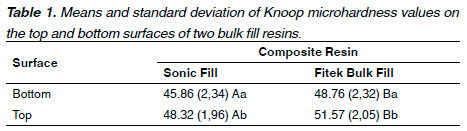
Means followed by distinct letters (upper-case horizontal and lower-case vertically comparing distance within each surface) differ from each other (p≤0.05).
DISCUSSION
The degree of polymerization is closely related to the intensity of light received by the photoinitiators so that they can be excited and the monomers can be converted into polymers4,26. During the laboratory test, in this study, in which the photopolymerizer was placed on the matrices (4mm of distance) and measured with the radiometer, we can observe that the power received by the radiometer at 4mm dropped drastically from 1792 mw/cm2 to a mean of 782 mw/cm3. This decrease in irradiance caused by the distancing of the polymer source probably caused a light scattering5. Thus, although the photoactivation distance was not a factor in this study, we can affirm that the greater the distance of the irradiated surface, the greater the light scattering5,25 and this possibly causes worse properties in the resinous materials.
These evidences are proven when analyzing the Knoop hardness values dfoun on the top and bottom surface of each resin. Regardless of the type of bulk fill resin tested, the hardness values found on the top surface were statistically higher than the values on the bottom surface, as in previous studies5,25. All of this was again confirmed with the results of the micro-meter, which demonstrated that the top surfaces presented higher knoop microhardness than the bottom surfaces.
In relation to the comparison of the tested materials, the results showed that the Filtek Bulk Fill resin obtained better results for both bottom and top surfaces compared to the results of the Sonicfill resin. The most plausible justification for the difference found is the type of monomers present in its organic matrix, which in the sonic fill is BisGMA (bisphenol A polyethylene glycol dimethacrylate) and in Filtek Bulk Fill the organic load is UDMA (Diurethane dimethacrylate) as the different diluents, TEGDMA (triethylene glycol dimethacrylate) on Sonicfill resin and EDMA (ethylene glycol dimethacrylate) found in Filtek bulk fill. Bis-GMA is capable of promoting strong hydrogen bonding through the hydroxyl group, increasing molecular weight, giving little mobility and high stiffness. There is also a synergistic effect between Bis-GMA and TEGDMA which increases the cross-linking density, that is, the cross-links between linear molecules producing three-dimensional polymers with high molecular mass19,27. Thus, the substitution of this monomer by another, in this case EDMA, caused changes in the mechanical properties of the material.
Another fact that deserves to be highlighted is that although the specimens of the resin were manually made, at the end of the insertion of the increment in the matrix, this set was compressed, in this case there could be less spaces between the material. In the Sonicfill resin, the insertion mode was mechanical, it could also be one of the reasons for this material to have lower hardness values, both at the top and at the bottom, because depending on the torque applied, the speed of release of the material can be modified28.
CONCLUSION
In view of the results of this study it can be concluded that:the top surface showed better mechanical performance than the bottom surface, independent of the resin tested. The composite resin Filtek Bulk Fill showed higher hardness values, both at the top and bottom surfaces, in relation to Sonic Fill resin.
REFERENCES
1. Mitra SB, Wu D, Holmes BN. An application of nanotechnology in advanced dental materials. J Am Dent Assoc. 2003 Oct; 134(10): 1382-90.
2. Polydorou O, Trittler R, Hellwig E, Kümmerer K. Elution of monomers from two conventional dental composite materials. Dent. mater. Washington. 2007 Dec; 23 (12):1535-41.
3. Filho JD, Poskus LT, Guimarães JG, Barcellos AA, Silva EM. Degree of conversion and plasticization of dimethacrylate-based polymeric matrices influence of light-curing mode. J Oral Sci. 2008; 50(3): 315-21.
4. Lopes LG, Jardim Filho Ada V, de Souza JB, Rabelo D, Franco EB, de Freitas GC. Influence of pulse-delay curing on sorption and sulubility of composite resin. J Appl Oral Sci. 2009 Jan-Feb; 17(1):27-31.
5. Miranda DA, Bertoldo CES, Ambrosano GMB, Aguiar FHB, Lima DANL, Lovadino JR. Effect of curing light distance and different mouthwashes on the sorption and solubility of a nanofilled composite. European Journal of Esthetic Dentistry. 2013; 8: 1-16.
6. de Araujo CS, Schein MT, Zanchi CH, Rodrigues AS Jr., Demarco FF. Composite resin microhardness the influence of light curing method, composite shade, and depth or cure. J Contemp Dent Pract 2008; 9: 43-50.
7. Ihsan H, Bülent B, Giray B, Orhan M D, Arife D, Ali Ö and Bülent B. Microhardness Evaluation of Resin Composites Polymerized by Three Different Light Sources. Dental Materials Journal 2007; 26(6):845-53.
8. Aguiar FHB, Lazzari CR, Lima DANL, Ambrosano GMB, Lovadino JR. Effect of light curing tip distance and resin shade on microhardness of a hibrid resin composite. Braz Oral Res 2005; 19: 302-6.
9. Aguiar FHB, Oliveira TRV, Lima DANL, Ambrosano GMB, Lovadino JR. Microhardness of diferente thicknesses of resin composite polymerizes by convectional photocuring at diferente distances. Gen Dent 2008;56:144-148.
10. Garcia D,Yaman P,Dennison J,Neiva GF. Polymerization Shirinkage and Depth of Cure of Bulk-Fill Flowable Composite Resins. Operative Dentistry 2014;39:441-8.
11. Benetti A, Havndrup-Pedersen C, Honoré D, Pedersen M, Pallesen U Bulk-Fill Resin Composites: Polymerization Contraction, Depth of Cure, and Gap Formation. Operative Dentistry. 2015.
12. Zorzin J,Maier E,Harre S,Fey t,Belli R,Lohbauer U,Petschelt A,Taschener M. Bulk-Fill Resin Composite: Polymerization Properties and Extended Light Curing. Dental Materials 015;31:293-301.
13. Li X,Pongprueksa P,Meerbeek BV,Munck J.Curing profile of bulk-fill resin-based composites. Journal of Dentistry 2015;43:664-72.
14. Flury S,Hayoz S,Peutzfeldt A,Husler J,Lussi A.Depth of cure of resin composites: Is the ISO 4049 method suitable for bulk fill materials.Dental Materials 2012;28:521-8.
15. Al-Ahdal K, Ilie N, Silikas N, Watts D. Polymerization kinetics and impact of post polymerization on the degree of conversion of bulk-fill resin-composite at clinically relevant depth. Dent Mater. 2015, July.
16. ALQahtani M, Michaud P, Sullivan B, Labrie D, ALShaafi M, Price R. Effect of High Irradiance on Depth of Cure of a Conventional and a Bulk Fill Resin-Based Composite. Operative Dentistry. 2015, 40-5.
17. Alrahlah A, Silikas N, Watts D. Post-cure depth of cure of bulk fill dental resin-composites. Dent Mater. 2013, Oct.
18. Benetti A, Havndrup-Pedersen C, Honoré D, Pedersen M, Pallesen U Bulk-Fill Resin Composites: Polymerization Contraction, Depth of Cure, and Gap Formation. Operative Dentistry. 2015.
19. Czasch P, Ilie N. In vitro comparison of mechanical of cure of bulk fill composites. Clin Oral Invest. 2013.
20. Pedalino I, Hartup GR, Vandewalle KS. Depth of cure of bulk-fill flowable composite resins. Gen Dent. 2015, Sep-Oct;63(5):28-34.
21. ALShaafi MM, Haenel T, Sullivan B, Labrie D, Alqahtani MQ, Price RB. Effect of a Broad-Spectrum LED Curing Light on the Knoop Microhardness of Four Posterior Resin Based Composites at 2, 4 and 6 mm Depths. Journal of Dentistry. 2016, 45:14-8.
22. Borges AB, Yui KCK, D'avila TC, Takahashi CL, Torres CRG, Borges LS. Influence of Remineralizing Gels on Bleached Enamel Microhardness In Different Time Intervals. Operative Dentistry.2010;35(2):180-6.
23. Gonçalves F, Kawano Y, Pfeifer C, Stansbury JW, Braga RR. Influence of BisGMA, TEGDMA, and BisEMA contents on viscosity, conversion, and flexural strength of experimental resins and composites. Eur J Oral Sci. 2009; 117(4):442-6.
24. Miranda Dde A, Pini NP, Bovi Ambrosano GM, Baggio Aguiar FH, Leite Lima DAN, et al. (2013a) Effect of Light Curing Tip Distance and Immersion Media on the Degree of Conversion, Sorption and Solubility of Methacylate and Silorane-Based Composites. JSM Dent 1: 2013.
25. Miranda DA, Bertoldo CE, Aguiar FH, Lima DA, Lovadino JR. Effects of mouthwashes on Knoop hardness and surface roughness of dental composites after different immersion times. Braz Oral Res 2011;25:168-173.
26. Ferracane JL. Correlation between hardness and degree of conversion during the setting reaction of unfilled dental restorative resins. Dent. Mater. Copenhagen: 1985 Fev; 1 (1):11-4.
27. Conceição EN, Mezzomo E, Cueva MA, Soares SG. Dentistica Saude e Estetica. 2ºEdição. Porto Alegre: Artmed; 2007.
28. Sonic Fill: Instruções de utilização. Orange, CA: Kerr Corporation; 2011.
29. ISSO 4049: Odontologia - Materiais restauradores baseados em polímeros, Genebra, Suíça: Organização Internacional de Normalização; 2009.