
INTRODUCTION
In Brazil, according to the Ministry of Health (2010), three million live births are registered per year in the country. Of these, 2.1 million are born in units of the Unified Health System (SUS), 1.4 million of which are normal deliveries and 670 thousand cesareans. Still, according to the report "World situation of childhood 2011"1, the rate of cesarean deliveries in Brazil is the largest in the world and accounts for 44% of total deliveries. In order to comply with the recommendations of the World Health Organization, Brazil will have to reduce this index up to three times2. In our country, the socioeconomic condition is directly related to the probability of cesarean delivery, with the highest prevalence in the Southeast region (45%) and the Northeast region, the lowest (25%)3.
A normal, natural or vaginal birth is understood as the one with spontaneous onset and the fetus in vertex position at 37 and 42 weeks completed2. According to the "Every Child's Birth Right" published by the United Nations Children's Fund1, in most cases, natural and humanized childbirth should be encouraged because it is safe and healthy for both the child and the childbearing4,5.
It is known that labor can result in severe pain, triggering potentially harmful physiological and emotional responses for the mother and baby, reinforcing the aversion to vaginal delivery5-7and increasing the need for analgesia1. The use of pharmacological methods of analgesia is an option, but it may have undesirable effects on the mother-child binomial8. In view of this fact, non-pharmacological methods have been studied, such as massage therapy, respiratory exercises, cryotherapy, electroanalgesia, adoption of vertical postures and stimulation of walking, hot baths and Swiss ball exercises9.
Physiotherapy follow-up in labor is not a common practice in Brazil and is not included in the list of procedures offered to women by the Unified Health System. However, this professional can add to the perinatal assistance team insofar as it is able to guide and make the woman more secure, confident and participative. The participation of the physiotherapist in obstetric care values the responsibility of the pregnant woman in the birth process, through the active use of her body, stimulating her to use it in favor of birth10-12.
Although the physiotherapist is a professional with competence to assist the parturient, in Brazil few are the services that rely on his presence. In this sense, it is important to increase the body of evidence related to this subject, in order to disseminate scientific knowledge and stimulate the presence of the physiotherapist in the assistance to the woman patient. In this context, it was the aim of the present study to identify the level of satisfaction of parturients assisted by physiotherapy team.
METHODS Type of Study and Ethical Aspects
This is a single-arm, prospective and cross-sectional study, structured according to Resolution 466/2012 of the National Health Council and approved by the Ethics Committee of the Faculty of Medical and Health Sciences of Juiz de Fora, under opinion number 0051/12.
Exclusion and Inclusion Criteria
Women in labor were included when admitted to the Normal Delivery Center of a public hospital in Juiz de Fora, Minas Gerais, on the days and times when the physiotherapy team was in the Childbirth Center over a non-consecutive period of 6 months.
Literate patients, older than 18 years of age, in the active phase of risk labor considered possible by the care team of the Childbirth Center and who accepted assistance from trainees of the Physical Therapy Course were the inclusion criteria.
Characteristics and Sample Size
A non-random sample with a determined size throughout the collection time. Parturients admitted to the Normal Delivery Center were approached, informed about the research procedures and questioned about their interest in participating in it. Of the 53 eligible parturients, 20 met the inclusion criteria, composed the research sample and signed a Free and Informed Consent Form.
Research Procedures
Three investigators took turns in the research procedures that included a) initial approach and evaluation of pain sensation, b) physiotherapeutic assistance, and c) evaluation of the assistance received.
Initially, parturients answered a questionnaire with information regarding the sociodemographic profile and identified the level of pain through the visual analogue scale.
Physiotherapy assistance was aimed at reducing perceived pain, improving the sense of well-being and contributing to the good evolution of labor. Physiotherapy care was based on therapeutic exercise, ambulation, breathing orientation, massage therapy and shower (Table 1) and only after the baby was born.
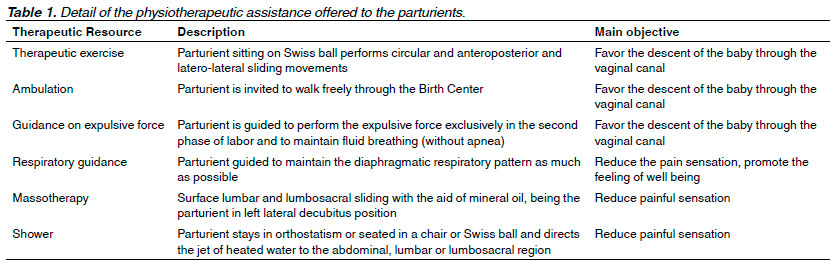
Considering the individuality of the parturition process, we opted not to maintain a pre-established protocol. For this reason, the number of repetitions and sets of exercises or movements, as well as resting time and order in which the resources were used was determined by the needs of each woman.
Doubts about labor raised spontaneously by the parturients were answered with the aim of making them more calm and confident in the process of parturition.
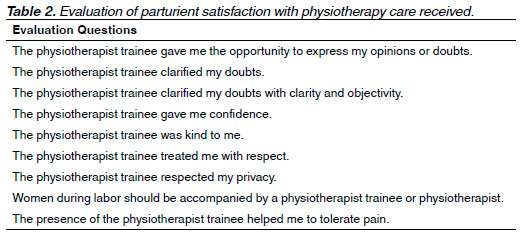
After delivery, when the woman was taken to the room for rest, another researcher contacted her to evaluate the care received. For this investigation, a structured and self-administered questionnaire was elaborated based on studies that evaluated satisfaction with physiotherapy care in general. The answers were set out in the form of five descriptors ranging from "I totally agree", if the interviewee considered the statement to be totally true, "I totally disagree" if the interviewee considered the statement totally false (Table 2).
Statistical analysis
The Microsoft Excel 2007 Office suite was used for data entry and analysis. The analysis of the sociodemographic profile of the sample was performed through descriptive statistics (mean and percentage), as well as the other results.
RESULTS
Twenty-four women with a mean age of 24 ± 6 years (ranging from 18 to 42 years), 45% of whom had incomplete elementary education and only 5% completed higher education. 10% declared themselves to be alcoholics and 15% smokers.
As for marital status, 50% were married, 45% were single and 5% divorced. The professional profile of the sample was quite variable and the average family income was 2.0 ± 1.0 minimum wages (ranging from 1 to 4 minimum wages).
Of the 20 parturients, 60% were primiparous. It was found that among the multiparous women, 35% performed vaginal delivery and of these, 30% experienced episiotomy, forceps and or perineal injury.
In terms of labor in progress, it was found that the mean expansion at the beginning of physiotherapeutic care was 4.4 ± 2.6 cm (ranging from 1 to 9 cm), the initial mean pain was 7.1 ± 3.7 (ranging from 0 to 10). It was recorded that 95% evolved for vaginal delivery and 5% for cesarean delivery.
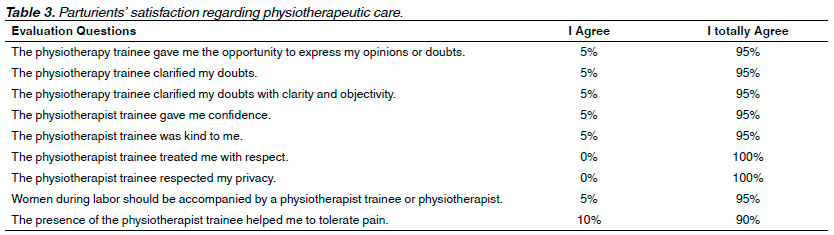
According to the satisfaction questionnaire the mean of "I agree" answers were 4 ± 3% (ranging from 0 to 10%) and 96 ± 3% (ranging from 90 to 100%) to "I totally agree" (Table 3). The other answers options were not registered.
DISCUSSION
The visual analogue scale was used to measure the pain of the parturient. The proposal of Knobel et al.(2005)13 is in line with the present study, since to evaluate care, parturient satisfaction and analgesic methods used during labor, they also used the visual analogue scale to measure pain.
The questionnaire to assess the satisfaction of parturients was structured based on articles that evaluated the satisfaction regarding the physiotherapeutic activity in general14,15. In the present study, high satisfaction with the assistance received was identified. The presence of a trained professional on the parturient side, full time, reduces her anxiety and increases the sense of comfort and hospitality, making the experience more pleasant and less traumatic16.
Furthermore, there is still a significant scientific gap in the current evaluation of parturient satisfaction, due to the difficulty in criticizing the service and the professionals who assist her. There is also a sense of relief that follows the delivery, abandoning any negative experiences experienced in the procedure17.
The physiotherapist is a professional who, in Brazil, is not yet widely included in obstetric care services. However, it has the potential to guide and educate the parturient about what will be required of her at the moment, which makes her more safety and confident. In addition, important strategies for childbirth progression can be used, such as stimulation of walking, breathing and relaxation exercises, massage and hot baths, and the well-being of the parturient9-12.
Massotherapy is one of the most natural means of relieving pain and discomfort, attenuating anxiety and stress, promoting muscle relaxation and reducing fatigue. Stimulating correct breathing also promotes relaxation, increases concentration and decreases risks of perineal trauma at the time of expulsion, as well as improving oxygenation for mother and baby. Hot bath in the first stage of labor reduces pain sensitivity and appears to be a good option for analgesia9. The adoption of vertical postures and maternal mobility during labor are efficient to uterine dynamics9,18,19. Swiss ball exercises, in addition to allowing body verticality, allow pelvic balance and favor fetal descent in the birth canal19. All these strategies were used with the parturients of the present study, in an individualized way, and were well accepted by them, what may justify the high satisfaction with the assistance received in the perinatal period.
Cryotherapy, although it is one of the oldest forms of analgesia, was not accepted by any parturient. Electroanalgesia was not listed as a therapeutic strategy in this study.
CONCLUSION
The results of the present study allow us to conclude that the individualized physiotherapy assistance focused on the reduction of pain sensation was considered satisfactory by the parturients attended.
REFERÊNCIAS
1. Guia dos direitos da gestante e do bebê. 1st ed. São Paulo: UNICEF; 2011.
2. Organização Mundial da Saúde 1996.
3. D' Orsi E, Chor D, Griffin K, Tuesta AA, Barbosa GP, Gama AS, Reis AC, Hartz Z. Factors associated with cesarean sections in a public in Rio de Janeiro, Brasil. Rev Saúde Pública 2006; 22: 2067-78.
4. Patah LEM, Malik AM. Modelos de assistência ao parto e taxa de cesárea em diferentes países. Rev Saude Publica 2011;45(1):185-94.
5. Ferreira Junior AR, Rocha FAA, Carneiro JM, Freitas NA. Discurso de mulheres na experiência do parto cesáreo e normal. Saúde. Com 2017; 13: 855-862.
6. Apolinário D, Rabelo M, LDG Wolf, Souza SRRK, Leal GCG. Práticas na atenção ao parto e nascimento sob a perspectiva das puérperas. Rev Rene. 2016; 17:20-8
7. Costa B, Figueiredo A, Pacheco A, Pais A. Parto: expectativas, experiências, dor e satisfação. Psic Saúde Doenças 2003; 4:47-67.
8. Medeiros, M. Q. (2016). Intervenções obstétricas durante o trabalho de parto e parto em mulheres de risco habitual de uma Maternidade de referência do Ceará (Doctoral dissertation).
9. Angelo PHM, Ribeiro KCL, Lins LG, Rosendo AMPHA, Sousa VPS, Micussi MTABC. Recursos não farmacológicos: atuação da fisioterapia no trabalho de parto, uma revisão sistemática. Fisioterapia Brasil 2016; 17: 285-92.
10. Padilha JF, Gasparetto A, Braz MM. Atuação da fisioterapia em uma maternidade: percepção da equipe multiprofissional de saúde. Fisioterapia Brasil 2016;16.
11. Souza APK, Ramos DJS. Fisioterapia e humanização do parto: uma análise partir de documentos oficiais da saúde. Revista Fisioterapia & Reabilitação 2017;1: 11-23.
12. Bavaresco GZ, Souza RSO, Almeica B, Sabatino JH, Dias M. O fisioterapeuta como profissional de suporte à parturiente. Ciência & Saúde Coletiva 2011; 16:3259-66.
13. Knobel R, Radünz V, Carraro TE. Utilização de estimulação elétrica transcutânea para alívio da dor no trabalho de parto: um modo possível para o cuidado à parturiente.Texto Contexto Enferm 2005; 14:229-36.
14. Mendonça KMPP, Guerro RO. Desenvolvimento e validação de um instrumento de medida da satisfação do paciente com a fisioterapia. Rev Bras Fisioter 2006;11: 370-74.
15. Suda Ey, Uemura MD, Velasco E. Avaliação da satisfação dos pacientes atendidos em uma Clínica Escola de Fisioterapia de Santo André, SP. Fisioter Pesq 2009;16: 126-31.
16. Domingues RMSM, Santos EM, Leal MC. Aspectos da satisfação das mulheres com a assistência ao parto: contribuição para o debate. Cad. Saúde Pública 2004; 20:S52-S62.