
INTRODUCTION
According to the Brazilian Society of Diabetes (2017)(1), type 1 diabetes mellitus (DM1) can be characterized as a metabolic disorder resulting from a problem in the secretion and/or action of insulin, mainly affecting children and adolescents, and also diagnosed in adults. In Brazil, it is estimated that today more than 13 million people live with diabetes, and this number in turn tends to increase more and more expressively, favoring the appearance of long-term chronic complications in this population 2.
In this context, some evidence 3, 5-8 highlights the impact of knowledge about changes in the general aspects of DM1, since the basic concepts about insulin application, physiology of the disease, relevance of physical exercise treatment and especially about self-care, are important measures in the reduction of difficulties related to metabolic control, coping and adherence to the proposed treatments 9.
It should be emphasized that the planning of care strategies involving the aspects mentioned above should be initiated preferentially in primary care in an interdisciplinary way 2, 3, 10, 11, being fundamental in this process the orientation of general care referring to the disease through health education groups 6.
The focus given by the media and in primary care, especially in the basic health units (UBS), is not directed at the patient with DM1, who presents frequent doubts regarding basic care with the disease. It is worth mentioning that the treatment of DM1, when performed correctly, prevents chronic complications and allows a good metabolic control.
Due to the scarcity of campaigns aimed at the public with DM1 and knowing the importance of preventive measures and their impact in reducing chronic complications, the aim of the present study was to assess the level of knowledge and attitude of youngsters with DM1 in relation to the disease and correlate these scores with glycated hemoglobin (HbA1c) rates in order to draw attention to this relevant issue within public health.
METHODS
This is a cross-sectional, descriptive study that evaluated 19 individuals of both genders, being included in the sample those aged between 18 and 30 years, with a previous diagnosis of DM1 confirmed in laboratory tests and who had data regarding to HbA1C performed up to three months prior to the evaluation. We excluded individuals who did not have the cognitive conditions to answer the questionnaires.
All patients underwent detailed clinical anamnesis and then answered the ATT-19 (Attitude Questionnaire) and the DKN-A (Diabetes Knowledge Questionnaire) questionnaires. The volunteers of the study were informed about the protocols and objectives of the study; after agreeing to participate as study volunteers, read and signed a free and informed consent form previously approved by the Research Ethics Committee in accordance with Resolution 466/12 of the National Health Council, under opinion 1,356,304.
Data Collection Procedure
To collect data, we used a systematic script considering the demographic variables (gender, age, education), clinical (time of exposure to disease and HbA1c), anthropometric (weight, height, BMI) and validated questionnaires and translated into Brazilian population, Diabetes Knowledge Questionnaire (DKN-A) and Diabetes Attitude Questionnaire (ATT-19).
To collect data on demographic and clinical variables, an anamnesis was performed, applied in a reserved manner, in a face-to-face situation with an average duration of 20 minutes. All volunteers were previously instructed to take on the day of the interview, HbA1c dosing exams of the last three months. After the interview we evaluated the anthropometric data and the height was measured in centimeters using a stadiometer with millimeter precision (Sanny, Brazil) and body weight measured by a digital weight scale (Welmy, Brazil), with an accuracy of 0.1 kg. The BMI was calculated as weight in kilograms divided by the square of the height in meters (kg/m2).
The DKN-A questionnaire (12), a self-administered questionnaire with 15 items of multiple choice answers about the different aspects related to the general knowledge of Diabetes was then applied, encompassing five broad categories: a) basic physiology - including insulin action; b) hypoglycemia; c) food groups and their substitutions; d) management of DM in the occurrence of some other disease; e) general principles of care of the disease. It has a range of 0-15 and each item is scored with score one for correct answer and zero for incorrect, and items 1 to 12 requiring a single correct answer. For items 13 to 15, only a few answers are correct and all must be referred for assignment of score one. A score greater than 8 indicates knowledge about diabetes.
After DKN-A, ATT-19 12 was applied, which involves psychological and emotional aspects regarding DM. It consists of 19 items that include six factors: a) stress associated with DM; b) treatment receptivity; c) trust in treatment; d) personal effectiveness; e) perception about health; f) social acceptance. Questions 11, 15, and 18 begin with the reverse score. The main application of the attitudes scale is associated to the evaluation of educational intervention. Each response is measured by the five-point Likert scale (I totally disagree - score 1 until I fully agree - score 5). The total score ranges from 19 to 95 points. A score greater than 70 points indicates a positive attitude towards the disease.
Statistical Analysis
Initially, the normality of the data was tested by the Shapiro Wilk test. After checking for normality, we used Pearson's correlation to correlate the level of knowledge and attitude to the metabolic control of individuals with DM1. It was accepted as significance level p <0.05 and 95% confidence interval. Statistical software GraphPad (version 5.01, GraphPad, La Jolla CA) was used for data processing. Descriptive analyzes of the data were presented by mean and standard deviation of the mean and categorical variables, such as absolute and relative frequency.
RESULTS
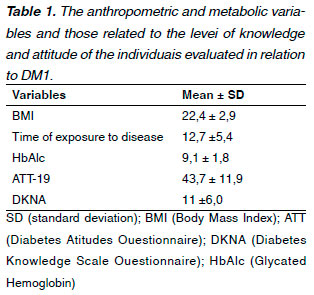
The 19 individuals with DM1, 72.2% female, had a mean age of 24.2 ± 4 years (mean ± standard deviation, range of 18 to 30 years), mean exposure time to the disease of 11.2 ± 6 years (mean ± standard deviation) and mean HbA1c values of 8.8 ± 2.7 (mean ± standard deviation). The majority of the sample, 76.9% was composed of graduate and under-graduates patients at the time of evaluation. The data referring to the anthropometric and metabolic variables and those related to the level of knowledge and attitude of the individuals evaluated in relation to DM1, are presented (Table 1).
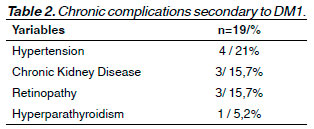
It is worth mentioning that 62% of the investigated individuals reported being physically active performing regular exercises supervised by physiotherapists and/or physical educators, 15.3% reported being smokers and 61.5% reported using alcoholic beverages. It is worth mentioning that 38.4% of the volunteers already presented some impairment secondary to DM1, according to data observed in Table 2.
The correlation between the level of knowledge assessed by DKNA and the metabolic control obtained through the result of the last HbA1c, was negligible, and presented an r = 0.03, as observed in Figure 1.
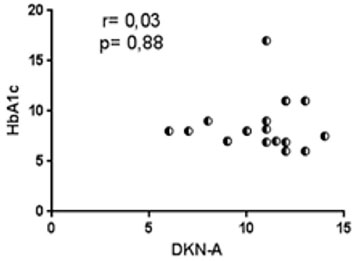 Figure 1. Correlation between levels and HbA1c and scores related to the level of knowledge of individuals (DKNA) in relation to DM1.
The correlation between the attitude level assessed by ATT-19 and the metabolic control obtained through the result of the last HbA1c was also negligible, r = 0.15, as observed in Figure 2.
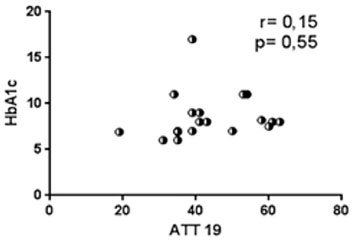 Figure 2. Correlation between levels and HbA1c and attitudinal related scores of individuals (ATT-19) in relation to DM1.
DISCUSSION
The present study contributes to the body of knowledge of the area by exploring the thematic knowledge and attitude of individuals with DM1 demonstrating the need to expand campaigns aimed at this target public, since the diseases resulting from the disease can be considered public health problems. Improving public policies emphasizing the need for more effective health education at all levels of health care appears to be a favorable strategy.
We verified that the majority of the volunteers were graduate (76.9%), presented favorable socioeconomic condition and a satisfactory average of scores of knowledge evidenced by the DKN-A questionnaire. On the other hand, the averages of ATT-19 scores related to attitudes towards DM1 were lower than 70, cut-off point indicating a positive attitude regarding the disease. The level of knowledge was not enough to influence the attitude toward DM1.
These findings are of concern and draw attention to the high average exposure time to the disease of the sample 12.7 ± 5.4 years (mean ± standard deviation), since with this long period of exposure to hyperglycemic alterations, the chance of these individuals developing irreversible chronic complications is quite high. In addition, the mean high levels of HbA1c are also highlighted, demonstrating inadequate glycemic control 14.
In the study by Rodrigues et al. (2009) 2 who investigated knowledge and attitude in individuals with type 2 diabetes mellitus (DM2), the variables schooling and diagnosis time were related to the knowledge and attitude of people with DM2, a result that diverges from our findings, since in our sample we did not identify relationship with schooling. The authors suggest that diversified educational strategies with well-used motivational resources may be simple alternatives for raising awareness and establishing relationships between individuals with DM and their disease.
Effective health education programs are capable of promoting attitude change by improving the perception about DM and quality of life of young individuals 15. Regular exercise also has an impact on the attitude towards DM, besides contributing to adjustments in metabolic control 16. On the other hand, another finding that calls attention to our results is the high HbA1c index of the sample, although most individuals report regular habits of physical exercise. Such a situation may be related to the attitude towards the disease (poor eating habits, neglect of the necessary care), in addition to the use of alcoholic beverages and use of cigarettes were quite prevalent among those evaluated.
The importance of information in changing habits and attitudes of individuals diagnosed with DM1 17 was also confirmed by O'Hara et al. (2014) 18, who demonstrated and affirmed in their study the importance of information in the change of habits and attitudes of individuals with DM1, through health education and good relationship with professionals in various health areas.
In this context, the participation of interdisciplinary teams whose role is to intervene through preventive measures and group health education can help in the process of acquiring knowledge and awareness of the complications of the disease, as well as helping to promote attitudes towards self-care 19.
However, campaigns that stimulate awareness about DM1 and the importance of self-care are not observed in easily accessible media such as radio and television. The Government only presents the Hiperdia program for the registration and follow-up of patients diagnosed with hypertension and/or diabetes mellitus treated in the ambulatory network of the Unified Health System - SUS, allowing the generation of information for the regularly acquisition, dispensation and distribution of medication to all registered patients. It is worth mentioning that Hiperdia is not obliged by law to have professionals of diverse areas, in the majority of the programs there are only doctors and nurses. The Brazilian Society of Diabetes addresses the spread of knowledge about DM1 and its self-care, but this information is restricted to a small public that has access to the Internet and knowledge about the existence of this organ.
In summary, the main contribution of the present study is to demonstrate the importance of the knowledge and the attitude of these youngsters who are diagnosed with DM1, since the scores of the study showed a low mean in the attitude of these individuals, against a favorable average of knowledge and unfavorable metabolic control. The strategies for approaching comorbidities, risks and complications from the disease need to be improved so that morbidity rates can be reduced in this group of patients in the future.
CONCLUSION
Individuals with DM1 presented unsatisfactory scores of knowledge and attitude regarding DM1, even with a large part of the sample presenting a good level of schooling. There was no correlation between such findings and metabolic control, possibly due to the patients' negligence in relation to their health condition. We also emphasize the need to optimize campaigns and health education programs aimed at this group of patients.
REFERENCES
1. Sociedade Brasileira de Diabetes. Diabetes. Availabe from:URL: http://www.diabetes.org.br/para-o-publico/diabetes/o-que-e-diabetes. Acessed 19 May, 2016.
2. Rodrigues FFL, Santos MA, Teixeira CRS, Gonela JT, Zanetti ML. Relationship between knowledge, attitude, education and duration of disease in individuals with diabetes mellitus. Acta Paulista de Enfermagem. 2012;25(2):284-90.
3. Leite SA, Zanim LM, Granzotto PC, Heupa S, Lamounier RN. [Educational program to type 1 diabetes mellitus patients: basic topics]. Arquivos brasileiros de endocrinologia e metabologia. 2008;52(2):233-42.
4. Torres Hde C, Franco LJ, Stradioto MA, Hortale VA, Schall VT. [Evaluation of group and individual strategies in a diabetes education program]. Revista de saude publica. 2009;43(2):291-8.
5. Sawtell M, Jamieson L, Wiggins M, Smith F, Ingold A, Hargreaves K, et al. Implementing a structured education program for children with diabetes: lessons learnt from an integrated process evaluation. BMJ open diabetes research & care. 2015;3(1):e000065.
6. Mendonça FdF, Nunes EFP. Avaliação de grupos de educação em saúde para pessoas com doenças crônicas. Trab educ saúde. 2015;13(2):397-409.
7. Maia FF, Araujo LR. Psychological aspects and blood glucose control of a type 1 diabetes mellitus group from Minas Gerais. Arquivos brasileiros de endocrinologia e metabologia. 2004;48(2):261-6.
8. Pontieri FM, Bachion MM. Crenças de pacientes diabéticos acerca da terapia nutricional e sua influência na adesão ao tratamento. Ciênc saúde coletiva. 2010;15(1):151-60.
9. Oliveira KCS, Zanetti ML. Conhecimento e atitude de usuários com diabetes mellitus em um serviço de atenção básica à saúde. Revista da Escola de Enfermagem da USP. 2011;45(4):862-8.
10. Fazeli Farsani S, Souverein PC, van der Vorst MM, Mantel-Teeuwisse AK, Knibbe CA, de Boer A. Disease history and medication use as risk factors for the clinical manifestation of type 1 diabetes in children and young adults: an explorative case control study. PloS one. 2014;9(2):e87408. Epub 2014/02/06.
11. Rodrigues TdC, Pecis M, Canani LHS, Schreiner LR, Kramer CK, Biavatti K, et al. Caracterização de pacientes com diabetes mellitus tipo 1 do sul do Brasil: complicações crônicas e fatores associados. Revista da Associação Médica Brasileira 2010; 56: 67-73.
12. Torres HC, Virginia AH, Schall VT. Validation of Diabetes Mellitus Knowledge (DKN-A) and Attitude (ATT-19) Questionnaires. Revista de saude publica. 2005;39(6):906-11.
13. Kraaij V, Garnefski N. Cognitive, behavioral and goal adjustment coping and depressive symptoms in young people with diabetes: a search for intervention targets for coping skills training. Journal of clinical psychology in medical settings. 2015;22(1):45-53.
14. Bem AFd, Kunde J. A importância da determinação da hemoglobina glicada no monitoramento das complicações crônicas do diabetes mellitus. J Bras Patol Med Lab. 2006;42(3):185-91.
15. Lascar N, Kennedy A, Hancock B, Jenkins D, Andrews RC, Greenfield S, et al. Attitudes and barriers to exercise in adults with type 1 diabetes (T1DM) and how best to address them: a qualitative study. PloS One 2014;9(9):e108019.
16. Naughton MJ, Yi-Frazier JP, Morgan TM, Seid M, Lawrence JM, Klingensmith GJ, et al. Longitudinal associations between sex, diabetes self-care, and health-related quality of life among youth with type 1 or type 2 diabetes mellitus. The Journal of pediatrics. 2014;164(6):1376-83 e1. Epub 2014/03/04.
17. Didarloo A, Shojaeizadeh D, Alizadeh M. Impact of Educational Intervention Based on Interactive Approaches on Beliefs, Behavior, Hemoglobin A1c, and Quality of Life in Diabetic Women. International journal of preventive medicine. 2016;7:38. Epub 2016/03/26.
18. O'Hara L, Gough B, Seymour-Smith S, Watts S. 'It's not a disease, it's a nuisance': controlling diabetes and achieving goals in the context of men with Type 1 diabetes. Psychology & health. 2013;28(11):1227-45. Epub 2013/05/30.
19. Maia MA, Reis IA, Torres Hde C. Relationship between the users' contact time in educational programs on diabetes mellitus and self-care skills and knowledge. Revista da Escola de Enfermagem da U S P. 2016;50(1):59-64. Epub 2016/03/24.
20. Portes LH. Abordagem do fisioterapeuta no diabetes mellitus: revisão de literatura. Arquivos de Ciências da Saúde. 2015;22(3):9-14.