
INTRODUCTION
Sexual function is an important component of health and quality of life, influencing well-being both physically and psychologically1.
The disorder in any of the phases of the sexual response (desire, arousal, orgasm, and resolution) can cause the appearance of Sexual Dysfunctions (SD), which, according to the American Psychiatric Association are a group of heterogeneous disorders that through a clinical disorder, alters sexual response and/or the ability to achieve sexual pleasure2,3.
Dysfunctions are gender-specific, and it is possible for an individual to have more than one SD at the same time. The term Female Sexual Dysfunction (FSD) relates to a wide variety of clinical symptoms, such as Female Orgasm Disorder, Female Sexual Desire/Arousal Disorder, Genital-Pelvic Pain/Penetration Disorder and Medication/Substance-Induced Sexual Dysfunction3, and it is necessary to have a minimum duration of six months of complaint and to bother the woman herself to be considered an SD. These symptoms are often associated with a marked decrease in the quality of life and interpersonal relationships of the affected women4.
In the USA, 9.7 million women experience some discomfort during sex, and difficulty reaching orgasm5. In Brazil, a study performed in seven states with 1,219 women over 18 years of age revealed that the prevalence of FSD increased according to age and low educational level. At least one sexual dysfunction was reported by 49.0% of women; 26.7% stated lack of sexual desire; 23.1% pain during sexual intercourse; and 21% orgasmic dysfunction6.
Self-esteem, body image, and the quality of the relationship with the partner, can affect the ability for sexual response. Marital conflicts cause serious emotional problems in women, thus altering their sexual response7,8,9.
Another factor that proves to be influential is the age of coitarca (first sexual intercourse). Ferreira, Souza and Amorim10 studied 100 women aged 20 to 39 years in Recife in 2007, the research showed that the age of coitarca is closely related to the presence of FSD's, where women who had coitarca before the age of 20, 45,8% had SD, while those who started after 20 only 10.7% showed SD.
In the mid-90s, there was already a tendency to anticipate the beginning of sexual life, especially among women, as well as the increase in the number of partners throughout life11.
Corroborating with the data previously cited, the Ministry of Health found that in 1984 the average age of coitarca was 16 years, and in 1998 it decreased to 15 years, showing that with the progression of time, the tendency of this age is to decrease more and more12. This age group fits according to the World Health Organization in adolescence, which ranges from 10 to 19 years of age13.
In 2007 Borges14 performed a study with 222 female adolescents aged 15 to 19 years, and 101 of the adolescents had already performed sexual activity.
The literature is rich in studies on FSD in women with advanced ages, or with very distant age ranges where the dysfunction has been manifesting for many years, not giving focus to this young population that, for starting sexual life early and having a larger number of partners, already have the initial symptoms15,16,17,18.
Understanding the human sexual response, its disorders, signs, symptoms, its interference in the quality of life and the people most affected, is still a challenge, because it is a subjective data, and it belongs to the intimacy of each woman, which is influenced by social, cultural and religious factors, facilitators or not, to externalize the information needed for diagnosis19.
The most appropriate instruments to assess female sexual function, taking into account the subjective characteristic of female sexual response are self-administered questionnaires, which assess various domains in the field of sexuality and have a high degree of reliability and validity, the most used among them is the Female Sexual Function Index (FSFI), designed to be an assessment tool in epidemiological studies respecting the multidimensional nature of female sexual function20,21,22.
Therefore, this study aims to better understand the dysfunctions and factors that affect the population of young university students aged 18 to 25 years, in order to bring more data to the scientific community, encouraging research related to the topic addressed, raising their awareness of their own sexual health, and maybe then to allow women's sexual health to be better understood and explored, collaborating for the creation of preventive strategies in the FSD's, increasing the early diagnosis and thus offering more effective treatment.
METHODS
A cross-sectional analytical study was performed with 522 university students. The proposed study was developed on the campus of the Center for Biological and Health Sciences at the University of Amazônia, a unit located in the city of Belém, Pará State, between April 25 and October 10 in 2014, in the morning, afternoon, and night shifts.
The research included: women aged between 18 and 25 years, who signed the Free and Informed Consent Form (ICF), with an active sexual life, who performed sexual activity in the last four weeks preceding the research, who did or did not use contraceptive drugs during research, nulliparous, or multiparous. The study excluded: virgins, pregnant women, or those who had not performed sexual activity in the last four weeks preceding data collection.
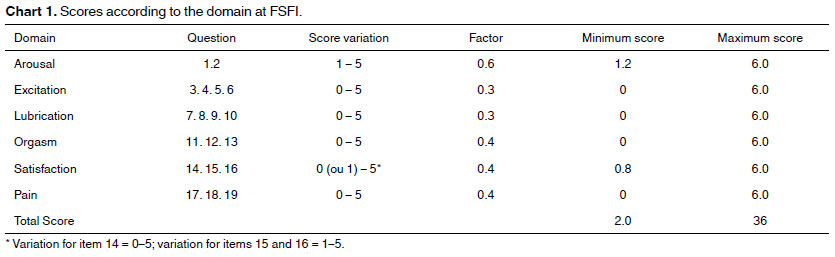
The participants were approached at the university premises, where they were individually introduced to the theme, as well as their risks and benefits. After their agreement to collaborate with the research, the FSFI was signed supporting the researchers to use the data provided, then an envelope containing a behavioral form was given identifying: current age, age at the beginning of sexual life, number of partners in the last four weeks, number of children, sex education, body satisfaction and happiness, and the translated version of the FSFI21, which was developed to be self-applied, with the proposal of evaluating the female sexual response by domains (or component phases of the sexual response): sexual desire, arousal, vaginal lubrication, orgasm, sexual satisfaction, and pain. It consists of 19 (nineteen) questions that seek to assess sexual function in the last 4 (four) weeks with scores on each component. There is an answer pattern for each question, which is scored from 0 to 5 each, increasingly to the presence of the function to be questioned. In the questions that address the pain domain, the score is reversed. After the answers, a total score is presented, resulting from the sum of the scores of each domain and multiplied by a specific factor that homogenizes the influence of each domain in the total score. (Chart 1) Final scores range from 2 to 36, with higher scores indicating a better degree of sexual function, women with scores less than or equal to 26.55 should consider themselves more likely to develop sexual dysfunction17.
The identification was established by progressive numbers, corresponding to the order of people who collaborated with the research, preventing any connection between the questionnaire and the person who answered it. After solving the questionnaires, the participant herself sealed the edge of the envelope with a sticker, which was then opened by the researcher after solving the data to perform the tabulation and statistical analysis.
The data tabulation was performed after using the Google Drive platform, so the data would have a better organization and calculation of results, minimizing typing errors. The analysis was performed using the Minitab version 14.0 and Microsoft Office Excel version 2010 softwares. Frequency distribution tables were built to archive the respondents' answers, obtaining relative and absolute frequency for the variables that were researched, as well as measures of central tendency and dispersion for quantitative variables. After defining the percentage of university students who presented FSD according to the FSFI cutoff score (less than or equal to 26 pts), the study participants were divided into two groups: Group A university students with no FSD, and group P university students with the presence of FSD.
To determine the association between sexual dysfunction and independent variables (associated factors), Fisher's exact test was used. For independent samples, the t-Student test (mean comparison test) was used. In all analyzes, the GPower 3.0.1 software was used to determine the critical values of the test statistic, the effect size, and test sensitivity equal to or greater than 0.8.
This study was assessed and approved by the Ethics and Research Committee on Human Beings of the University of Amazônia (Opinion number: 618,629), as well as the authorization of the director of CCBS allowing the collection of data on the University's premises.
RESULTS
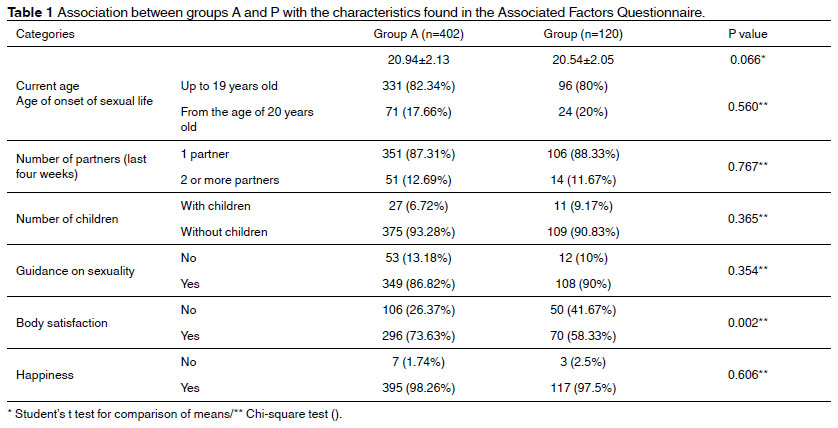
It was found a prevalence of FSD of 22.99% (120 university students) described by graph 1, with an average total score on the questionnaire of 21.57 ± 1.98 (Table 1), while the other 77.01% (402 university students) who did not have dysfunction obtained an average of 29.94 ± 1.99 (Table 1). They were divided into: Group A with 402 university students and Group P with 120 university students.
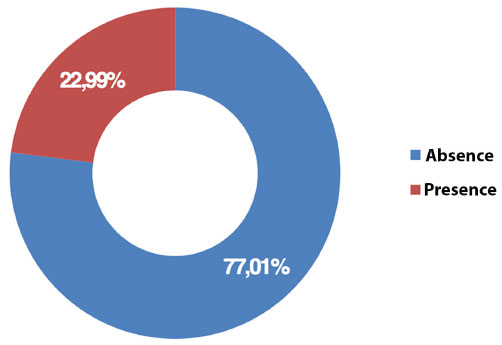
Graph 1. Presence or absence of female sexual dysfunction (n = 522).

In red, the percentage of women who were prone to having FSD, and in blue the percentage of women who obtained a score greater than 26 points.
There were no significant differences between the average age of current university students in group A (20.94 ± 2.13 years) with those in group P (20.54 ± 2.05 years), t520 = -1.811, p = 0.071. This homogeneity was also observed in relation to the age of onset of sexual life in both groups, since most university students started their sexual life before age 19 (82.34% in group A, and 80% in group P), X24 = 2.118, p = 0.714.
As for the number of partners, there was also no significant difference between groups, where 87.31% of group A reported only one partner in the last four weeks and 12.69% two or more partners. Similar to group P, 88.33% reported only one partner and 11.67% two or more partners.
In order to identify the variables that have effects on female sexual function, we performed an ANOVA, having as factors the onset of sexual life, body satisfaction, happiness and sexual education received. An interaction was detected between the four factors, F5,457.
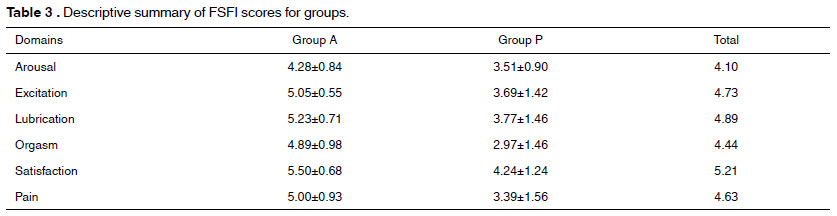
The mean scores of each domain were described, which revealed that the domain that had the highest score was "Sexual Satisfaction" with an average of 5.21 points (pts), followed by the "Vaginal Lubrication" domain with 4.89 pts. The third domain with the best score was "Sexual Arousal", the "Pain" domain ranked fourth with 4.63 pts and "Orgasm" came in fifth with an average of 4.44 pts (and the most affected in group P with 2.97 ± 1.46). The domain that presented the lowest score among the 522 university students was "Sexual Desire", with an average of only 4.10 points (Table 3). A Multivariate Analysis of Variance (MANOVA) determined significant differences between groups P and A for all domains of sexual function (Desire: F1.521 = 76.469, p = 0.001, η2 = 0.128; Arousal: F1.521 = 245.132, p = 0.001, η2 = 0.320; Lubrication: F1.521 = 223.734, p = 0.001, η2 = 0.301; Orgasm: F1.521 = 275.087, p = 0.001, η2 = 0.346; Sexual Satisfaction: F1.521 = 206.570, p = 0.001, η2 = 0.284, and Pain: F1.521 = 195.342, p = 0.001, η2 = 0.273), in all analyzes, large effect sizes were found, suggesting marked differences between groups.
DISCUSSION
Satisfactory sex life is an integral part of the overall health of the human being and individual well-being, sexuality in both genders is multifactorial and influenced by all dimensions of the individual. The initial approach on the subject still causes insecurity and discomfort in women when asked about it, due to cultural and social influences there is still a barrier when talking about sex and pleasure11,12.
In many universities, there is no important focus on female sexuality23, in order to contribute to the lack of knowledge of university students about their own bodies and sexual health, which may perhaps influence the values of dysfunction in this population.
The prevalence of FSD in the present study was equivalent to 22.9% of university students, considered within the standards when compared to the national literature that reports a dysfunction rate of 21.9% to 77.2%17,10. When compared to international literature, it remained below the standard, which is around 42% 24,25.
In Brazil, more precisely in the state of Sergipe, a study involving 201 women had a global prevalence of 21.9% of female sexual dysfunction, and when evaluated in terms of schooling, women who attended school up to high school and up to higher education, the prevalence of sexual dysfunction was 24.2% and 13.4%, respectively17. Contrary to the data obtained in a study with 273 young university students in the metropolitan region of Florianópolis, which identified an index of 25% of FSD25 in them.
In Portugal, a study was developed showing a prevalence of 74% of dysfunction in 422 interviewees, and unlike previously mentioned by the authors, FSD appeared to be significantly more prevalent in women with a higher level of education (university students)26.
Most of the national articles study the correlation between the age of coitarca, the number of partners and the presence of dysfunction, since the influence of relational factors on the female sexual response is increasingly being noticed.
National and international studies agree that women who initiated sexual life before the age of twenty are up to four times more likely to develop an FSD compared to those who initiated their sexual life after this age, the authors cited also relate women with a history of a single partner to a better index of sexual function10,26, what contradicts the results obtained herein, where the factors mentioned above did not present confirmed significance, due to the homogenization of responses in both groups studied, when added, 81.8% reported the coitarca before 20 years and 87.5% had only one sexual partner.
The sex education factor did not obtain a statistically relevant value in the present study, since 87.5% of the total sample reported having received guidance on sexuality, from family members and/or outside the family environment.
Guidance on sexuality is a tool that seeks to stimulate reflection on all topics involving sexuality, aiming to achieve knowledge about one's own body, sexual well-being, gender relations with equality, respect for diversity, and prevention of disorders such as unplanned pregnancy, sexually transmitted diseases, and sexual disorders27.
The proposed study showed that the interaction of the variables body satisfaction, happiness, and beginning of sexual life are related to female sexual function. According to the results, women who are not satisfied with their bodies and have a lower level of happiness are more likely to develop an FSD. However, the presence of dysfunction did not make them any less happy.
Subjective issues such as body satisfaction and happiness are showing their influence on the female sexual response28,29 every day. Women who do not fit the body standard imposed by society, especially young women where sex appeal during the period is more present, whether due to eating disorders (e.g., overweight), hormonal (e.g., acne and stretch marks), and even clothing they cause insecurity in this population, who are not satisfied with their own body, and they fear revealing it to their partner, for fear of disapproving it29,30,31.
This insecurity has a negative effect on the quality of life of these women, interfering in their relationships and decreasing happiness, in the most severe cases, and they may even develop psychological disorders32 which is in line with OU differ from the results obtained by Pujols, Seal, and Meston, who verified in their study with 154 women the existence of a positive correlation between body image and sexual function and satisfaction33. Also agreeing with Veríssimo3 and Seara35, who both observed that women who were too insecure with the exposure of their bodies during sexual activity presented greater anxiety, which ended up negatively influencing their FSFI36 score, found that women with body image problems were 2.5 times more likely presenting problems in terms of sexual function. Factors such as the quality of the relationship with the partner and factors in the context of sexual intercourse have a determining effect on the sexual function of women (Câmara et al., in press), such as the level of love and romanticism in the relationship, like being embraced by partner, enjoy doing things together, have privacy for sex, and consider sex important in the relationship. It is possible that satisfaction with the body does not influence sexual function, but that it covarie it due to factors of the relationship with the partner as indicated in the studies by Câmara et al. (in press).
As for the analysis of the FSFI domains, the one with the lowest score overall was the domain of sexual desire. However, it was noted that the domain with the lowest score for group P was the domain of orgasm, although the women said they were moderately sexually satisfied. This paradox is recurrent in literature data (Câmara et al, in press), and may be related to the affective bond developed with the partner in the form of secondary gains, such as intimacy and emotional closeness in sexual contact. There were significant differences in all domains of sexual function, the effect of belonging or not to a group is considered extremely strong in all comparisons made.
Most studies reveal the desire disorder as the most common, agreeing with the data obtained herein. A systematic review dating from 1966 to 2004 on female sexual dysfunctions in the world, confirmed a 64% prevalence of women with desire dysfunction37. In Brazil, a 2004 study found that 49% had at least one sexual dysfunction, with 26.7% having a desire dysfunction, 23% dyspareunia and 21% orgasm dysfunction, which also corroborated with the data presented in the study38.
Therefore, it is necessary to produce more research correlating the FSD in young women, covering a larger number of subjects, in different regions of the country, in order to increase knowledge about the influence of social and economic factors on sexual function of women in this age group, always aiming for a better approach, by health professionals, of this problem so relevant to the woman's quality of life.
CONCLUSION
It can be noted that in addition to physical factors, the social, behavioral, and psychological factors also affect female well-being, in which psychological aspects may be correlated with the sexual function of university students. It was also proven that the FSD's, contrary to what was expected, manifest themselves in both young and mature women, and the disorder that most affected the group with sexual dysfunction according to the evaluation made by FSFI, was the orgasm disorder that obtained the lowest score, followed by pain and desire disorders respectively. The prevalence of FSD found in the university students studied was 22.99%, similar to that reported in the literature.
REFERENCES
1. Mendonça CR,Silva TM,Arrudai JT. Função sexual feminina: aspectos normais e patológicos, prevalência no Brasil, diagnóstico e tratamento. Rev. Femina; 40(4), jul.-ago.2012.
2. Antonioli RS,Simões D. Abordagem fisioterapêutica nas disfunções sexuais femininas. Rev. Neurociências 2010;18(2):267-274.
3. Araújo AC,Neto FL. A Nova Classificação Americana Para os Transtornos Mentais - o DSM-5. Rev. Bras. de Ter. Comportamental. 2014, Vol. XVI, no. 1, 67 - 82.
4. Burri A, et al. A genome-wide association study of female sexual dysfunction.PLoS One. 2012;7(4):e35041.
5. Weber M,et al. Vaginal anatomy and sexual function. Obstet. Gynecol. 1995; 86: 46-9.
6. Fleury HJ, Abdo CHN. Importância do apoio psicoterapêutico para disfunção sexual no envelhecimento. Diagn. Tratamento; 18(4), dez 2013.
7. Phillips NA. Female Sexual Dysfunction:evaluation and treatment. Am. Fam. Phys. 2000; 62: 127-36, 141-2.
8. Filetto JN, Makuch MY. Long-term follow-up of women and men after unsuccessful IVF. Reprod Biomed. 2005;11(4):458-63.
9. Clayton AH. The pathophysiology of hypoactive sexual desire disorder in women. Intern. Journal of Gynecology & Obstetrics, v. 110, n. 1, p. 7-11, 2010.
10. Ferreira ACGL, Souza AI, Amorim, MMR. Prevalência das disfunções sexuais femininas em clínica de planejamento familiar de um hospital escola no Recife, Pernambuco. Rev. Bras. Saúde Matern. Infant. 2007. 7:143-50.
11. Moreira MRC, Santos JFFQ.Entre a modernidade e a tradição:a iniciação sexual de adolescentes piauienses universitárias. Esc. Anna Nery. 2011, vol.15, n.3, pp. 558-566.
12. MCCABE, M. P. et al. Risk factors for sexual dysfunction among women and men: a consensus statement from the fourth international consultation on sexual medi- cine.J Sex Med.13:153e167. 2016
13. Brasil. Ministério da Saúde. Coordenação Nacional DST/AIDS. Centro Brasileiro de Análise e Planejamento (CEBRAP). Pesquisa sobre comportamento sexual da população brasileira e percepções sobre HIV/AIDS. Brasília: Ministério da Saúde; 2000.
14. Nogueira LA, Bandeira J, Santhyago MCG. Educação em saúde na atenção ao adolescente: relato de experiência. Em Extensão, v.11, n.2, 2013.
15. Borges ALV. Relações de gênero e iniciação sexual de mulheres adolescentes.Rev. Esc. Enf. USP 2007; 41(4):597-604.
16. Ferreira ALCG, et al. Disfunções sexuais femininas. Rev. Femina;Novembro 2007. vol 35 nº 11.
17. Lara LAS; et al. Prevalência de disfunção sexual em dois grupos de mulheres de diferentes níveis socioeconômicos. Rev Bras Ginecol Obstet. 2010; 32(3):139-43.
18. Prado DS, Mota VPLP, Lima TIA. Prevalência das disfunções sexuais femininas em clínica de planejamento familiar de um hospital escola no Recife, Pernambuco. Rev. Bras. Saúde Matern. Infant., Recife, 7 (2): 143-150, abr. / jun., 2007
19. Piassarolli VP, et al. Treinamento dos músculos do assoalho pélvico nas disfunções sexuais femininas. Rev Bras Ginecol Obstet. 2010; 32(5): 234-40.
20. Ressel LB, et al. A influência da família na vivência da sexualidade de mulheres adolescentes. Esc Anna Nery, v. 15, n. 2, p. 245-250, 2011.
21. Meston, C. Validation of the Female Sexual Function Index (FSFI) in women with female orgasmic disorder and in women with hypoactive sexual desire disorder. Journal Sex Marital Ther. 2003; 29:39-46.
22. Pacagnella RC, Vieira EM, Rodrigues JROM, Souza C. Adaptação transcultural do Female Sexual Function Index. Cad. Saúde Pública, Rio de Janeiro, 24(2):416-426, fev, 2008.
23. Rosen RC, et al. Sexual desire problems in women seeking healthcare: a novel study design for ascertaining prevalence of hypoactive sexual desire disorder in clinic-based samples of US Women. Journal of Womens Health, v. 21, n. 5, p. 505-515, 2012.
24. Neumann AF, et al. Perfil da sexualidade feminina em universitárias de um curso de medicina de Santa Catarina. Arquivos Catarinenses de Medicina, v.40, n.1, 2011.
25. Shifren JL, et al. Sexual Problems and Distress in United States Women: Prevalence and Correlates. Obstetric & Ginecology. Vol. 112, n. 5, Novembro 2008.
26. Wallwiener CW, et al. Sexual function, contraception, relationship, and lifes- tyle in female medical students. J of Women Health. 00(00), 2016.
27. Latorre GFS.Confiabilidade e validade do FSFI online e disfunção sexual feminina. 2013. 172 f. Dissertação (Mestrado em Fisioterapia - Área Saúde da Mulher) - Universidade do Estado de Santa Catarina. Programa de Pós-Graduação em Fisioterapia, Florianópolis, 2013.
28. Cerejo AC. Disfunção sexual feminina: Prevalência e fatores relacionados. Revista Portuguesa de Medicina Geral e Familiar, [S.l.], v. 22, n. 6, p. 701-20, nov. 2006. ISSN 2182-5173.
29. Brêtas, JRS, et al. Aspects of sexuality in adolescence. Ciência & Saúde Coletiva, v. 16, n. 7, p. 3221-3228, 2011.
30. KAO H. et al. Experience of pelvic floor muscle exercises among women in Taiwan: a qualitative study of improvemente in urinary incontinence and sexuality. J Clinic Nurs, doi: 10.1111/jocn.12783. 2015
31. Cardoso FL, Marinho A, Pimentel GGA. Questões de gênero em universitários praticantes de esportes de aventura. Rev. da Educação Física/UEM, v. 24, n. 4, 2014.
32. Maia RF et al. A influência da mídia na sexualidade do adolescente. Revista Mackenzie de Educação Física e Esporte. V.5, N.3, 2010.
33. Sacomori C, et al.Relação entre características antropométricas e função sexual feminina. Rev Brasileira de Ciência e Movimento21.2 (2013): 116-122.
34. Machado A, Serrano F. Hormonal contraception and female sexuality. Acta Obstet. Ginecol. Port. V.8, N.2, 169-175, 2014.
35. Campagna VN, Souza ASL. Corpo e imagem corporal no início da adolescência feminina. Boletim de psicologia, v. 56, n. 124, p. 9-35, 2006.
36. Pujols Y, Seal BN, Meston CM. The association between sexual satisfaction and body image in women. J Sex Med. 2010 Feb;7(2 Pt 2):905-16.
37. Veríssimo CMA. Funcionamento sexual feminino e exposição corporal na gravidez de termo. 2011. Tese (Mestrado em Medicina) - Universidade de Lisboa, Lisboa, 2011.
38. Seara MLP, et al. Imagem corporal e função sexual das mulheres mastectomizadas. 2012. Tese (Mestrado em Medicina) - Universidade de Lisboa, Lisboa, 2012.
39. Panjari M, Bell RJ, Davis SR. Sexual function after breast cancer. J Sex Med. 2011 Jan;8(1):294-302.
40. West SL, Vinikoor, LC, Zolnoun D. A systematic review of the literature on female sexual dysfunction prevalence and predictors. Annual Review of Sex Research, v. 15, n. 1, p. 40-172, 2004.
41. Abdo, CHN, et al. Prevalence of sexual dysfunctions and correlated conditions in a sample of Brazilian women- results of the Brazilian study on sexual behavior (BSSB). Int J Impot Res. 2004;16(2):160-6.