
INTRODUCTION
Population aging can be observed worldwide and results from changes in health indicators, especially from falling fertility and mortality, the latter strongly linked to improvements in health conditions and technological and scientific advances1,2.
In Brazil, it is estimated that the increase in the elderly population will be approximately 15 times, between 1950 and 2025, while the total population will be no more than five times in the respective period. This estimate makes Brazil the country with the sixth-largest elderly population in the world3, which will reverse its age pyramid4.
The aging process favors biological, psychological, and social changes that often lead to a reduction in autonomy and independence5. As a consequence, elderly people tend to modify their role in the family, work, and society in a negative, quantitative and qualitative way, which predisposes the feeling of helplessness in the face of the environment they helped to build, compromising their quality of life6.
Quality of life is related to self-esteem and personal well-being and covers a wide range of aspects, such as functional capacity, socioeconomic level, emotional state, social interaction, intellectual activity, self-care, family support, health status, cultural and ethical values, and religiousness, lifestyle, satisfaction with employment and/or with the activities of daily living and the living environment. Thus, the concept of quality of life is subjective and dependent on the socio-cultural level, age, and personal aspirations of each individual3.
The World Health Organization Quality of Life (WHOQOL) defines the quality of life as the individual's perception of his position in life, in the context of the culture and the value system in which he lives, in relation to his goals, expectations, standards and concerns. This concept covers aspects such as independence, physical, psychological, social interactions, environment, and spirituality3,5,7. In this context, good or excellent quality of life includes a minimum of conditions so that individuals can develop the maximum of their potential, conquering their goals and expectations. However, most individuals tend to relate the quality of life to health, since for them quality of life is directly associated with the concept of having a good state of health8.
In recent years, much has been said about active aging, which is essential for the longevity of the elderly population. It is conceptualized as a process of optimizing health opportunities, participation, and safety, with the aim of improving the quality of life as people get older9-13. Considering that good cognitive and emotional status are linked to autonomy, mobility and communicative capacity, favoring functional capacity and independence, it can be said that these outcomes are also related to active aging, and quality of life13.
In view of the fact that population aging shows an increasing need for studies to better understand and meet the particularities of the elderly, this study was structured with the aim of assessing the functional capacity, cognitive status, and quality of life of institutionalized elderly people. In addition, it was intended to verify the correlation between the variables evaluated.
METHODS
The presentation of the data followed the recommendations of STROBE (Strengthening the Reporting of Observational Studies in Epidemiology) (Malta, Cardoso, Bastos, Magnanini & Silva, 2010).
Design and ethical aspects
This is an observational, descriptive and cross-sectional study approved by the Ethics and Research Committee (Opinion No. 2.143.343). The volunteers or their legal guardians signed a free and informed consent form, according to Resolution 466/12 of the National Health Council.
Study location and period
A study performed at LTCF in the city of Juiz de Fora, Minas Gerais state, from February to June 2017. To minimize the risk of bias, data collection was performed by trained individuals and under professional supervision.
Eligibility and non-inclusion criteria
Individuals with a minimum age of 60 years, of both genders, residing in an LTCF in the city of Juiz de Fora, Minas Gerais state, were eligible. Residents who did not accept to participate in the research were excluded. Those who did not complete all the research stages were excluded from the final analysis.
Sample size and characteristics
The LTCF was selected for convenience. Of the total of 58 elderly residents, 33 participated voluntarily in the research.
Researched outcomes
Functional and cognitive capacity were the primary outcomes and quality of life the secondary outcome.
Research procedures
Information regarding the sample's socio-demographic profile was captured through interviews. Information not provided by the elderly (for not knowing or remembering) was captured in medical records and in informal interviews with professionals linked to assistance.
The Katz Index investigated functional capacity through six questions aimed at the ability to perform activities of daily living and self-regulation and the Mini-Mental State Examination screened the cognitive status of the volunteers through 10 questions scored according to the interviewee's education.
To assess the quality of life, the Short Form 36 Questionnaire was used, a generic instrument composed of 36 questions subdivided into eight domains (functional capacity, limitation by physical aspects, pain, general health, vitality, social aspects, limitation by emotional aspects and mental health).
ANALYSIS OF RESULTS AND STATISTICS
The data relating to the characteristics of the sample and the results of the applied questionnaires were analyzed using the statistical program Statistical Package for the Social Sciences (SPSS Inc. Chicago, IL, USA). In the descriptive analysis of the data, the variables were presented in absolute (n) or relative (%) frequency. The distribution of variables was tested using the Shapiro-Wilk test. Pearson's correlation was used to correlate the studied variables according to their distribution. The p-value considered for all analyzes was p≤ 0.05.
The collected data will be stored for a minimum of five years.
RESULTS
The sample, initially composed of 33 elderly people, was reduced to 19 due to the fact that 14 did not respond, for various reasons, to all the research instruments. The flow of participants throughout the survey is shown in figure 1.
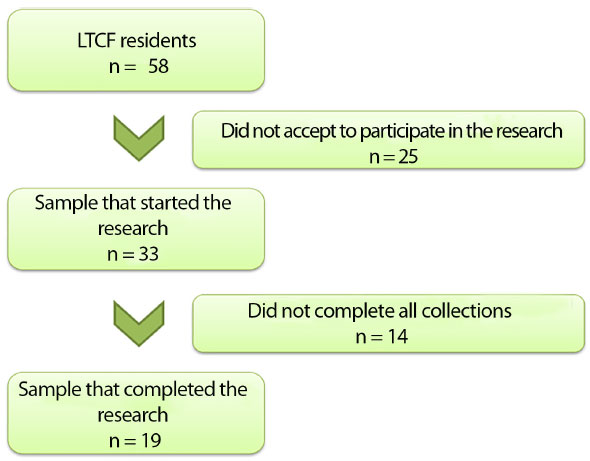
Figure 1. Sample flow throughout the survey
Nineteen volunteers responded to the questionnaires with no apparent difficulty, 16 of whom were female. The mean age was 78.63 (± 9.19 years), ranging from 60 to 92 years of age, as shown in the graph1.
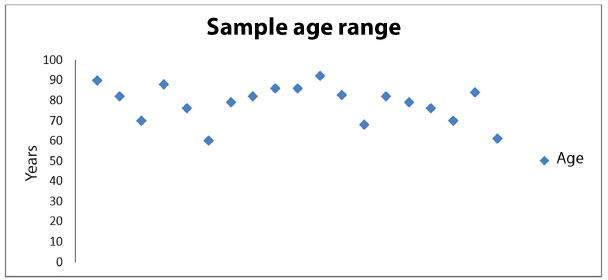
Graph 1. Sample age profile
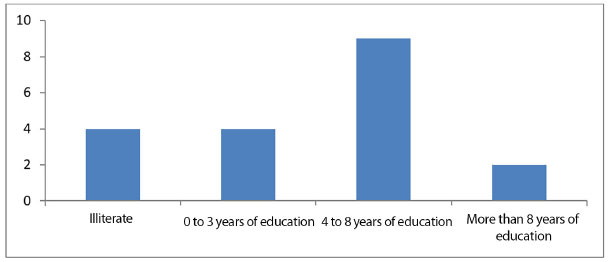
As for education, 21.1% were illiterate and only 10.5% had education over 8 years (Graph 2). In the study, it was possible to observe that the majority of the sample (48%) is within the range of 4 to 8 years of study.
Source: The author (2017)
Graph 2. Sample education
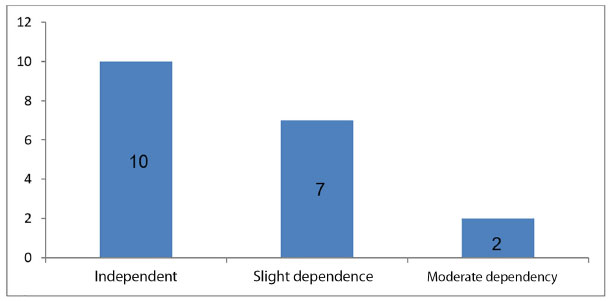
The Katz index showed that 47.4% of the elderly had mild or moderate dependence (Graph 3) and that 9 of the 19 volunteers reported continence problems.
Source: The author (2017)
Graph 3. Sample’s Katz index results
The mini-mental state examination (MMSE) showed that only 22% of the sample had a score higher than expected according to the level of education reported, and the other participants in the sample (78%) had a score below or equal to the expected score (Graph 4).
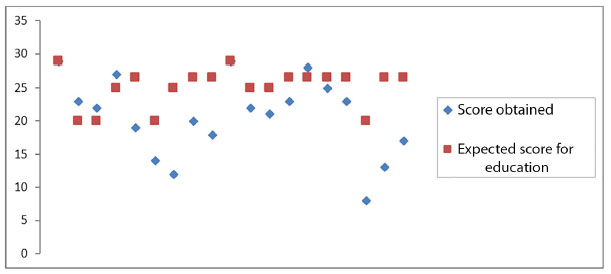
Source: The author (2017)
Graph 4. MMSE results according to the score obtained and expected
The quality of life, analyzed by the SF-36, showed that the domain "Vitality", 52.63% of the sample feels exhausted and tired all the time (63.42 ± 26.87), a counterpoint to the domain "General Health State", in which 68% of the volunteers registered a score indicating excellent health status (67 ± 23.56). In the functional capacity domain, it was observed that 57.8% of the sample had a score equal to or less than 50 (40.79 ± 28.92), that is, it has a functional limitation. The mental health of 68.42% of the sample was considered good, since they had scores greater than 50 (74.53 ± 23.93). With regard to the other domains, there were limitations due to physical aspects (59.21 ± 45.03), pain (55.74 ± 27.71), social aspects (65.63 ± 30.58) and limitations due to emotional aspects (59.58 ± 45.24), both with a score higher than 50 points, that is, a large portion of the sample has limitations resulting from physical, social, emotional aspects and due to the report of body pain, in general, as shown in Graph 5.
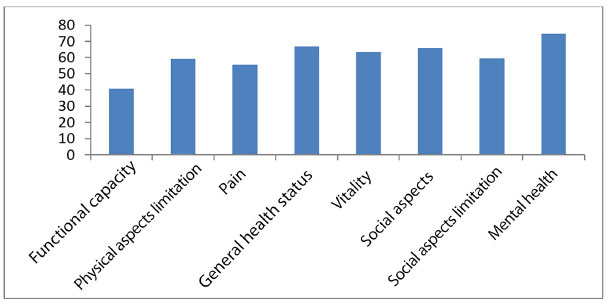
Source: The author (2017)
Graph 5. Results of the SF-36 questionnaire domains
Correlations were found to be non-existent between MMSE and Katz index (p=0.828), between the functional capacity domain of SF-36 and MMSE (p=0.051) and between this same domain and the Katz index (p=0.517).
DISCUSSION
Functional capacity, functional independence, good cognition, good mental health, and health are important factors for quality aging. In the present study, the Katz index pointed out that 47.4% of the elderly have mild or moderate dependence for some activities of daily living. This instrument pointed out that the item continence was referred to as compromised by 9 of the 19 participants, which means that they have loss of feces and/or urine involuntarily.
High continence impairment was also reported by Oliveira et al. (2012), whose study recorded incontinence in 30.5% of elderly volunteers14. According to Reis et al. (2003), changes in motivation, mobility, lucidity and the existence of associated diseases, such as diabetes mellitus and neurological changes, are factors that can explain the tendency to urinary and fecal incontinence observed among the elderly15.
The mini-mental state examination (MMSE) aims to investigate the cognitive state, screening for any symptoms potentially suggestive of dementia16,17,18. Our results suggest cognitive impairment in 78% of the elderly, which is in line with the result reported by Converso et al. (2007) reporting a cognitive decline in 76.72% of their sample19. Analyzing the mental health domain of the SF-36 with the results obtained by the MMSE, there is a divergence of results, which can be explained by the fact that the SF-36 is a generic instrument of quality of life that investigates an item related to mental health while MMSE is specific for cognition.
Institutionalization can predispose to stress and depression, to a decline in self-esteem and to an increased risk of loneliness or social isolation, which may justify the high percentage of cognitive decline observed among institutionalized elderly20. According to Converso et al. (2007), cognitive decline is directly related to age, and decreased memory performance and, often, institutionalization occurs due to functional dependence19.
In the present study, the quality of life, analyzed by the SF-36, identified a limitation for performing physical activities in 79.94% and a report of exhaustion and tiredness in 52.63% of the volunteers. However, in the general health status domain, 68% of the elderly had a score greater than 61, which means that, despite physical limitations, exhaustion, and tiredness, they assess their health as excellent. This apparent contradiction can be explained by the link between health and different aspects of life, such as access to appropriate treatments, the quality of interpersonal bonds and religiosity20.
We observed that older people had lower functional capacity, which seems logical, since advancing age predisposes to musculoskeletal, joint, and somatosensory changes that compromise balance, and walking. Freitas et al. (2010) report that before institutionalization, the elderly maintained their autonomy and independence and that after these outcomes were reduced. This may suggest that institutionalization favors functional decline and, consequently, the quality of life of the resident population20. However, different results were recorded by Pimenta et al. (2008), who identified greater functional capacity among older adults, which can be explained by the fact that the studied elderly engage in regular physical activity21.
It is known that good functional capacity and the consequent functional independence are prerequisites for active aging and that it can differ between genders. In this context, Campos et al. (2015) concluded that active aging is different between genders and that women have higher rates of functional dependence, cognitive deficit, depression, worse family functioning and a more negative perception of their own health13. In addition, Xavier et al (2003) observed that elderly people dissatisfied with their quality of life had more health problems and more depressive symptoms, this discontent being related to the lack of physical health22. Farias et al. (2012)23 observed that, among elderly people aged 79 years or older, not all determinants of active aging are relevant and that the physical, emotional, social, economic and cognitive dimensions, family life, physical health, social support networks, activities developed daily and with satisfaction, they contribute positively and with greater efficiency in the evaluation of active aging1,23. However, when correlated and associated the tests between these elements and determinants of active aging, no statistical significance was evidenced.
CONCLUSION
It is concluded that the elderly participants in this study showed functional loss observed in 9 volunteers through the Katz Index, resulting in mild or moderate dependence. Cognitive impairment was identified in 78% of the sample through a score lower than expected for their education according to the MMSE. SF-36 identified a reduction in quality of life, as the majority of the sample reported exhaustion, tiredness, and limitations in functional activities.
Although the aging process is an important factor related to cognitive impairment, reduced functional capacity and decline in quality of life, no significant correlations were identified between these outcomes in the present study.
REFERENCES
1. Carvalho Td, Milani M, Ferraz AS, Silveira ADd, Herdy AH, Hossri CAC, et al. Diretriz Brasileira de Reabilitação Cardiovascular - 2020. Arquivos brasileiros de cardiologia. 2020 2020-06-01;114(5):943-87.
2. Chaves GSS, Ghisi GLM, Britto RR, Servio TC, Cribbie R, Pack Q, et al. Health Care Administrators' Attitudes Toward Cardiac Rehabilitation in North and South America and the Development of a Scale to Assess Them. Heart, lung & circulation. 2019 Nov 27. PubMed PMID: 31812629. Epub 2019/12/10. eng.
3. Knuuti J, Wijns W, Saraste A, Capodanno D, Barbato E, Funck-Brentano C, et al. 2019 ESC Guidelines for the diagnosis and management of chronic coronary syndromes. European heart journal. 2020 Jan 14;41(3):407-77. PubMed PMID: 31504439. Epub 2019/09/11. eng.
4. Turk-Adawi K, Supervia M, Lopez-Jimenez F, Pesah E, Ding R, Britto RR, et al. Cardiac Rehabilitation Availability and Density around the Globe. EClinicalMedicine. 2019 Aug;13:31-45. PubMed PMID: 31517261. Pubmed Central PMCID: PMC6737209. Epub 2019/09/14. eng.
5. Benjamin EJ, Muntner P, Alonso A, Bittencourt MS, Callaway CW, Carson AP, et al. Heart Disease and Stroke Statistics-2019 Update: A Report From the American Heart Association. Circulation. 2019 Mar 5;139(10):e56-e528. PubMed PMID: 30700139. Epub 2019/02/01. eng.
6. Organization WH. Global action plan for the prevention and control of noncommunicable diseases 2013-2020. 2013.
7. Benjamin EJ, Blaha MJ, Chiuve SE, Cushman M, Das SR, Deo R, et al. Heart Disease and Stroke Statistics-2017 Update: A Report From the American Heart Association. Circulation. 2017 Mar 7;135(10):e146-e603. PubMed PMID: 28122885. Pubmed Central PMCID: PMC5408160. Epub 2017/01/27. eng.
8. Ribeiro ALP, Duncan BB, Brant LC, Lotufo PA, Mill JG, Barreto SM. Cardiovascular health in Brazil: trends and perspectives. Circulation. 2016;133(4):422-33.
9. Cesar L, Ferreira J, Armaganijan D, Gowdak L, Mansur A, Bodanese L, et al. Guideline for stable coronary artery disease. Arquivos brasileiros de cardiologia. 2014;103(2):01-59.
10. Ghisi GLdM, Durieux A, Manfroi WC, Herdy AH, Carvalho Td, Andrade A, et al. Construção e validação do "CADE-Q" para educação de pacientes em programas de reabilitação cardíaca. Arquivos brasileiros de cardiologia. 2010;94:813-22.
11. Ghisi GLdM, Leite CM, Durieux A, Schenkel IdC, Assumpção MSd, Barros MMd, et al. Validação para o português do Maugerl CaRdiac preventiOn-Questionnaire (MICRO-Q). Arquivos brasileiros de cardiologia. 2010 2010-03;94(3):394-400.
12. de Padua Mansur A, Favarato D. Mortalidade por doenças cardiovasculares no Brasil e na região metropolitana de São Paulo: atualização 2011. Arquivos brasileiros de cardiologia. 2012;99(2):755-61.
13. Davari M, Maracy MR, Khorasani E. Socioeconomic status, cardiac risk factors, and cardiovascular disease: A novel approach to determination of this association. ARYA atherosclerosis. 2019 Nov;15(6):260-6. PubMed PMID: 32206069. Pubmed Central PMCID: PMC7073799. Epub 2020/03/25. eng.
14. Baker A. Crossing the quality chasm: a new health system for the 21st century. British Medical Journal Publishing Group; 2001. p. 1192.
15. Sommaruga M, Vidotto G, Bertolotti G, Pedretti RF, Tramarin R. A self administered tool for the evaluation of the efficacy of health educational interventions in cardiac patients. Monaldi archives for chest disease = Archivio Monaldi per le malattie del torace. 2003 Mar;60(1):7-15. PubMed PMID: 12827828. Epub 2003/06/28. eng.
16. Ghisi GLdM, Oh P, Thomas S, Benetti M. Avaliação do conhecimento de pacientes de reabilitação cardíaca: Brasil versus Canadá. Arquivos brasileiros de cardiologia. 2013;101(3):255-62.
17. Team RC. R: A language and environment for statistical computing. Vienna, Austria; 2013.
18. Mukherjee D, Bhatt DL, Roe MT, Patel V, Ellis SG. Direct myocardial revascularization and angiogenesis--how many patients might be eligible? The American journal of cardiology. 1999 Sep 1;84(5):598-600, A8. PubMed PMID: 10482164. Epub 1999/09/11. eng.
19. Culler SD, Kugelmass AD, Brown PP, Reynolds MR, Simon AW. Trends in coronary revascularization procedures among Medicare beneficiaries between 2008 and 2012. Circulation. 2015 Jan 27;131(4):362-70; discussion 70. PubMed PMID: 25533970. Epub 2014/12/24. eng.
20. Alm-Roijer C, Stagmo M, Uden G, Erhardt L. Better knowledge improves adherence to lifestyle changes and medication in patients with coronary heart disease. European journal of cardiovascular nursing : journal of the Working Group on Cardiovascular Nursing of the European Society of Cardiology. 2004 Dec;3(4):321-30. PubMed PMID: 15572021. Epub 2004/12/02. eng.
21. Alm-Roijer C, Fridlund B, Stagmo M, Erhardt L. Knowing your risk factors for coronary heart disease improves adherence to advice on lifestyle changes and medication. Journal of Cardiovascular Nursing. 2006;21(5):E24-E31.
22. Fiscella K, Franks P. Should years of schooling be used to guide treatment of coronary risk factors? The Annals of Family Medicine. 2004;2(5):469-73.
23. Fiscella K, Tancredi D. Socioeconomic status and coronary heart disease risk prediction. Jama. 2008;300(22):2666-8.
24. Kayaniyil S, Ardern CI, Winstanley J, Parsons C, Brister S, Oh P, et al. Degree and correlates of cardiac knowledge and awareness among cardiac inpatients. Patient education and counseling. 2009 Apr;75(1):99-107. PubMed PMID: 18952393. Pubmed Central PMCID: PMC2935489. Epub 2008/10/28. eng.