
INTRODUCTION
Heavy metals are chemical elements with a density greater than 7 g/cm3 and are considered ubiquitous in the environment, having as sources natural means, as in the case of volcanic activities and rock decomposition, and anthropogenic sources, as in the case of mining, agriculture, and industrial activities1-3. They are classified according to their toxicity as essential and non-essential, the former have human physiological functions in certain concentrations, such as zinc, iron, and manganese; while non-essentials have no physiological function, being considered toxic and raising concerns according to their concentrations, such as, for example, mercury, arsenic, cadmium, chromium, and lead4,5.
Lead has been used by humanity for thousands of years and for different purposes, such as the production of electric accumulators, ammunition, the production of paints, glass, plastics, and ceramics (1). Its toxicity has records that lead it to the era before Christ, being considered one of the oldest and most studied toxic agents of occupational importance and responsible for diseases of environmental origin more common worldwide1,6,7. This metal is responsible for causing systemic intoxication, inducing damage to multiple organs, even at lower levels of exposure1.
Despite efforts to reduce the sources of exposure to lead in recent decades, this metal remains a major cause of environmental health problems. Few studies in Brazil raise epidemiological data for the entire population and information on diseases and conditions caused by exposure to lead has not yet been fully quantified in Brazil8,9.
Due to the lack of data, Brazilian legislation was based on studies performed in other countries to determine its lead poisoning parameters. Through Regulatory Norm NR-7, Ordinance No. 24, of the Secretariat for Safety and Health at Work - SSST, of December 29, 1994, the upper limit of legal normality (parameters for biological control of occupational exposure to lead) was established) of 40 µg/dL, and the Maximum Allowable Biological Index (IBPM), 60 µg/dl. These indexes do not take into account criteria that interfere in the levels of intoxication, such as socioeconomic, clinical, nutritional differences and even the norms and working hours of the Brazilian population5,10,11. These indexes also cannot be used in evaluations of the non-occupational population, mainly because some studies have shown associations between low levels of lead in the blood (<10 µg/dL) and adverse health effects, mainly related to the neurotoxicity of this metal, and the same studies, as well as those performed by the Centers for Disease Control and Prevention (CDC), concluded that there is no safety margin in lead exposures, especially for children12-14.
There are rules in the country that regulate the allowed levels of lead in food, RDC No. 42, of 29 August 201315, in air pollution in the workplace, NR 15 - Unhealthy Activities and Operations16, in lead-based outdoor paints and child and school use paints, varnishes, and surface coating materials, Law No. 11,762 of August 1, 200817; and since the 90s, lead is no longer allowed in automotive gasoline, and specifications for the sale of automotive gasoline have been established through ANP Ordinance No. 309, of December 27, 200118. However, without inspections and research, it is not possible to state that the Brazilian exposure to lead is being reduced.
In view of this brief exposure, the aim of the present study was to review the allowed lead limits, the risks and diseases generated under exposures below these limits, as well as to identify the epidemiological data of lead poisoning in Brazil.
METHODS
Research Strategies
Studies published in the MedLine (National Library of Medicine) and SciELO databases were analyzed. The continued search was used to complement the summary of the studies with other articles and data from official websites such as the Ministry of Health, Ministry of Labor and the Centers for Disease Control and Prevention (CDC).
The search strategy used the following keywords: "lead poisoning", in MedLine; and "Poisoning" and "Lead", in SciELO. The inclusion and exclusion criteria were applied based on the types of studies.
Inclusion, Exclusion and Outcome Criteria
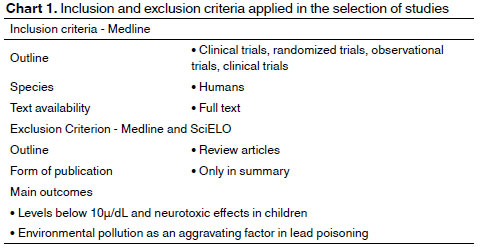
Clinical, randomized, observational and clinical studies in humans were selected, according to the criteria presented in Chart 1.
RESULTS
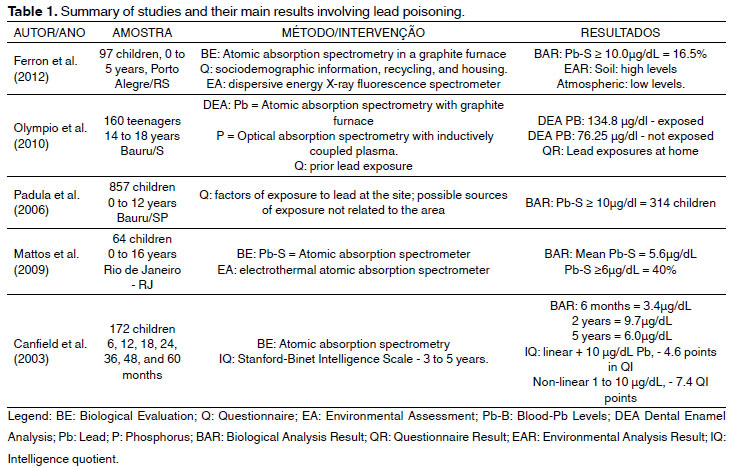
Initially, 62 studies were identified in SciElo and 12602 in MedLine involving the descriptor "lead poisoning". Using the MedLine filter, through the inclusion and exclusion criteria, 21 articles were selected. The same criteria were used in SciElo, by reading the abstracts, selecting 36 articles. The titles and abstracts of the 57 articles were read to select the works that were used in the review, excluding those that did not match the purpose of the review. Finally, 5 studies were selected. Below is the flowchart (Figure 1) that shows the selection of articles in stages and Table 1 showing the summary of the studies and their main results.
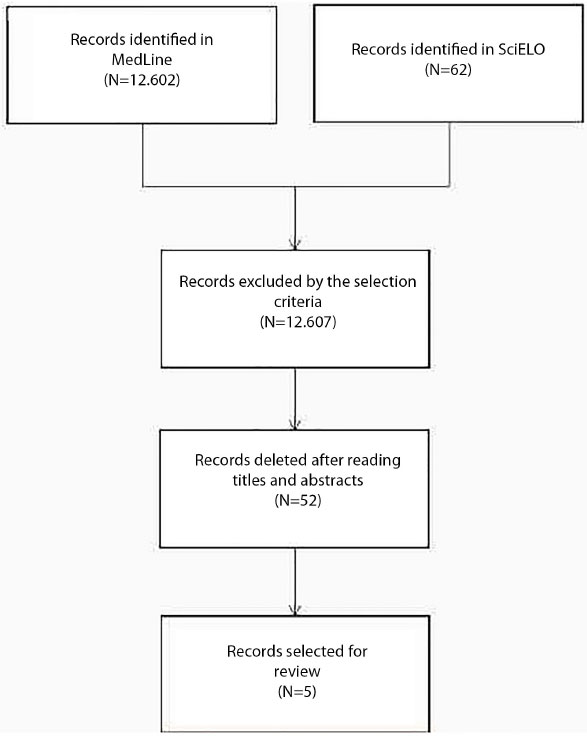
Figure 1. Flowchart of the selection of studies included in the review
DISCUSSION
In Brazil, there are few data on lead poisoning in the general population, both in occupational exposure and in the unexposed. Some studies indicate that in Brazil there are many sources of lead contamination that vary from the pollution of the work environment to domestic dust. A study performed by Roscoe et al., in 1999, in the United States, and another performed by Olympio et al., in 2010, in Bauru, SP, pointed out that living in or around lead-contaminated areas and having lived with people who work in battery, paint, or ceramic factories that use lead are risk factors for exposure to this metal in homes, as particles of this element can be carried to the home environment on the skin and clothing of workers, if it is not carried out the proper hygiene19.20.
There are laws that define the limits of lead allowed in water, food and that prohibit the use in gasoline and paints and the NR7 legislation that defines the limits for occupational exposure; however, there are no laws that determine the allowed limits for lead in the blood of the non-occupationally exposed population, nor studies that show the reality of the population's exposure in the country. It is worth noting that the NR7 itself is based on studies performed in North America, which does not represent the reality in Brazil, since factors such as ethnicity, nutrition, and even exposure level interfere with absorption and, consequently, lead poisoning5. Not only about the inadequate transposition of values, there are still concerns about the fact that these values are not updated even after studies have shown health hazards in concentrations below the established limits.19.21
The main concern with lead rates is the fact that many studies, as well as the CDC, have concluded that there is no safe level for lead poisoning in children - even values below 10 μg/dL, previously considered as a limit value, they are considered neurotoxic. Since 2012, the CDC considers this value only as a reference to identify exposure and initiate protocols to control poisoning and contamination7,22. Some studies mention the possibility of the occurrence of a "silent pandemic" of neurodevelopmental disorders arising from exposure to this metal in children when it is continuous, even at low concentrations23. Silent because it does not present symptoms in most cases and when symptoms do exist, it is generally confused with other diseases, and the possibility of poisoning by this heavy metal is not investigated (23).
Lead poisoning pathways are mainly respiratory and gastrointestinal, after the lead is absorbed into the bloodstream where it binds to erythrocytes and is transported to soft tissues, especially to the brain, kidneys, liver, heart among others7.24. Most of the lead, around 95% in adults and 70% in children, is deposited on bones and teeth, where they remain for years, having a half-life of approximately 30 years in this tissue7,24. This deposition in the bones and long half-life have serious consequences for the organism, since this lead can be released again into the bloodstream, gradually or even acutely in cases of fractures; which represents a greater risk for children and pregnant women who have active bone remodeling. In addition to the long half-life period, it is still a bioaccumulative element, that is, even if low doses do or do not cause health problems acutely, a period of prolonged exposure to these concentrations may contribute to future diseases and serious health problems for the individual.
Lead affects all organs and systems of the human body, it is responsible for causing hypochromic microcytic anemia with increased reticulocytes, interfering with heme synthesis and destroying erythrocytes2,6,7. It is absorptive and when in low doses can increase the risk of spontaneous abortions, premature births or underweight newborns. Lead poisoning also interferes with the transformation of vitamin D, decreasing its absorption; in kidney function, it causes tubular damage; in addition to directly or indirectly affect other organs. The main toxic effect of lead is on the nervous system because it ranges from behavioral changes, such as motor dysfunction, hyperactivity, and decreased IQ, peripheral neuropathies, which can even cause acute encephalopathies2,6,7,23.
The neurotoxic phenomena of lead are mainly due to its ability to replace calcium, which allows it to cross the blood-brain barrier and its interference in the release of neurotransmitters from presynaptic nerve endings, a fundamental role of calcium in the body2,25,26. In particular, in the developing nervous system, the continuous release of quantities below the neurotransmitter threshold in the synaptic cleft influences the maintenance of the efficiency of a synaptic connection and the survival of the postsynaptic cell25. Cognitive and neuropsychological development is also compromised due to anemia and low iron absorption that are consequences of lead poisoning, even at low concentrations2.26.
A study performed by Dr. Lanphear in 2000, concluded that concentrations below 10 μg/dL interfere with cognitive and academic skills22. Another study performed in 2003 by Dr. Canfield with children concluded that children's intellectual functioning is inversely associated with blood lead concentrations, even at levels below the limit defined by the CDC27.
Lead exposure occurs mainly in battery production industries, recycling plants, and mining areas, but this metal can be present in several other places, from the environment to homes, such as painting walls, old pipes, in some food and even colorful toys and magazines, as well as in the dust of houses that are close to sources of lead emission or that have a resident who works in these places and does not manage the proper hygiene of the body and clothes23,28,29. Children are more susceptible to environmental lead poisoning because the contact and ingestion of lead particles present in household dust, in the splinters of wall paints and in the toys and magazines becomes greater due to the relationship of the child habit of "hand-mouth" and "mouth-object". In addition to this factor, the level of absorption by the children's organism is higher and the immaturity of the organism itself, which is in formation and has blood-brain barriers still under development2,28,30.
In Brazil there are studies in specific areas of environmental accidents involving metals, such as the cases of Adrianópolis, PR, and Santo Amaro,BA,31 and areas around industries that involve lead in their processes, as an example the research performed in Bauru,SP,30. In this study, data were collected on children living within a radius of up to 1000m in an accumulator industry, which produces automotive lead-acid batteries. Among the 857 children examined, 314 presented values greater than 10 μg/dL, a limit defined by the CDC, some of which were higher than 25 μg/dL. In both cases neuropediatric examinations were necessary and in some cases even hospitalization for treatment30.
Two studies, one performed in Rio de Janeiro, in the Parque João Goulard community, and the other performed in Vila Dique, in Porto Alegre, RS, investigated and identified a high prevalence of lead contamination in children, and in both cases the areas surveyed had no previous reports of contamination by environmental lead, but were located close to industrial facilities and informal garbage dumps28,32. The study performed by Mattos, included 64 children, resulting in 5% of these with more than 10 μg/dL of lead and 40% with values between 6 μg/dL to 10 μg/dL32, while the study by Ferrom, performed with 97 children, found 16.5% of children with a lead level above 10 μg/dL28. These studies show that lead poisoning goes well beyond occupational exposure and needs to be monitored even in environments where there is no detection of a specific source of lead emission, especially in children, as some studies point to the existence of damage even at the lowest doses28,32.
Another aggravating factor with lead poisoning is the lack of knowledge and information by the population about the risks to which they are exposed. A 2010 study performed in Bauru, SP, pointed to the lack of information from the population on the forms of contamination, prevention, symptoms, and care in relation to lead, although many have already heard about lead being a toxic metal23. Given the above, it is observed that the danger represented by lead is greater than society understands. There are risks of environmental exposures unknown to most of the Brazilian population, and that the dangers to health have an alarming proportion.
All the abovementioned makes it essential that revisions of the NR7 are performed and the establishment of parameters for the Brazilian population in general, especially children and pregnant women, in addition to studies that show the true levels of exposure and contamination in the country, which in recent years has suffered from very serious environmental disasters as in the cases of Mariana and Brumadinho, oil spills in the oceans, in addition to having many small battery recycling plants and facilities of secondary smelters, many without due safety criteria and some even clandestine that emit pollutants to their workers and to the neighboring population.
CONCLUSION
The evident scarcity of epidemiological data involving lead poisoning in Brazil makes it difficult to assess the country's real situation, since the few existing studies have demonstrated the existence of exposure and poisoning by this metal in the country. This review confirms the need for new studies that assess the main risk sites and that can be the basis for changes in regulatory standards that establish exposure limits, especially in the face of international studies that show that many diseases occur below these limits.
REFERENCES
1. Moreau RL de M, Siqueira MEPB de. Toxicologia Analítica. Rio de Janeiro: Guanabara Koogan; 2008. 318 p.
2. Andrade Filho A de, Campolina D, Dias MB. Toxicologia na prática clínica. Belo Horizonte,MG: Folium; 2013. 700p p.
3. Brasil M da S. Chumbo [Internet]. [citado 16 de outubro de 2019]. Disponível em: http://www.saude.gov.br/vigilancia-em-saude/vigilancia-ambiental/vigipeq/contaminantes-quimicos/chumbo
4. Kim J-J, Kim Y-S, Kumar V. Heavy metal toxicity: An update of chelating therapeutic strategies. J Trace Elem Med Biol Organ Soc Miner Trace Elem GMS. julho de 2019;54:226-31.
5. Cordeiro R, Lima-Filho EC de. A inadequação dos valores dos limites de tolerância biológica para a prevenção da intoxicação profissional pelo chumbo no Brasil. Cad Saúde Pública. junho de 1995;11(2):177-86.
6. Gidlow DA. Lead toxicity. Occup Med. 1o de julho de 2015;65(5):348-56.
7. Meyer PA, Brown MJ, Falk H. Global approach to reducing lead exposure and poisoning. Mutat Res. agosto de 2008;659(1-2):166-75.
8. Ministério da Saúde. Dados Epidemiológicos [Internet]. [citado 16 de outubro de 2019]. Disponível em: http://www.saude.gov.br/vigilancia-em-saude/vigilancia-ambiental/vigipeq/contaminantes-quimicos/chumbo/dados-epidemiologicos
9. Alvarenga K de F, Morata TC, Lopes AC, Feniman MR, Corteletti LCBJ, Alvarenga K de F, et al. Brainstem auditory evoked potentials in children with lead exposure. Braz J Otorhinolaryngol. fevereiro de 2015;81(1):37-43.
10. Ministério do Trabalho. NORMA REGULAMENTADORA 7 [Internet]. [citado 16 de outubro de 2019]. Disponível em: http://www.guiatrabalhista.com.br/legislacao/nr/nr7.htm
11. Paolielo MMB, Gutierrez PR, Turini CA, Matsuo T, Mezzaroba L, Barbosa DS, et al. Valores de referência para plumbemia em população urbana. Rev Saúde Pública. abril de 1997;31(2):144-8.
12. Bellinger DC. Very low lead exposures and children's neurodevelopment. Curr Opin Pediatr. abril de 2008;20(2):172-7.
13. Health NC for E. CDC - Lead - Blood Lead Levels in Children [Internet]. 2019 [citado 16 de outubro de 2019]. Disponível em: https://www.cdc.gov/nceh/lead/prevention/blood-lead-levels.htm
14. Sanborn MD, Abelsohn A, Campbell M, Weir E. Identifying and managing adverse environmental health effects: 3. Lead exposure. CMAJ Can Med Assoc J J Assoc Medicale Can. 14 de maio de 2002;166(10):1287-92.
15. Ministério da Saúde. RESOLUÇÃO - RDC No 42, DE 29 DE AGOSTO DE 2013 [Internet]. [citado 16 de outubro de 2019]. Disponível em: http://bvsms.saude.gov.br/bvs/saudelegis/anvisa/2013/rdc0042_29_08_2013.html
16. Ministério do Trabalho. NORMA REGULAMENTADORA 15 - NR 15 [Internet]. [citado 16 de outubro de 2019]. Disponível em: http://www.normaslegais.com.br/legislacao/trabalhista/nr/nr15.htm
17. Brasil. Lei 11.762 de 1o de Agosto de 2008 [Internet]. [citado 16 de outubro de 2019]. Disponível em: http://www.planalto.gov.br/ccivil_03/_Ato2007-2010/2008/Lei/L11762.htm
18. Brasil AN de P. PORTARIA ANP No 309, DE 27.12.2001 - DOU 28.12.2001 [Internet]. [citado 16 de outubro de 2019]. Disponível em: http://legislacao.anp.gov.br/?path=legislacao-anp/portarias-anp/tecnicas/2001/dezembro&item=panp-309--2001
19. Cordeiro R, Lima Filho EC, Salgado PET. Distúrbios neurológicos em trabalhadores com baixos níveis de chumbo no sangue. I: Neuropatia periférica. Rev Saúde Pública. junho de 1996;30(3):248-55.
20. Roscoe RJ, Gittleman JL, Deddens JA, Petersen MR, Halperin WE. Blood lead levels among children of lead-exposed workers: A meta-analysis. Am J Ind Med. 1999;36(4):475-81.
21. Cordeiro R, Lima Filho EC, Salgado PET, Santos CO, Constantino L, Malatesta MLLS. Distúrbios neurológicos em trabalhadores com baixos níveis de chumbo no sangue: II-Disfunções neurocomportamentais. Rev Saúde Pública. agosto de 1996;30(4):358-63.
22. Lanphear BP, Dietrich K, Auinger P, Cox C. Cognitive deficits associated with blood lead concentrations <10 microg/dL in US children and adolescents. Public Health Rep. 2000;115(6):521-9.
23. Melchiori LE, Kusumi P, Rodrigues OMPR, Valle TG do, Capellini VLMF, Neme CMB. Percepção de risco de pessoas envolvidas com intoxicação por chumbo. Paid Ribeirão Preto. abril de 2010;20(45):63-72.
24. Evans M, Elinder C-G. Chronic renal failure from lead: myth or evidence-based fact? Kidney Int. fevereiro de 2011;79(3):272-9.
25. Bressler JP, Goldstein GW. Mechanisms of lead neurotoxicity. Biochem Pharmacol. fevereiro de 1991;41(4):479-84.
26. Lidsky TI, Schneider JS. Lead neurotoxicity in children: basic mechanisms and clinical correlates. Brain J Neurol. janeiro de 2003;126(Pt 1):5-19.
27. Canfield RL, Henderson CR, Cory-Slechta DA, Cox C, Jusko TA, Lanphear BP. Intellectual Impairment in Children with Blood Lead Concentrations below 10 μg per Deciliter. N Engl J Med. 17 de abril de 2003;348(16):1517-26.
28. Ferron MM, Lima AK de, Saldiva PHN, Gouveia N. Environmental lead poisoning among children in Porto Alegre state, Southern Brazil. Rev Saúde Pública. abril de 2012;46(2):226-33.
29. Olympio KPK, Naozuka J, Oliveira PV, Cardoso MRA, Bechara EJH, Günther WMR. Association of dental enamel lead levels with risk factors for environmental exposure. Rev Saúde Pública. outubro de 2010;44(5):851-8.
30. Padula NA de MR, Abreu MH de, Miyazaki LCY, Tomita NE. Intoxicação por chumbo e saúde infantil: ações intersetoriais para o enfrentamento da questão. Cad Saúde Pública. janeiro de 2006;22(1):163-71.
31. Brasil M da S. Incidentes com Chumbo no Brasil [Internet]. [citado 16 de outubro de 2019]. Disponível em: http://www.saude.gov.br/vigilancia-em-saude/vigilancia-ambiental/vigipeq/contaminantes-quimicos/chumbo/incidentes-com-chumbo-no-brasil
32. Mattos R de CO da C, Carvalho MAR de, Mainenti HRD, Xavier Junior EC, Sarcinelli P de N, Carvalho LBV de, et al. Avaliação dos fatores de risco relacionados à exposição ao chumbo em crianças e adolescentes do Rio de Janeiro. Ciênc Amp Saúde Coletiva. dezembro de 2009;14(6):2039-48.