
INTRODUCTION
The standard lipid profile consists of the serum determination of total cholesterol, high density lipoproteins (HDL), low-density lipoproteins (LDL), non-high-density lipoproteins (non-HDL), very low-density lipoproteins (VLDL) and triglycerides1,2. These parameters are used in clinics to assess the risk of atherosclerotic coronary disease and dyslipidemia1, 3, 4.
For many years, the literature and the current technical norms established that the measurement of the lipid profile should be performed on blood samples collected during a 12-hour fast1, 5, 6. Recent studies show that the non-fasting dosage of the lipid profile portrays more effectively the potential cardiovascular risk, since the patient is in the fed state most of the day7, 8.
The Danish Society for Clinical Biochemistry (2009), the United Kingdom's National Institute of Clinical Excellence (2014), the European Society for Atherosclerosis and the European Federation of Clinical Chemistry and Laboratory Medicine (2016), recommend that fasting is not mandatory for the dosage of the lipid profile2,9,10,11. However, the American College of Cardiology/American Heart Association (ACC/AHA) released a guideline in 2013, showing a preference for using fasting samples for dosing the lipid profile12, 13.
In December 2016, the Brazilian Society of Clinical Pathology (SBPC), the Department of Atherosclerosis of the Brazilian Society of Cardiology (SBC/DA), the Brazilian Society of Clinical Analyzes (SBAC), the Brazilian Diabetes Society (SBD) and the Brazilian Society of Endocrinology and Metabology (SBEM) prepared the "Brazilian Consensus for the Standardization of the Laboratory Determination of the Lipid Profile", which addresses the flexibility of fasting to assess the lipid profile, whose main advantages and motivations aim at the collection practicality for the patient; safe collection, especially for diabetics on insulin therapy, pregnant women, children, and the elderly; a greater range of times for blood collection, which reduces congestion in the morning in laboratories7.
Due to controversies on the subject, the present study aims to critically assess, through a careful review of the scientific literature, whether there are significant differences in the dosage of the lipid profile in blood samples collected with and without fasting.
METHODS
The present study is a systematic review whose research was performed in the Medline database. Studies originally published in the English language and indexed in the last 5 years were analyzed. The search strategy used the combination of the descriptors Fasting, Fasting Time, Lipoproteins. To identify the designs of the studies, the terms randomized controlled trial, observational study, and clinical trial were used.
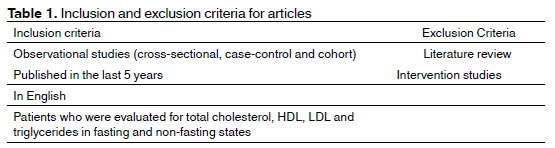
The inclusion and exclusion criteria were applied freely and independently by a reviewer, who judged the selected studies from the points raised in each exposed item (Figure 1).
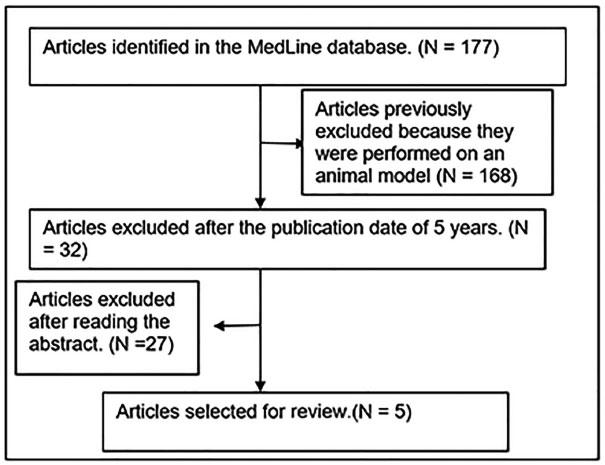
Figure 1. Flowchart of the study selection process
RESULTS
34 studies involving fasting times and lipoproteins were identified, however only 5 were part of the scope of this review.
Figure 1 shows the flowchart used to select the articles analyzed.
The studies used were analyzed for the values of total cholesterol, HDL, LDL and triglycerides dosed in fasting and non-fasting states and the values found by the authors were organized in Table 2.
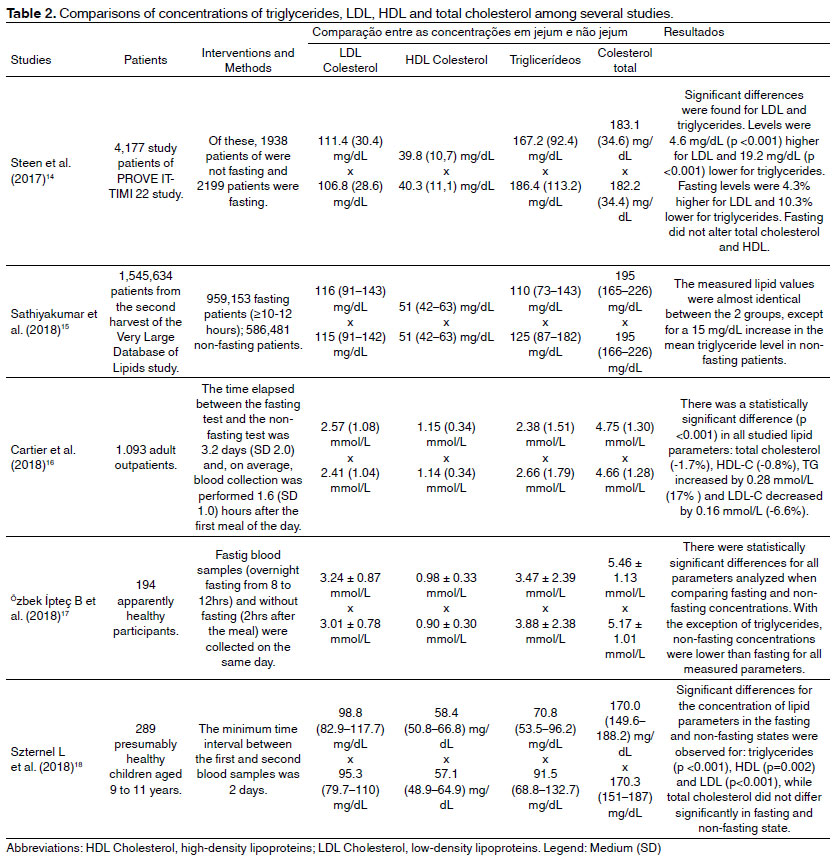
In the studies analyzed, HDL and total cholesterol remained constant or had very small variations, LDL showed a decrease in concentration and triglycerides showed an increase in concentration between the fasting state and the non-fasting state.
DISCUSSION
The results confirm the premise, presented by world guidelines, that the measurement of the lipid profile without fasting can be used for evaluation and clinical decision-making, since there are no significant differences in the measurements of fasting and non-fasting parameters14, 15, 16, 7.
The studies analyzed found very similar variations between the fasting and non-fasting states for the tests that constitute the lipid profile. The parameters of HDL and total cholesterol remained constant or had very small variations between the two fasting states2,14,16,17,18. In contrast, LDL and triglycerides showed, respectively, a decrease and an increase in fasting and non-fasting state concentration14,17, 16, 17, 18.
Most studies used adult and apparently healthy patients16, 17, 18. However, the same variations were observed in patients hospitalized after acute coronary syndrome (ACS), a fact evidenced by Steen et al.,(2017) who researched the impact of fasting on the evaluation of patients after hospitalization for ACS. This study proved that although fasting affects the measurements of lipid parameters, the variation is small and clinically insignificant, both after ACS and during the follow-up of these patients14. The same was observed in diabetic patients, for whom the lipid parameters showed the same pattern of change after ingestion. Although diabetic patients have higher levels of triglycerides and LDL than healthy patients, the variation found between fasting and non-fasting states was very similar in both groups16. These data support the recent guidelines and consensus that standardize the flexibility of the lipid profile even in patients with ACS and in diabetic patients7.
One of the motivations for making the fasting more flexible in order to determine the lipid profile is to increase children's adherence to this test, since applying the fasting requirement in children is more difficult than in adults, due to the majority not being in fasting before a routine visit to the doctor, being necessary to schedule the exam for another day7, 19. The study performed by Szternel L et al., (2018), showed that there were no significant differences between the concentrations of most lipid parameters in children, in both fasting states, except for triglycerides and LDL. Even for these parameters, the changes were clinically insignificant and would not impact clinical decision-making7. Some similar studies emphasize the importance of determining more accurate reference values for children in order to reduce false-positive and negative results in children7, 19.
The 2016 Brazilian Consensus for the Standardization of Laboratory Determination of the Lipid Profile stipulates that LDL can be dosed directly or calculated using Friedewald or Martin formulas. However, limitations on the use of Friedewald's formula, such as fasting dosages and triglycerides below 400mg/dL, must be taken into account. For dosages performed without fasting, direct LDL dosing or estimation using the Martin formula is recommended7, 20. Most studies analyzed showed only one LDL result per patient that was directly dosed or estimated using the Friedewald formula, except for Sathiyakumar et al., (2018), who made a comparison between the LDL dosed directly and the estimated by the Friedewald and Martin formulas. The authors proved that the LDL estimate by the Friedewald formula in samples without fasting leads to greater errors in the LDL estimate and in the patient's classification regarding cardiovascular risk compared to fasting samples, and they conclude that the LDL estimation by the new method, the Martin's formula, leads to greater precision in the result both in fasting and non-fasting samples15.
Most of the studies analyzed had the limitation of being performed in a cross-sectional way, that is, they used dosage data from different patients to compare the dosages of the lipid profile in fasting and non-fasting samples. When using the average dosage of the analyzed parameters, variations that occur in the population as a whole are observed, and it is not possible to evidence specific changes that may occur in more specific clinical situations. It is possible to emphasize the need for further studies to more accurately determine a new reference value for the non-fasting state.
CONCLUSION
This review confirms the premise presented by recent worldwide guidelines and consensus on the non-mandatory fasting for the realization of the lipid profile, considering that no significant differences were found between the dosages performed with and without fasting, and even for the parameters that presented some divergence, this does not imply relevant clinical changes, requiring only a small adjustment in the reference values for the non-fasting state. Therefore, dosages without prior fasting can be used by doctors for clinical decision-making.
REFERÊNCIAS
1. Xavier HT., Izar MC., Faria Neto JR., Assad MH., Rocha VZ., Sposito AC. et al . V Diretriz Brasileira de Dislipidemias e Prevenção da Aterosclerose. Arq. Bras. Cardiol. 2013; 101(4 Suppl 1): 1-20.
2. Nordestgaard BG, Langsted A, Mora S, Kolovou G, Baum H, Bruckert E, et al. Fasting is not routinely required for determination of a lipid profile: clinical and laboratory implications including flagging at desirable concentration cut-points—a joint consensus statement from the European Atherosclerosis Society and European Federation of Clinical Chemistry and Laboratory Medicine. European heart journal 2016; 37(25): 1944-1958.
3. Moura EC, Castro CM, Mellin AS, Figueiredo DB. Perfil lipídico em escolares de Campinas, SP, Brasil. Rev. Saúde Pública. 2000; 34(5): 499-505.
4. National Cholesterol Education Program. Expert Panel on Detection, Evaluation, and Treatment of High Blood Cholesterol in Adults. Adult Treatment Panel II. Second report of the Expert Panel on Detection, Evaluation, and Treatment of High Blood Cholesterol in Adults. Bethesda, MD: The National Heart, Lung, and Blood Institute of the National Institutes of Health, 1993:3093-5.
5. Rifai N, Warnick GR. Lipids, lipoproteins, apolipoproteins, and other cardiovascular risk factors. In: Burtis CA, Ashwood ER, Bruns DE, (eds), Tietz Textbook of Clinical Chemistry and Molecular Diagnostics, 4th ed. Philadelphia: Elsevier Saunders; 2006, p903-982.
6. Simundic AM, Cornes M, Grankvist K, Lippi G, Nybo M. Standardization of collection requirements for fasting samples: for the Working Group on Preanalytical Phase (WG-PA) of the European Federation of Clinical Chemistry and Laboratory Medicine (EFLM). Clin Chim Acta 2014; 432: 33-37.
7. Sociedade Brasileira de Análises Clinícas. Consenso Brasileiro para a Normatização da Determinação Laboratorial do Perfil Lipídico [Internet]. 10 dez. 2016 [acesso em: 15 jun. 2019]. Disponível em: http://www.sbpc.org.br/upload/conteudo/consenso_jejum_dez2016_final.pdf
8. Scartezini M, Ferreira CES, Izar MCO, Bertoluci M, Vencio S, Campana GA, et al. Posicionamento sobre a flexibilização do jejum para o perfil lipídico. Arq Bras Cardiol, 2017; 108(3), 195-197.
9. Nordestgaard BG, Hilsted L, Stender S. Plasmalipider hos ikkefastende patienter og signalværdier pålaboratoriesvar. Ugeskr Laeger 2009; 171: 1093.
10. Langsted A, Nordestgaard BG. Nonfasting lipids, lipoproteins, and apolipoproteins in individuals with andwithout diabetes: 58 434 individuals from the Copenhagen General Population Study. Clin Chem 2011; 57: 482-489.
11. Rabar S, Harker M, O'Flynn N, Wierzbicki AS. (2014). Lipid modification and cardiovascular risk assessment for the primary and secondary prevention of cardiovascular disease: summary of updated NICE guidance. Bmj 2014; 349, g4356.
12. Stone NJ, Robinson JG, Lichtenstein AH, Merz CNB, Blum CB, Eckel RH, et al. 2013 ACC/AHA guideline on the treatment of blood cholesterol to reduce atherosclerotic cardiovascular risk in adults: a report of the American College of Cardiology/American Heart Association Task Force on Practice Guidelines. Journal of the American College of Cardiology 2014; 63(25 Part B), 2889-2934.
13. Mora, S. Nonfasting for routine lipid testing: from evidence to action. JAMA internal medicine 2016; 176(7), 1005-1006.
14. Steen D L, Umez-Eronini AA, Guo J, Khan N, Cannon CP. The effect of fasting status on lipids, lipoproteins, and inflammatory biomarkers assessed after hospitalization for an acute coronary syndrome: Insights from PROVE IT-TIMI 22. Clinical cardiology 2018; 41(1), 68-73.
15. Sathiyakumar V, Park J, Golozar A, Lazo M, Quispe R, Guallar E, et al. Fasting versus nonfasting and low-density lipoprotein cholesterol accuracy. Circulation 2018; 137(1), 10-19.
16. Cartier LJ, Collins C, Lagacé M, Douville, P. Comparison of fasting and non-fasting lipid profiles in a large cohort of patients presenting at a community hospital. Clinical biochemistry 2018; 52, 61-66.
17. İpteç BÖ, Balik AR, Yüksel S, Yilmaz FM, Yilmaz G. Hemodilution is not the only reason of difference: Comparison of fasting and non-fasting lipoproteins in paired samples. Clinical biochemistry 2018; 61, 28-33.
18. Szternel L, Krintus M, Bergmann K, Derezinski T, Sypniewska G. Non-fasting lipid profile determination in presumably healthy children: Impact on the assessment of lipid abnormalities. PloS one 2018; 13(6), 1-14.
19. Kubo T, Takahashi K, Furujo M, Hyodo Y, Tsuchiya H, Hattori M, et al. Usefulness of non-fasting lipid parameters in children. Journal of Pediatric Endocrinology and Metabolism 2017; 30(1), 77-83.
20. Martin SS, Blaha MJ, Elshazly MB, Toth PP, Kwiterovich PO, Blumenthal RS, et al. Comparison of a novel method vs the Friedewald equation for estimating low-density lipoprotein cholesterol levels from the standard lipid profile. Jama 2013; 310(19), 2061-2068.