
INTRODUCTION
Tuberculosis (TB) is a common and deadly infectious disease despite the existence of an effective treatment. Today it represents a major public health problem on a global scale1.
In 2017, approximately 10 million people developed TB worldwide, of which about 1.6 million deaths were caused by such disease.2 Tuberculous meningitis (TBM) is the most serious form of TB. More than half of patients treated with TBM die or suffer severe neurological sequelae, largely due to late diagnosis. TBM represents approximately 1% of all TB cases and approximately 5% of extrapulmonary TB cases.3 In many parts of the world, tuberculosis is the most common cause of bacterial meningitis4.
The absolute incidence of TBM varies greatly according to location, and it is influenced by the overall incidence of tuberculosis, age structure and HIV-1 seroprevalence within a population.5 For patients co-infected with HIV, TBM mortality is about 60%6,7.
In adults, the best-documented risk factor for TBM is HIV-1 co-infection. Among HIV-infected individuals living in areas where tuberculosis is highly endemic, the proportion of HIV-1-associated meningitis attributable to Mycobacterium tuberculosis can exceed 50%7,8.
In developing countries, the diagnosis of pulmonary tuberculosis depends mainly on the isolation of acid-fast bacilli (AFB) in the direct examination of sputum. The diagnosis of extrapulmonary tuberculosis is less easy depending on the difficulty of obtaining material by invasive gesture (bone biopsy, cerebrospinal fluid, liver biopsy, etc.) and sometimes difficult bacteriological documentation (less bacterial inoculum)9.
The diagnosis of these forms is often difficult and late, especially when resources are limited, which causes high mortality10.
Late diagnosis and treatment are associated with a poor prognosis in TBM. Thus, new tests that can be used at the point of care are extremely important, especially for drug-resistant TBM, which has a dismal result5.
The use of an absolute gold standard for microbiological confirmation is likely to lead to overestimations of diagnostic sensitivity, and the additional use of compound gold standards and latent class analyzes, as well as rational decision trees combining diagnostic information with data from clinical results, should also be part of the evaluation reaching a faster and more accurate diagnosis5.
The aim of this study was to determine, by means of a systematic review, diagnostic methods for tuberculous meningitis, demonstrating beyond the gold standard what should be observed in the exams and in the patient's clinic.
METHODS
The most relevant studies originally published in the English language over the past 5 years were analyzed, using the Medline database as a reference, aiming at studies with greater clinical relevance, where original articles were chosen.
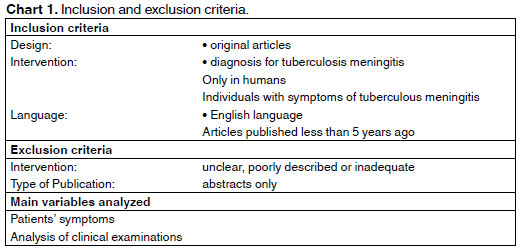
The present study used the following keywords to formulate the search phrase: ("Meningeal Tuberculosis" OR "Meningeal Tuberculosis" OR "TB Meningitis" OR "TB Meningitides" OR "Tubercular Meningitis" OR "Tubercular Meningitides" OR "Meningitis, Tuberculous" OR "Tuberculous Meningitides" OR "Tuberculous Meningitis" OR "Tuberculosis Meningitides" OR "Tuberculosis Meningitides" OR "Tuberculous Hypertrophic Pachymeningitides") AND ("Diagnoses" OR "Diagnoses and Examinations" OR "Postmortem Diagnosis" OR "Postmortem Diagnoses" OR "Antemortem Diagnosis" OR "Antemortem Diagnoses") AND ("Viral Meningitides" OR "Viral Meningitis"). The inclusion and exclusion criteria were applied based on the types of studies, language, the disease surveyed, along with its diagnosis and publication date from the points raised in each exposed item (Chart 1). For the selection of studies, the inclusion and exclusion criteria presented in Table 1 were applied.
RESULTS
4041 studies involving tuberculous meningitis and the diagnosis related to it were identified. However, from the application of the previously defined criteria, only 326 were part of the scope of this review. Of these, only 5 were eligible to be part of the scope of this study. Figure 1 shows the flowchart used to select the articles that were analyzed.
The articles that met the criteria have shown studies performed in various regions of the world, demonstrating pertinent points of the diagnosis of tuberculous meningitis concerning other meningitis or its severity, which from then on can lead to its lethality.
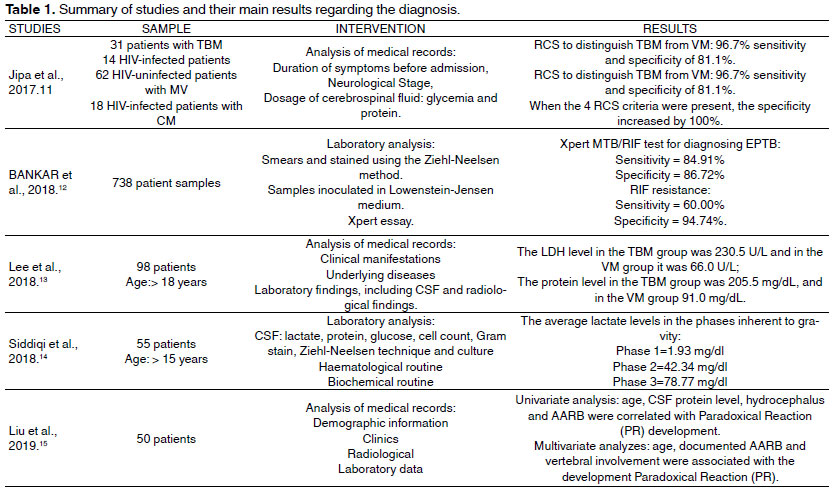
Table 1 shows the studies showing the studied samples, followed by the analyzes performed on medical records for the patient's clinic and laboratory analysis.
DISCUSSION
From the analysis performed through medical records and laboratory analysis, the articles demonstrated that it is possible to make a faster preliminary diagnosis with overestimation of sensitivity and greater reliability, thus being able to avoid late diagnosis and treatment that are associated with a poor prognosis11 12,13,14,15.
In the article by Siddiqi et al. (2018)14, the author reports that the main diagnostic component that showed increased values according to the disease severity stage is the lactate dosed from the cerebrospinal fluid.
In another study13, the main factors that should be used for decision tree analysis were assembled in cases where quick decisions should be made where the result of the isolation of the bacteria cannot be expected. Among them are listed some determining points, such as sodium in the serum (hyponatremia), lactate and protein in the cerebrospinal fluid (CSF), difficulty in urination, and symptoms of cranial nerve paralysis.
Regarding factors that worsen the condition or paradoxical reaction, which is the return of the initial symptoms after the beginning of treatment, the study by Liu et al. (2019)15 presents the main parameters that can be predictive of this worsening, namely age, visualization of the bacteria by the documented method Alcohol-Acid Resistant Bacilli (AARB) staining, the cerebrospinal fluid protein level and vertebral involvement.
Jipa et al. (2017)11 demonstrates in their study the use of rapid clinical score (RCS) as a parameter to separate tuberculous meningitis from other meningitis such as viral meningitis where the duration of symptoms before admission (DSBA), neurological stage according to the Medical Research Council (MRC), the ratio between CSF and blood glucose and CSF protein to assess the likelihood of TBM in patients with CSF clear meningitis.
In the article by Bankar et al. (2018)12, they analyze the use of the diagnosis made through the Xpert Mycobacterium tuberculosis/rifampicin (MTB/RIF) assay, where a sensitivity of 84.91% and specificity of 86.72% can be verified. If the cases are positive for culture, the sensitivity reaches 94.12% and 80.56% in cases with negative sputum smear microscopy.
New metabolites are being studied to be used as TBM markers where in the future they can be used in order to increase the reliability of the initial diagnosis. Li et al. (1017)16 studied a total of 25 metabolites significantly different in CSF from TBM compared to VM.
Méchaï et al. (2019)4 states that GeneXpert represents the most significant advance in TBM diagnoses in the last decade, but it lacks sensitivity and it cannot be used to rule out the diagnosis. A greater volume of CSF appears to be of interest in improving diagnostic performance.
Most of the studies presented prove that the lactate dosage in CSF is one of the main parameters to be analyzed, in addition, the symptoms of cranial nerve involvement are well documented.
The studies have some limitations whose interpretations and comparisons may be impaired, such as: 1) the articles present different aspects of the diagnosis of TBM; 2) use of different methods in the evaluation of the investigated factors, such as the use of medical records or the direct intervention in the patient.
CONCLUSION
In conclusion, TBM remains the most lethal form of TB. The best way to improve survival is through early diagnosis and treatment, which becomes necessary to highlight the main initial signs and symptoms, with great emphasis on the neurological stage, together with a quick and clear diagnosis. In addition to the already established gold standard for the isolation of M. Tuberculosis, it is necessary to use indicators such as the measurement of lactate, glycemia, and proteins in the CSF, together with new techniques that are being studied, such as the Xpert MTB/RIF assay, which should be used for both diagnosis, as well as to know the stage of the disease.
REFERENCES
1. Tékpa G, Fikouma V, Téngothi RMM, Longo JD, Woyengba APA, Koffi B. Aspects épidémiologiques et cliniques de la tuberculose en milieu hospitalier à Bangui. The Pan African Medical Journal. 2019;33:31.
2. WHO. Global tuberculosis report 2018 [Internet]. WHO. [cite' 29 mars 2019]. Disponible sur: http://www.who.int/tb/ publications/global_report/en/.
3. Thwaites GE, van Toorn R, Schoeman J. Tuberculous meningitis: more questions, still too few answers. Lancet Neurol 2013;12(10):999-1010.
4. Me'chaï F, Bouchaud F. Tuberculous meningitis: Challenges in diagnosis and management. Revue neurologique (2019), https://doi.org/10.1016/j.neurol.2019.07.007
5. Robert J. Wilkinson, Ursula Rohlwink, Usha Kant Misra, Reinout van Crevel, Nguyen Thi Hoang Mai, Kelly E. Dooley, Maxine Caws, Anthony Figaji, Rada Savic, Regan Solomons and Guy E. Thwaites 2017
6. Cecchini D, Ambrosioni J, Brezzo C, Corti M, Rybko A, Perez M, et al. Tuberculous meningitis in HIV-infected and noninfected patients: comparison of cerebrospinal fluid findings. Int J Tuberc Lung Dis Off J Int Union Tuberc Lung Dis 2009;13(2):269-71.
7. Thwaites GE, Duc Bang N, Huy Dung N, Thi Quy H, Thi Tuong Oanh D, Thi Cam Thoa N, et al. The influence of HIV infection on clinical presentation, response to treatment, and outcome in adults with Tuberculous meningitis. J Infect Dis 2005;192(12):2134-41.
8. Marais S, Pepper DJ, Schutz, C, Wilkinson RJ, Meintjes G. Presentation and outcome of tuberculous meningitis in a high HIV prevalence setting. PLoS ONE 6, e20077 (2011).
9. Guillet-Caruba C, Martinez V, Doucet-Populaire F. Les nouveaux outils de diagnostic microbiologique de la tuberculose maladie. La Revue de médecine interne. 2014;35:794-800.
10. Hoog Van't Ah, Williamson J, Sewe M, Mboya P, Odeny Lo, Agaya Ja, Amolloh M, Borgdorff MW, Laserson KF. Facteurs de risque de décès et d'excès de mortalité chez les adultes atteints de tuberculose à l'Ouest du Kenya. Int J Tuberc Lung Dis. 2012 Dec;16(12):1649-56.
11. Jipa R, Olaru ID, Manea E, Merisor S, Hristea A. Rapid clinical score for the diagnosis of tuberculous meningitis: A retrospective cohort study. Ann Indian Acad Neurol. 2017;20(4):363-366.
12. Bankar S, Set R, Sharma D, Shah D, Shastri J. Diagnostic accuracy of Xpert MTB/RIF assay in extrapulmonary tuberculosis. Indian J Med Microbiol 2018; 36: 357-63.
13. Lee S, Kim S, Chang H, Jung H, Kim Y, Hwang S, Kim S, Park H, Lee J. A New Scoring System for the Differential Diagnosis between Tuberculous Meningitis and Viral Meningitis. J Korean Med Sci. 2018 Jul 31;33(31):e201
14. Siddiqi Z, Siddiqi MS, Fatma J, Karoli R, Singhal V, Gupta M. Cerebrospinal Fluid Lactate in Tubercular Meningitis: Diagnostic or Prognostic Marker? J Assoc Physicians India. 2018; 66(5):18-21.
15. Liu Y, Wang Z, Yao G., Luc Y, Hu Z, Yao H., Zhang Q, Zhu H, Song Z, Wang W, Liu D. Paradoxical reaction in HIV-negative tuberculous meningitis patients with spinal inv.vement. International Journal of Infectious Diseases 79 (2019) 104-108.
16. Li Z, Du B, Li J, Zhang J, Zheng X, Jia H, Xing A, Sun Q, Liu F, Zhang Z. Cerebrospinal fluid metabolomic profiling in tuberculous and viral meningitis: Screening potential markers for differential diagnosis. 2017; 466: 38-45.