
INTRODUCTION
Syphilis or Lues is a sexually transmitted infection (STI) whose etiologic agent is the bacterium Treponema pallidum. Transmission occurs through unprotected sexual intercourse (vaginal, anal, and oral), which may also occur during pregnancy or at the time of delivery4. In this study, two types will be analyzed: Acquired Syphilis (AS) transmitted through an infected partner, whether symptomatic or not, using a treponemal and non-treponemal test reactive to any titration and without prior registration, and Congenital Syphilis (CS) transmitted during pregnancy or at delivery, with any titration on treponemal tests or not both of the mother and the newborn, generating a great impact on the public health of the country due to the large number of live births who contracted the disease3.
This STI has several phases that will depend on the degree of infectivity and/or time of exposure in the body: latent (the asymptomatic phase that is divided into: recent with less than two years of infection and late with more than two years of infection), primary ( presenting a deep, painless and scabless wound, lesions - hard chancre that appear after 10 days of infection), secondary (the individual has a fever, water, and skin rashes often confused with allergic reactions and viruses) and tertiary (more severe complications, reaching bones, heart, eyes, blood vessels and neurological impairment and symptoms may appear 2 to 40 years after infection)18,22,23.
In 2010, syphilis became part of the National Compulsory Notification List of diseases, conditions, and public health events due to the increase in cases of acquired, congenital, and pregnant syphilis where the main causes are: the reduction in condom use, worldwide shortage of penicillin, resistance of professionals to perform medication in Primary Care units. Congenital syphilis has been part of compulsory notifications and syphilis in pregnant women since 1986 and 2005, respectively. The Notifiable Diseases Information System (SINAN) is responsible for the STI data source, although underreporting is still frequent4,5.
The estimate of the World Health Organization (WHO) is that there are more than 12 million cases of syphilis in the country and the lack of information about the disease is still one of the main problems, especially with regard to the severity of its evolution, if treatment is not started quickly, irreversible brain complications, impairment of the cardiovascular system and also of organs such as skin, eyes, and bones may occur. The diagnosis is made through non-treponemal tests (VDRL/Venereal Disease Research Laboratory) and treponemal tests (FTA-ABS [Fluorescent treponemal antibody absorption, rapid tests, among others) available in the Unified Health System (SUS). Another lack of information is related to the treatment performed using benzathine penicillin available in the public health network1,5.
Syphilis cases have been increasing more and more across the country, with the Southeast region being the area with the highest incidence of all types of the disease and Minas Gerais presenting the lowest incidence of cases in the region. It is considered that in the period between 2001 and 2016 the increase in syphilis in pregnant women and in children under one-year-old was quite expressive, as demonstrated by the Epidemiological Bulletin of the Ministry of Health (MS), which aims to update, disseminate, monitor, and inform about the course of the disease1,3.4. The municipality of Juiz de Fora, MG, presents data greater than the national average with regard to acquired syphilis3.
For the Unified Health System (Sistema Único de Saúde) users to have access to the examination, diagnosis and treatment, it is necessary to look for the nearest Testing and Counseling Center/Specialized Care Service (CTA/SAE), remembering that it is also extremely important to perform the test of the sexual partner14,16. Based on the abovementioned, the aim of the present study was to verify the prevalence of syphilis cases in the city of Juiz de Fora, Minas Gerais state, and to establish a comparison between the state of Minas Gerais and Brazilian data.
METHODS
This is a descriptive epidemiological study, whose data were obtained by consulting the following SINAN databases (Notifiable Diseases Information System), Epidemiological Bulletin of Minas Gerais (BEM), Epidemiological Bulletin of Juiz de Fora/Minas Gerais and scientific articles related to the theme through the search engine Scielo, accessed between July and October 2019. Data from cases of acquired and congenital syphilis recorded from 2012 to 2017 in Brazil in general and in the municipality of Juiz de Fora, Minas Gerais state, were analyzed.
RESULTS
The data from the present study showed the incidence and significant increase in cases of AS and CS through data obtained by the Epidemiological Bulletin of the municipality of Juiz de Fora, Minas Gerais state, compared to the cases reported in the country.
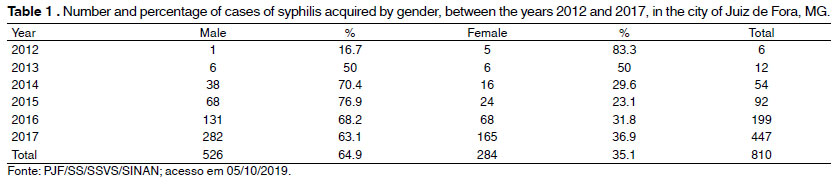
Table 1 shows that in the municipality of Juiz de Fora, Minas Gerais state, among the 810 cases of acquired syphilis reported, more than 50% occurred in male individuals in 2017. The latest data released by the Ministry of Health for the year 2016 showed an acquired syphilis detection rate of 42.5 cases per 100 thousand inhabitants for Brazil and 35 cases per 100 thousand inhabitants for Minas Gerais (BRASIL, 2017).
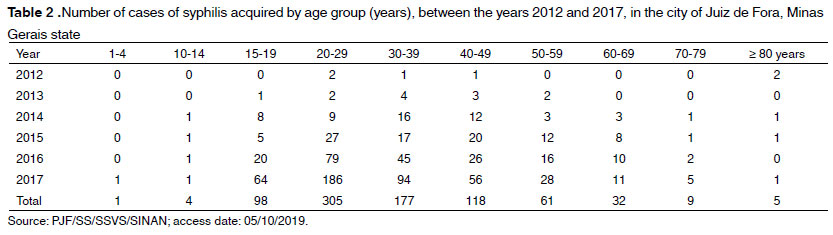
The majority of notified cases of AS are found in men aged between 20 and 29 years, but an incidence up to 49 years is also observed as shown in the table below, and it is relevant to remember that these numbers may be high due to the increase in notifications and not necessarily a real increase in cases3.
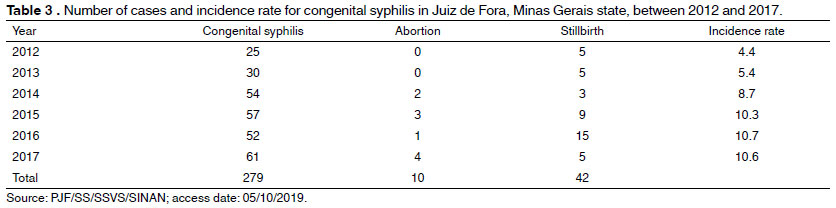
According to data presented by the Epidemiological Bulletin of Juiz de Fora, Minas Gerais state, 331 cases of CS were reported in the municipality between 2012 and 2017, a progressive increase and higher than the incidence rate observed in Brazil in 2016, the infant mortality resulting from CS specific to this condition was 15.4 deaths for 100 thousand live births (BRASIL, 2017).
DISCUSSION
Syphilis has become a worldwide epidemic causing a major public health problem. Among the types of this STI, the most alarming data are found in notifications from AS and CS, as will be described below.
According to the Ministry of Health (MS), AS is defined based on two criteria: 1) by asymptomatic individuals who present a non-treponemal test reactive to any titration and a reactive treponemal test without previous treatment record; 2) by symptomatic individuals with at least one test reactive to any titration, treponemal or not2. It is characterized by contagious lesions such as hard chancre and secondary lesions, responsible for 95% of syphilis cases7. It is an STI of compulsory notification since 2010 through the Notifiable Diseases Information System (SINAN) presenting 40% of the mortality rate6.
The Ministry of Health (MS) demonstrates, through data from the Epidemiological Bulletin of Syphilis (2017), that the Southeast region represents 59.2% of the reported cases, and the municipality of Juiz de Fora, MG, presents higher data than the national average according to gender: 1.5 cases in men to 1 case in women, deserving extra attention with regard to preventive and enlightening campaigns and actions to the community and region1,3,5.
CS results from the transmission of Treponema Pallidum via the transplacental route from the infected mother or who was not treated correctly, occurring at any time during pregnancy or at the time of delivery, which results in high rates of fetal and neonatal morbidity and mortality8,11. The highest proportion of CS occurs in the Southeast region, when deaths in children under 1 year of age are observed, with a rate of 18.1 deaths per 1,000 live births in the state of Rio de Janeiro, with 23.2% of the total in the country1. It has been included in compulsory notification of diseases since 1986 by SINAN6.
The criteria for defining CS according to the MS are, as follows: every newborn, stillborn, or abortion of a woman with syphilis that is not treated or treated inadequately; all children under 13 years of age who present clinical manifestations and radiological or CSF changes and non-treponemal reagent test; non-treponemal or ascending titles greater than that of the mother; treponemal tests still reactive after 6 months of age and microbiological evidence of Treponema pallidum infection found in nasal discharge or skin lesions1. The incidence rate of CS in the city of Juiz de Fora, MG, was higher than the rate observed in Brazil in 20161,3.
WHO has defined the elimination of CS as a priority. In the capital of Minas Gerais, Belo Horizonte, there was an improvement observed in access to prenatal care, in the expansion of basic health teams, in the agility of the results of rapid tests, but even with these efforts, the rates were still high and the purpose established was not was successful35.
According to MS, in Brazil, there are about 50 thousand parturients diagnosed with syphilis a year and the result is that 12 thousand live births have congenital syphilis in the country, an alarming rate that calls attention to basic health care. In epidemiological terms, it should be emphasized that CS is an indicator of the quality of prenatal care for a population, since the numbers are increasing and worrying, the quality of this care needs to be reviewed19,28,32.
The great challenge today in public health is to enable health workers to promote positive results to the cure, promotion, and protection plan through the identification of the pregnant woman and her access to prenatal care services with regular consultations and examinations, identification and treatment of diseases in order to reduce the prevalence of CS. In addition, it is necessary to provide guidance on prevention through the use of condoms, the reduction of sexual partners, the treatment of partners and the reduction of drug users12,13.
Testing and Counseling Centers (CTAs) are currently defined as health services responsible for performing STD diagnosis and prevention actions, as well as investigating and describing the profile of users, guiding them to specific prevention measures. It is very important for the population to have the knowledge that the service is entirely confidential, offering monitoring by a health team for guidance, regardless of positive or negative result14,15,16.
The tests performed for the diagnosis of syphilis are divided into: Treponemal: (Rapid tests, FTA-ABS, among others). FTA-ABS often shows false positive results where about 1% of the population presents reactive without having the infection and is the first to become reactive. These reactions show an atypical fluorescence pattern, occurring, for example, in patients with Lyme Disease, after vaccinations with live viruses, some types of infections, post-transfusions of blood products, medications, elderly and pregnant women, chronic hepatitis, in patients with systemic lupus erythematosus, leprosy, malaria, illicit drug users, antiphospholipid syndrome. In these cases, the VDRL is generally unreactive. Non-treponemal: the VDRL is the most widely used diagnostic test due to its sensitivity and specificity and may remain reagent with a drop in titrations even after healing, which is called serological scar20. The serological scar occurs when the individual treated correctly presents reagent treponemal and non-treponemal tests with low titration and can only be considered so if there is proof that the user had syphilis and has adequate treatment, in other situations a possible reaction can be considered falsely positive20,32,33,34.
The medication of choice for treatment is benzathine penicillin G in therapeutic regimens appropriate to each stage of the infection; in pregnant women, the appropriate treatment is one that is completed at least 30 days before delivery, where the partner was also treated with the same therapeutic scheme. The non-treatment of the partner has high rates of reinfection and vertical transmission of the disease34.
As syphilis can show late symptoms (up to 40 years after infection), neurological complications are often confused with dementia in the elderly. The criteria for the investigation the process include: complete history (reported by a family member or caregiver), clinical evaluation, cognitive, screening and laboratory tests such as: complete blood count, electrolyte levels, blood glucose, urea, creatinine, TSH, aminotransferases, vitamin B12, folic acid, and serology for: syphilis and HIV21.Many psychiatric treatments have an unwanted effect, or no effect, due to the carelessness of some professionals in following the clinical protocol properly and, therefore, not obtaining the correct diagnosis.
With all the data demonstrated, it is up to the public health authorities in the municipality of Juiz de Fora, MG, to design and implement health actions in schools, neighborhoods, and media in order to make these numbers smaller in the coming years since this is a treatable and curable epidemic, it is enough that the entire process is followed correctly, from notification to the end of treatment.
CONCLUSION
The alarming rates of STIs in Brazil have become a serious public health problem. Among them, Syphilis has gained great visibility due to the high number of notifications mainly in pregnant women. The biggest concern is in relation to CS, since prenatal consultations usually happen only after the first trimester, making prevention of the fetus difficult and causing its transmission. No less important, the continuity of treatment and the use of condoms is an issue that the population needs to be aware of and that should be increasingly clarified by competent bodies.
Syphilis is a treatable epidemic, accessible to diagnosis and treatment and with a good prognosis for cure. It is necessary and urgent that we speak openly about this now through advertising campaigns, social actions, etc., so that these numbers are lower in the coming years, so that newborns have a better quality of life, so that sex is healthy for the entire population. After all, prevention will always be the best conduct.
REFERENCES
1. BRASIL. Ministério da Saúde. Secretaria de Vigilância em Saúde. Boletim Epidemiológico - Sífilis 2017, Brasília, v.48, n.36, 2017.
2. BRASIL. Ministério da Saúde. Secretaria de Vigilância em Saúde. Departamento de Vigilância, Prevenção e Controle das Infecções Sexualmente Transmissíveis, do HIV/AIDS e das Hepatites Virais. Agenda de Ações Estratégicas para Redução da Sífilis no Brasil/Ministério da Saúde, secretaria de Vigilância em Saúde, Departamento de Vigilância. Prevenção e Controle das Infecções Sexualmente Transmissíveis, do HIV-AIDS e das Hepatites Virais. - Brasília: Ministério da Saúde, 2017. 34p. : Il.
3. BOLETIM EPIDEMIOLÓGICO, Nº 2, AGOSTO DE 2018 (A Sífilis em Juiz de Fora- MG). Disponível em: https://WWW.pjf.mg.gov.br> secretarias > servicos > boletim > arquivos
4. BRASIL. Ministério da saúde, Secretaria de Vigilância em Saúde. Programa Nacional de DST e AIDS. Diretrizes para o Controle da Sífilis Congênita/ Ministério da Saúde, Secreatria de Vigilância em saúde, Programa nacional de DST e Aids. Brasília: Ministério da Saúde. 2005. 52p. Série manuais n.62.
5. BRASIL. Ministério da Saúde. Coordenação de Doenças Sexualmente Transmissíveis e Aids. Sífilis: Estratégias para Diagnóstico no Brasil. Brasília, 2010.
6. Secretaria do Estado de Minas Gerais, Sífilis 2019,17 de Novembro de 2016. 10:56. Atualizado em 27 de Agosto de 2019 , 10:51 Disponível em: http://www.saude.mg.gov.br/sifilis/page/1611-sifilis-2017
7. OLIVEIRA, L.P.N. Sífilis Adquirida e Congênita. Monografia: Universidade Castelo Branco. Salvador. Bahia, 2011.
8. Campos ALA, Araújo MAL, Melo SP, Andrade RFV, Gonçalves MLC. Syphilis in parturients: aspects related to the sex partner. Rev Bras Ginecol Obstet. 2012 Sept; 34(9):397-402. Doi: http://dx.doi.org-10.1590-S0100-72032012000900002
9. Galatoire PSA, Rosso JÁ, Sakae TM. Congenital Syphilis incidence in Brazilian States between 2007 and 2009. ACM arqcatarin med [Internet] 2012 Apr [cited 2018 June 18]; 41(2):26-32. Available from: http://www.acm.org.br-revista-pdf-artigos-924.pdf
10. De Lorenzi DRS, Fiaminghi LC, Artico GR. Trasmissão vertical da Sífilis: prevenção, diagnóstico e tratamento. Femina 2009; 37(2): 83-90. [Links]
11. Pires ON, Pimentel ZNS, Santos MVS, Santos WA. Vigilância epidemiológica da sífilis na gravidez no centro de saúde do bairro Uruará- área verde. J Bras Doenças Sex Transm 2007; 19(3-4): 162-5. [Links]
12. De Lorenzi DRS, Madi JM. Sífilis Congênita como Indicador de Assistência Pré-natal. Ver BrasGinecolObstet 2001; 23(10): 647-52. [Links]
13. Brasil, Ministério da Saúde, Coordenação Nacional de DST-AIDS. Projeto Nascer: maternidades. Brasília: Ministério da Saúde; 2002.
14. Germano FN, Silva TMG, Medoza-Sassi R, Martinez AMB. Alta prevalência de usuários que não retomam aos Centros de Testagem e Aconselhamento(CTA) para o conhecimento de seu statussorológico - Rio Grande, RS, Brasil. CienSaude Colet. 2008;13(3):1033-40.
15. Bassicheto KC, Mesquita F, Zacaro C, Santos EA, Oliveira SM, Veras MASM et al. Perfil epidemiológico dos usuários de um Centro de Testagem e Aconselhamento para DST-HIV da Rede Municipal de São Paulo com sorologia positiva para o HIV. Rev. Bras.epidemiol. 2004; 7(3):302-10.
16. Ministério da Saúde. Coordenação Nacional de DST e AIDS. Diretrizes dos Centros de Testagem e Aconselhamento (CTA)- Manual. Brasília: Ministério da Saúde: 1999.
17. Ministério da Saúde (BR). Secretaria de Vigilância em Saúde. Departamento de IST, AIDS e Hepatites Virais. Sífilis. Bole Epidemiol [Internet]. 2018 out [citado 2019 maio 22];45(49):1-43. Disponível em:http://www.aids.gov.br-pt-br-pub-2018-boletimepidemiologico-de-sifilis-2018.
18. Ministério da Saúde (BR). Secretaria de Vigilância em Saúde. Departamento de IST, Aids e Hepatites Virais. Manual diagnóstico da sífilis [Internet]. Brasília: Ministério da Saúde;2016[citado 2019 maio 22]. Disponível em; http://www.aids.gov.br-pt-br-pub-2016-manual-tecnico-paradiagnostico-da-sifilis
19. Organização Mundial de Saúde. Eliminação mundial da sífilis congênita: fundamento lógico e estratégia para ação. Genebra: Organização Mundial da Saúde;2008.
20. Sífilis - Biblioteca Virtual em Saúde do Ministério da Saúde bvsms.saude.gov.br>publicações>sífilis estratégia diagnostico Brasil.
21. MINISTÉRIO DA SAÚDE SECRETARIA DE ATENÇÃO À SAÚDE PORTARIA CONJUNTA Nº 13, DE 28 DE NOVEMBRO DE 2017. Aprova o Protocolo Clínico e Diretrizes Terapêuticas da Doença de Alzheimer.
22. Ministério da Saúde (BR). Secretaria de Vigilância em Saúde. Departamento de IST, Aids e Hepatites Virais. Sífilis. Bole Epidemiol [Internet]. 2018 out [citado 2019 maio 22];45(49):1-43.
23. Ministério da Saúde (BR). Secretaria de Vigilância em Saúde. Departamento de IST, Aids e Hepatites Virais. Manual técnico para diagnóstico da sífilis [Internet]. Brasília: Ministério da Saúde; 2016 [citado 2019 maio 22].
24. Andrews CH, Faxelid E, Sychaerun V, Phrasisombath K. Determinants of consistent condom use among female sex workers in Savannakhet, Lao PDR. BMC Womens Health [Internet]. 2015 Ago [citado 2019 maio 22];15(63):2-8.
25. Organização Mundial da Saúde. Eliminação mundial da Sífilis Congênita: fundamento lógico e estratégia para ação [Internet]. Suíça: Organização Mundial da Saúde; 2004 [citado 2014 out 10]. 38p. Disponível em: http://whqlibdoc.who.int/publications/2008/9789248595851_por.pdf
26. Ministério da Saúde (BR). Secretaria de Vigilância em Saúde. Departamento de DST, Aids e Hepatites Virais. Sífilis. BolEpidemiol. 2015;4(1):1-28.
27. Loureiro MDR, Cunha RV, Ivo ML, Pontes ERJC, Fabbro MMFJD, Ferreira MAF. Syphilis in pregnancies and vertical transmission as a public health problem.RevEnferm UFPE online. 2012 Dec;6(12):2971-9.
28. Domingues RMSM, Szwarcwald CL, Souza Júnior PRB, Leal MC. Prevalência de sífilis na gestação e testagem pré-natal: Estudo Nascer no Brasil. RevSaude Publica. 2014 out;48(5):766-74.
29. Pan American Health Organization. 2014 update: elimination of mother-to-child transmission of HIV and syphilis in the Americas. Washington, DC: Unit of HIV, Hepatitis, Tuberculosis, and Sexually Transmitted Diseases; 2014 [citadoem 11 nov 2015]. Disponível em: http://www.unicef.org/lac/Elimination_MTCT_in_the_Americas_2014_ENG.pdf [ Links ]
30. Sífilis 2015. BolEpidemiol. 2015 [citado em 9nov 2015];4(1). Disponível em: http://www.aids.gov.br/sites/default/files/anexos/publicacao/2015/57978/_p_boletim_sifilis_2015_fechado_pdf_p__18327.pdf [ Links ]
31. Infectious Diseases and Immunization Committee. Congenital syphilis: no longer just of historical interest. PaediatrChild Health. 2009;14(5):337. [ Links ]
32. Damasceno ABA, Monteiro DLM, Rodrigues LB, Barmpas DBS, Cerqueira LRP, Trajano AJB. Sífilis na gravidez. Revista hupe.2014; 13(3): 89-95.
33. Wokowski KA, Berman SM. Diasese Control and Prevention. Sexually transmitted diaseases treatment guidelines.2010.MMWR Recom Rep. 2011. 60 (1) :18.
34. Campos ALA, Araújo MAL, Melo SP, Gonçalves MLC. Epidemiologia da Sífilis gestacional em Fortaleza, Ceará, Brasil: agravos sem controle. Cad. Saúde Pública 2010;26(9): 1747-55.
35. Nonato SM. Sífilis na gestação e fatores associados à sífilis congênita em Belo Horizonte-MG, 2010-2013. Epidemiol. Serv. Saúde 2015; 24(4).
36. Silva L. A recrudescência da sífilis congênita: um alerta. Commun. Res. 2015; 20(4).