
INTRODUCTION
Staphylococccus aureus corresponds to a genus of bacteria, which appears in the form of Gram-positive cocci, with a cluster-shaped arrangement, are catalase positive, coagulase-negative and facultative anaerobes(1). They are present in the microbiota of the human body (skin, nostrils, throat, intestine, urinary tract, umbilical region, and armpits)(2), however in special conditions, such as compromised immune system or even trauma that compromise the integrity of the skin barrier;(3), added to the virulence factors characteristic of genus (capsule, peptidoglycan, teichoic acid, protein A, adhesins, extracellular enzymes, leukocidins and hemolysins)(1-4), become pathogenic bacteria, thus being an important etiological agent of several infections, from superficial to deep(3).
What makes Staphylococcus aureus an agent of great clinical and epidemiological importance worldwide is its ability to develop resistance(1). Given this, it was of fundamental importance to know the resistant strains, called MRSA (methicillin-resistant Staphylococcus aureus)(3), which, by definition, are resistant to this penicillin and all other beta-lactams(5) and are also responsible for the high growth of infections within the nosocomial environment(2-6).
This etiological agent has been considered a real challenge to public health, as the limitation of treatment caused by resistance (7) has been a determining factor in the higher mortality rate when compared to infections caused by non-resistant strains (Methicillin-sensitive Staphylococcus aureus - MSSA)(2-8). The emergence of these resistant strains is related to the indiscriminate use of antibiotics (3), acquisition of the R plasmid (7-9), hyperproduction of b-lactamases, and the presence of an altered penicillin-binding protein (PBP). This protein is called PBP2a, encoded by the mecA gene in the SCCmec chromosome cassette types I, II, and III, and has a low affinity for beta-lactam antibiotics (7-8-9). Another complicating factor in staphylococcal infections is the form of transmission, as they can occur directly or indirectly, where infected or simply colonized by strains of (MRSA), they can be an important risk factor for the development of infections(2).
The growing number of staphylococcal infections in hospitals, strains of methicillin-resistant Staphylococcus aureus (MRSA), and limited treatment point to the need for effective control of the spread of these strains and awareness about the indiscriminate use of antibiotics, factors that justify the performance of this study. Based on the aforementioned, the aim of the study was to analyze, through a systematic review, the presence of MRSA colonization in healthcare professionals, since these are possible vectors in healthcare-associated infections (HAIs).
METHODS
Search strategies
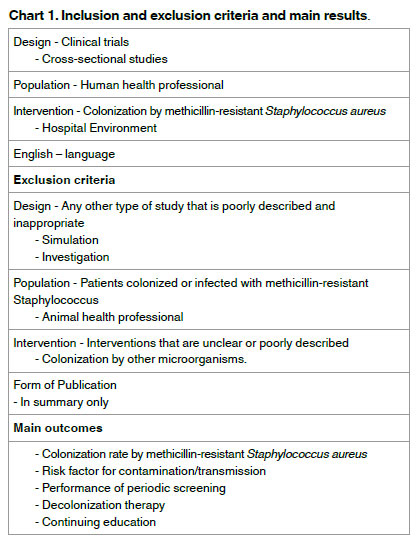
The most relevant studies originally published in English in the last five years were analyzed using the Humans filter, using the MEDLINE (National Library of Medicine) databases as a reference. The search strategy used the following search phrase: (“colonization methicillin-Resistant Staphylococcus aureus” OR “colonization MRSA”) AND “Carrier state” AND (“health personnel” OR “Health Care Providers” OR “Health Care Provider” OR “Healthcare Providers” OR “Healthcare Provider”). The inclusion and exclusion criteria were applied freely and independently by two reviewers based on the points raised in each exposed item (Chart 1).
RESULTS
Initially, 35 studies were identified, involving MRSA colonization in healthcare professionals. However, based on the application of the previously defined criteria, only 6 were part of the scope of this review. The selected studies were judged by independent reviewers and this process can be better visualized in the Flowchart (Flowchart 1).
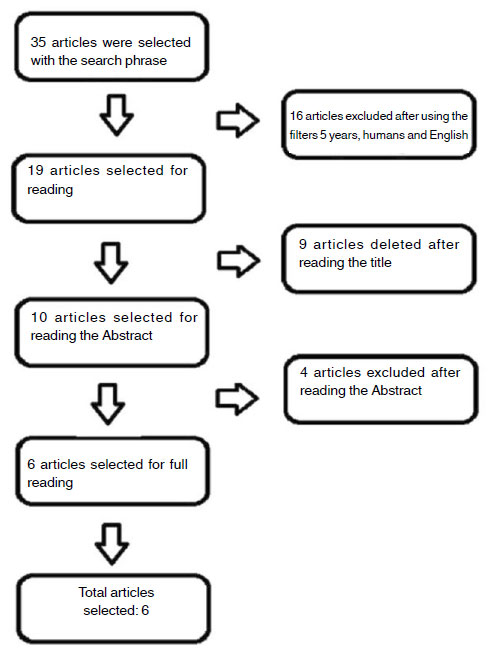
Flowchart 1.
In Chart 1, we can find the Summary of the studies that were part of the scope of this review as well as their main results, which verified the colonization of MRSA in healthcare professionals.
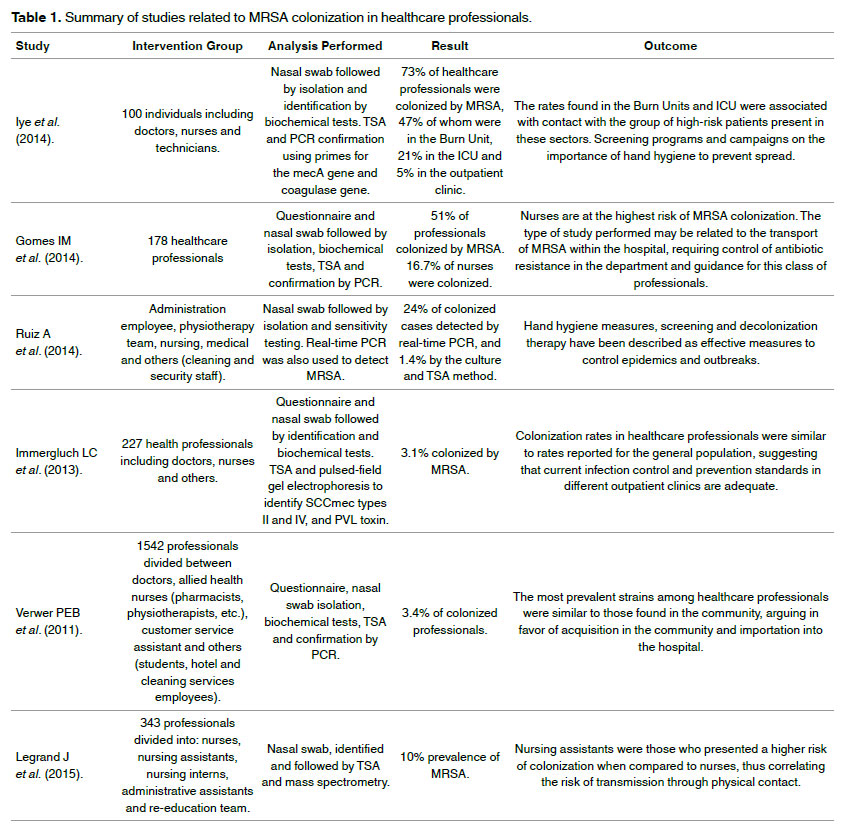
The results of the present study reveal the existence of healthcare professionals colonized by MRSA, which constitutes an important risk factor for the spread and possible cause of healthcare-associated infections - HAIs (1).
DISCUSSION
The target sectors of the studies performed by different authors were the most varied, among which the burn units, rehabilitation, pediatrics, ICU, and outpatient clinics stand out. The groups were composed of doctors, nurses, nursing technicians, physiotherapists, pharmacists, occupational therapists, administrative staff, general services, and customer service assistants, among others(5-10-12-11-13). However, only health professionals are part of this review, as described in the inclusion criteria. Thus, although some data indicate that the problem goes beyond the correlation between caregivers and patients, as the authors Ruiz et al.,2014 and Verwer et al., 2011 highlighted general services, security, and care assistance professionals, equally colonized by MRSA data will not be considered as viable results for this discussion.
Studies performed by Gomes et al.,2014, Verwer et al., 2011 and Legrand et al., 2015 pointed to the Nursing class as the professional most susceptible to contamination, with a colonization prevalence of 16.7%, 5.2%, and 16.1% respectively. Other authors such as Silva et al., 2012, Moura et al., 2011, Reinato et al.,2015, Arantes et al., 2013, also reveal the most varied percentages of colonization by methicillin-resistant S aureus 3.3%, 7.1%, 28.6%, 65.11%(14-15-16-17), although their studies have assessed the susceptibility of the Nursing class alone, they all corroborate the premise that the colonization of these professionals are justified by direct contact with patients, (13-18) as well as by delay in hospital environment (14-8), thus leading them to a position of transient or persistent carriers and consequently, possible spreaders of MRSA (14-18). Legrand et al., 2015, in their discussion, also raises the existence of other factors involved in the dynamics of colonization by MRSA: type and pathological characteristics of the patient, the organization of Nursing care, clinical intervention performed and the variation in compliance with measures of hygiene between sectors, however, they report the inability of their study model to estimate the impact on transmission (13).
It is interesting to highlight the outcome of the authors Immergluck et al., 2013 and Ruiz et al., 2014, who describe MRSA colonization rates in healthcare professionals as similar to those found in the population (3.1%) and those described in the literature (2.4%), respectively, a fact that should not be neglected, as there is extensive published evidence that attests to the great ease of dissemination of MRSA in the intra-hospital environment (19), through direct contact(8-20-21) and, in addition, only a single carrier can be a risk factor in sectors where patients are more vulnerable(14). It is worth noting that the reviewed literature by Albrich et al., 2008, concluded that around 5% of healthcare professionals become colonized by MRSA and develop the disease (20-21).
Evidence supports that the high percentage of 73% of healthcare professionals colonized by MRSA, according to Iyer et al., 2014, should be considered as a potential risk aspect in dissemination(22), however, their study did not evaluate the persistence or transience of colonization, since they are important factors related to the risk of transmission(14-22).
Direct contact with the patient, as well as prolonged time in a hospital environment, as risk factors for contamination(14-17) are confirmed when evaluating the control group of Iyer et al., 2014, where 100% of students, without any exposure to this type of environment, did not show colonization by MRSA. In view of this, it is interesting to discuss the control measures for dissemination, suggested by the author, such as compliance with hand hygiene standards, continuing education, and MRSA screening. It is believed that adherence to hand hygiene standards has a positive impact on controlling the spread of this strain in hospitals since this microorganism is easily transported through the hands (8-14). The need for continued investment in educational measures for the healthcare team is also highlighted, since through continued education it is possible to implement actions to protect, prevent, reduce, and treat MRSA infections (1-23). Another point addressed is MRSA screening as a routine for healthcare professionals, however, it is still debatable, as despite being advantageous(21), some authors suggest it only in sectors where patients are more vulnerable(24) and/or in cases of outbreaks(18-20), as their high cost still limits implementation(20).
In addition to the control measures mentioned by Iyer et al., 2014, the authors Ruiz et al., 2014 and Immergluch et al., 2013 also mention decolonization therapy and rational use of antibiotics. Decolonization therapy can be defined as the topical and/or systemic administration of antimicrobials or antiseptics with the aim of eradicating or suppressing the carrier’s state, bearing in mind that the colonized person may be a transient, intermittent, or persistent carrier, however, still very controversial, as it seems that the heterogeneity of the results does not clearly demonstrate the benefits, being indicated by some authors as the procedure of choice in cases of outbreaks(20) or in sectors where patients are more susceptible and at risk of death(14). It is known that the rational use of antibiotics is an important factor in minimizing the selection of antimicrobial resistance(25-26), as MRSA strains are also frequently resistant to other classes of antibiotics such as aminoglycosides, macrolides, and quinolones, thus proving to be as a microorganism with great potential for multidrug resistance(5-7-19).
It is worth mentioning that among the findings of Verwer et al., 2011, a high percentage of 81.1% of MRSA strains was found to be similar to those found in the CA-MRSA community (Community-associated-MRSA). It is suspected that importation into the hospital environment is more likely through the influx of contaminated and/or colonized patients(3-13) than through healthcare professionals(13). These strains have a different profile when compared to hospital HA-MRSA strains, as they carry the cassette chromosome mec (SCCmec) types IV and V(4), which confers resistance to beta-lactam antibiotics while being susceptible to most other antimicrobials. A priori, these data can change the hospital epidemiological profile (3) and exempt health professionals as responsible for transmission due to the increased prevalence of CA-MRSA in the community(21). It can be seen that MRSA colonization in healthcare professionals has a worldwide distribution (Saudi Arabia, Brazil - Niterói/RJ, Ecuador - Quito, United States - Atlanta, Australia, and France) allowing to show that the problem of multi-resistance to antibiotics and infections related to healthcare are globalized issues (6-14-19) and deserve special attention in the control and dissemination of these superbugs in the hospital environment(1).
CONCLUSION
This review demonstrates that there is colonization by MRSA in healthcare professionals and points to the risk of transmission of this microorganism through direct contact, which may therefore result in an increase in the occurrence of infections related to healthcare. Therefore, there is a need to raise awareness among the entire multidisciplinary team regarding compliance with hand hygiene standards, the rational use of antibiotics, and the importance of continued education as protection, prevention, and control measures, to contribute to patient safety and reduce the incidence of hospital infections.
REFERENCES
1. Ratti RP, Sousa CP. Staphylococcus aureus meticilina resistente (MRSA) e infecções nosocomiais. Rev Ciênc Farm Básica Apl 2009;30:9-16.
2. Sales LM, Silva TMd. Staphylococcus aureus Meticilna Resistente: Um Desafio para a Saúde Pública. Acta Biomedica Brasiliensia 2012;3:1-13.
3. Gelatti LC, Bonamigo RR, Becker AP, PA DA. [Methicillin-resistant Staphylococcus aureus: emerging community dissemination]. An Bras Dermatol 2009;84:501-6.
4. Gomes IM, Marlow MA, Pinheiro MG, et al. Risk factors for Staphylococcus aureus and methicillin-resistant S aureus colonization among health care workers in pediatrics departments. Am J Infect Control 2014;42:918-20.
5. Immergluck LC, Satola SW, Jain S, et al. Methicillin-resistant Staphylococcus aureus colonization among pediatric health care workers from different outpatient settings. Am J Infect Control 2013;41:841-3.
6. Zurita J, Mejia C, Guzman-Blanco M. Diagnosis and susceptibility testing of methicillin-resistant Staphylococcus aureus in Latin America. Braz J Infect Dis 2010;14 Suppl 2:S97-106.
7. Souza MV, Reis C, Pimenta FC. Revisão sobre a aquisição gradual de resistência de Staphylococcus aureus aos antimicrobianos. Revista de Patologia Tropical 2005;34:27-36.
8. Carvalho JF, Fontes FL. Review of the findings related to staphylococcus aureus stranins resistant in Brazil from 2010 to 2013. Arq Ciênc Saúde 2014;21:28-35.
9. Ueno M, Jorge AOC. Characterization of Methicillin-Resistant Staphylococcus aureus by phenotypic methods and plasmid profile analysis. Rev biociênc 2001;7:15-22.
10. Iyer A, Kumosani T, Azhar E, Barbour E, Harakeh S. High incidence rate of methicillin-resistant Staphylococcus aureus (MRSA) among healthcare workers in Saudi Arabia. J Infect Dev Ctries 2014;8:372-8.
11. Verwer PE, Robinson JO, Coombs GW, et al. Prevalence of nasal methicillin-resistant Staphylococcus aureus colonization in healthcare workers in a Western Australian acute care hospital. Eur J Clin Microbiol Infect Dis 2012;31:1067-72.
12. Ruiz A, Mora M, Zurita C, Larco D, Toapanta Y, Zurita J. Prevalence of methicillin-resistant Staphylococcus aureus among health care workers of intensive care units in Ecuador. J Infect Dev Ctries 2014;8:116-9.
13. Legrand J, Temime L, Lawrence C, Herrmann JL, Boelle PY, Guillemot D. Occupational determinants of methicillin-resistant Staphylococcus aureus colonization among healthcare workers: a longitudinal study in a rehabilitation center. Infect Control Hosp Epidemiol 2015;36:767-76.
14. de Moura JP, Pimenta FC, Hayashida M, Cruz ED, Canini SR, Gir E. Colonization of nursing professionals by Staphylococcus aureus. Rev Lat Am Enfermagem 2011;19:325-31
15. Arantes T, Paixão GOD, Silva MD, Castro lSA. Evaluation of colonization and resistance profile of Staphylococcus aureus in nasal secretion samples professionals nursing. Rev Bras Farm 2013;94:30-4.
16. Reinato LA, Pereira FM, Lopes LP, Pio DP, Gir E. Nasal colonization in nursing professionals from units specialized in HIV/AIDS. Rev Bras Enferm;68:292-6, 320-4.
17. da Silva EC, Samico TM, Cardoso RR, et al. Colonization by Staphylococcus aureus among the nursing staff of a teaching hospital in Pernambuco. Rev Esc Enferm USP 2016;46:132-7.
18. Dulon M, Peters C, Schablon A, Nienhaus A. MRSA carriage among healthcare workers in non-outbreak settings in Europe and the United States: a systematic review. BMC Infect Dis 2014;14:363.
19. Menegotto FR, Picoli SU. Resistent oxacilin Staphylococcus aureus (MRSA): incidence of cepas acquired in the community (CA-MRSA) and importance of research and descolonization in hospital. RBAC 2007;39:147-50.
20. Alvarez C, Labarca J, Salles M. Prevention strategies for methicillin-resistant Staphylococcus aureus (MRSA) in Latin America. Braz J Infect Dis 2010;14 Suppl 2:S107-18.
21. Albrich WC, Harbarth S. Health-care workers: source, vector, or victim of MRSA? Lancet Infect Dis 2008;8:289-301.
22. Cruz EDA, Pimenta FC, Palazzo ICV, Darini ALC, Gir E. Prevalence of Staphylococcus aureus in saliva of healthcare workers. Colomb Med 2011;42:10-6.
23. Silva AM, Carvalho MJ, Canini SRMS, Cruz EDA, Simões CLAP, Gi E. Methicillin Resistant Staphylococcus Aureus: Knowledge and Factors Related to the Nursing Team’s Adherence to Preventive Measures. Rev Latino-Am Enfermagem 2010;18:346-51.
24. Geofrey A, Abade A, Aboud S. Methicillin-resistant staphylococcus aureus (MRSA) colonization among Intensive Care Unit (ICU) patients and health care workers at Muhimbili national hospital, Dar Es Salaam, Tanzania, 2012. Pan Afr Med J 2015;21:211.
25. Paim RSP, Lorenzini E. Strategies for prevention of bacterial resistance: Contributions to patient safety. Rev Cuid 2014;5:757-64.
26. Luna CM, Rodriguez-Noriega E, Bavestrello L, Gotuzzo E. Treatment of methicillin-resistant Staphylococcus aureus in Latin America. Braz J Infect Dis 2010;14: 121-129