
INTRODUCTION
It is known that the option of stretching or warming up muscles as preparation for physical exercise is the focus of much discussion among sports professionals(1,2,3). The techniques are widely used from recreational activities to high-level sports, aiming at preventing injuries(4), improving muscular performance(5), increasing joint range of motion (6), among other objectives(2).
Static stretching aims to increase mobility and ROM(7). The ideal stretching time to acquire these gains is still much debated and according to Bandy et al., 1997(8), the time needed is 30 to 60s for a more effective result.
In line with these findings, Gonçalves et al., 2012(9), evaluated the acute and chronic effects of a stretching program on flexibility and horizontal impulsion, realizing that stretching brought deficits in the muscle strength variable, however, it has benefits in the impulsion and flexibility variables. About stretching time in strength performance, according to Paulo et al., 20121(10), exercises that increase muscular flexibility, consequently, tend to decrease maximum strength capacity, both in the upper and lower limbs.
Another modality is muscle warm-up, which is a great option for improving muscle power(12), always seeking benefits such as preparation for the exercise to be practiced and reducing injuries, which is a factor widely discussed in the scientific community(2,4, 13,16).
Although some evidence reports disagreements about which type of warm-up is most beneficial, there are conclusions that warm-up performed aerobically tends to improve the speed of chemical reactions in the human body, however, one should focus on the principle of specificity(14,15).
A meta-analysis performed by Fradkin et al., 2010(16), showed that after muscle warm-up, there was an improvement in performance and sports performance. Warming up before practicing sports is effective for better physical performance, allowing the body to better adapt to the stress of physical exercise(17).
According to Wojtys et al., 1996(18) and Emery et al., 2005(19), the warm-up proved to be effective in muscular power, in which athletes participated in a warm-up program, resulting in an improvement in side jumping and static balance in female soccer players, however, there is an obstacle during clinical practice and a lack of studies regarding the comparison of stretching and warming up on muscle power. The present study aims to compare the effects of warming up and stretching on muscle power, evaluating through the Counter Movement Jump (CMJ), Squat Jump (SJ), and Drop Jump (DJ) tests.
METHODS
This respective randomized clinical trial experimental study performed in a university at Juiz de Fora - MG, after approval by the Research Ethics Committee aimed to analyze the effects of warming up and muscle stretching on muscular power. The study used the following inclusion criteria (patients aged 18 to 60 years, both genders, practicing some type of sport and with no previous history of surgery) and exclusion (reporting osteomyoarticular pain, obese (= or >30kg/m²), pregnant women, patients with heart problems). 21 individuals were recruited and initially instructed to read and sign the Informed Consent Form, in accordance with Resolution 466/12.
An interview was performed to complete the validated International Physical Activity Questionnaire (IPAQ), where we assessed the level of physical exercise practiced by the individuals. Muscle power was also evaluated using the tests: Squat Jump (SJ), Drop Jump (DJ), and Counter Movement Jump (CMJ). The SJ is described as follows: volunteers squat to start the test, then they must jump once as high as they can, keeping their knees straight while jumping and finishing the movement in a squat position again. In relation to the DJ test, the participant will begin a fall with the dominant lower limb onto a 50 centimeters high box, then he must jump from the surface of the box towards the ground, when he touches his feet to the ground he must jump once as much as possible. as high as he can while keeping his knees straight during the jump and, when returning, he should keep his knees bent in a squat position. In the CMJ test, the participant will start the test in an orthostatic position, then flex his knees, performing a small squat followed by a maximum jump, keeping his knees straight and arms hanging during the flight, and the test must be completed in orthostatic position. Participants will be instructed to perform all tests before and after the interventions, being evaluated using the MYJUMP application(2).
Initially, a randomization was performed to identify which intervention would be performed first, and after an interval of at least 24 hours for the physiological variables to return to resting conditions(20). The second meeting with the other intervention was performed. The warm-up intervention was performed on the treadmill for 5 minutes and the intensity was according to the maximum HR, according to the target zone calculated by age(21). The intervention with static stretching consisted of 3 sets of 30 seconds on the hamstring muscles, triceps surae, rectus femoris, hip adductors, and hip abductors, being performed bilaterally(2). The study was approved by the Research Ethics Committee of the School of Medical and Health Sciences of Juiz de Fora – SUPREMA (FCMS/JF-SUPREMA), under CAAE 91937018.4.0000.5103. Initially, for data analysis, the normality of the data was tested, validating the use of parametric statistics.
Data were presented as mean ± standard deviation, minimum, and maximum for descriptive statistics. To compare the effect of stretching and warm-up on the CMJ, DJ, and SJ tests, before and after the interventions, the paired t-test was performed. To compare the stretching versus warm-up groups for jump height in the CMJ test, the one-way ANOVA test was used. All analyses were performed using the GraphPad Prism Software(5) (2015), adopting a significance level of 5%.
RESULTS
The present study aimed to evaluate stretching and warming up on the variables of three tests from the MYJUMP application(2). The CMJ and SJ analyze the variables of jump height, flight time, speed, strength, and muscular power, while the DJ analyzes the variables of reactive force index, jump height, flight time, contact time, and stiffness. To this end, the study variables were analyzed on the pre- and post-intervention period for comparison at the end.
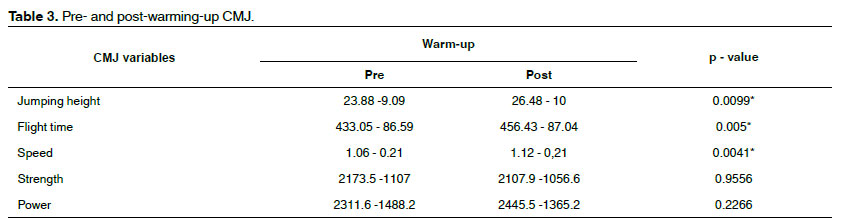
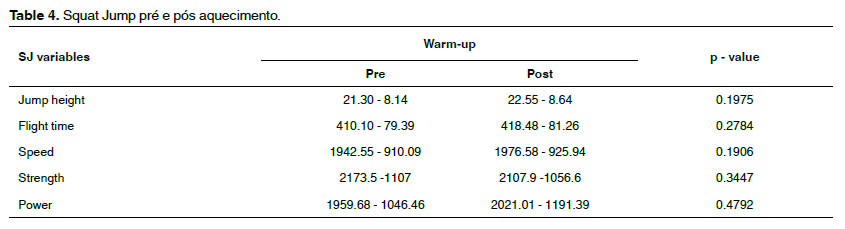
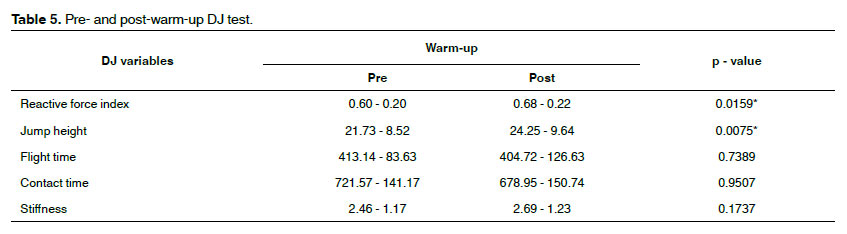
According to the findings, we noticed that there was a significant difference in the warm-up intervention in the CMJ test in the variables of jump height, flight time, and speed (P<0.05). For the DJ test, we could identify a significant difference in the reactive strength index and jump height variables, since P<0.05. Finally, in the SJ test, no significant difference was found in any of the variables analyzed (P>0.05). The descriptive analysis of the sample can be seen in table 1.
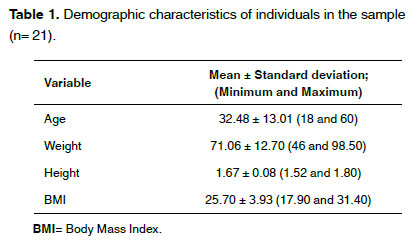
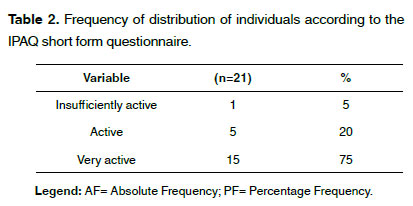
Of these participants, 75% were classified as very active, according to the IPAQ questionnaire. These data are observed in Table 2.
After analyzing the data using the one-way ANOVA test, the stretching versus warm-up groups were compared for the jump height variable in the CMJ test. We observed that the variable post-warm-up jump height was significantly different for all other groups evaluated: pre- and post- warm-up jump height and pre- and post-stretching.
After analysis using the paired-T test, we verified that muscle warm-up was significant for the variables: jump height, flight time, and speed. These data are observed in table 3.
In the analysis of the paired-T test, it was found that muscle warm-up was not significant in any of the variables analyzed in the SJ test. These data are observed in table 4.
In the analysis of muscle warm-up for the DJ test, we found that muscle warm-up was significant only for the variables reactive strength index and jump height. These data are observed in table 5.
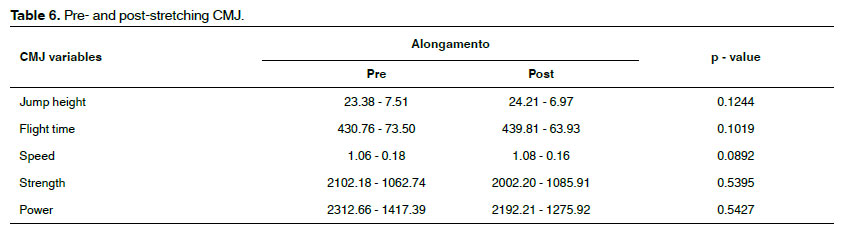
For the analysis of muscle stretching, we verified that it was not significant in any of the variables analyzed in the CMJ test. These data are observed in table 6.
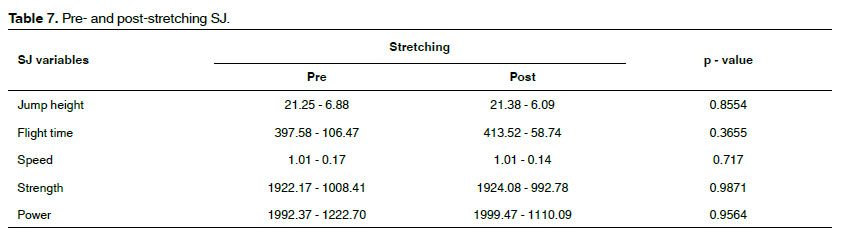
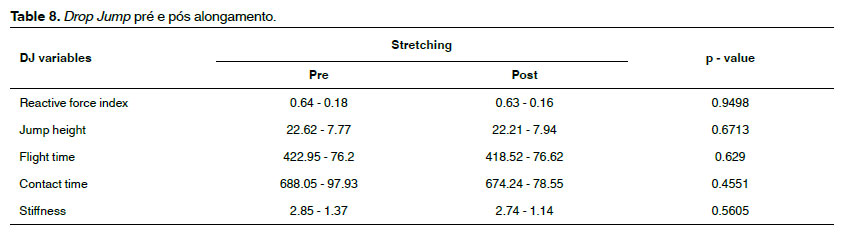
For the SJ and DJ test, muscle stretching was not significant in any of the variables analyzed in the SJ test. These data are observed in tables 7 and 8.
DISCUSSION
This study aimed to evaluate the effects of stretching and warming up on muscle power through the CMJ, SJ, and DJ evaluation tests. The secondary aim was also to verify the frequency of physical exercise of individuals using the IPAQ short-form questionnaire (Table 2).
According to the findings, we could find that the majority of volunteers depend on a large amount of time during the week to perform physical exercises, being considered in the present study as very active. We evidenced a significant difference in the warm-up intervention in the CMJ test, in the variables of jump height, flight time, and speed. For the DJ test, we found a significant difference in the Reactive Strength Index and Jump Height variables after the warm-up and finally, in the SJ, no significant difference was found in the analyzed variables.
We can observe in the literature that muscle warm-up has physiological effects that can promote improvement in physical capacity, such as increased temperature(22), increased blood flow(23), altered sensitivity of the Golgi tendon organ(24), increased synovial fluid(25). Pagaduan et al., 2012(26), evaluated the jumping performance in the CMJ test in 29 healthy football players, performing different warm-up protocols (which consisted of five minutes of running at a pre-defined pace, dynamic static stretching, and passive static stretching). The results revealed that the five-minute run, whether or not associated with dynamic stretching, showed greater gains than static stretching in CMJ scores. According to the authors, a possible mechanism for this superiority is a better ability to form cross-bridges and better activation of the central nervous system with an increased firing rate for motor units during running. In line with these results, Healy and Harrison, 2014(27), evaluated a gluteal activation protocol based on a standardized dynamic warm-up, seeking to analyze performance in the vertical jump, and noticed in their results that on the 1st and 2nd days, there was a significant difference in contact time, flight time and vertical ground reaction force scores. However, in a study performed by Franco and Reyes 2016(28), which aimed to verify the specificity of a warm-up for muscular performance, they found that specific high-intensity warm-up training resulted in a worsening of the vertical jump score. One explanation for these findings is the tendency for volunteers to enter into the anaerobic glycolytic pathway, thus increasing the concentration of blood lactate and thus decreasing the availability of ATP(29).
Given the different forms of warm-up, the increase in load has been observed in programs to improve vertical jump, however, no difference was observed for the groups analyzed(30). In this way, the present study intended not to use a load for the volunteers, minimizing the possibility of them increasing the concentration of blood lactate. It seems satisfactory for improving performance in jumping, consistent running programs lasting four to five minutes at a submaximal pace associated with specific exercises aiming at improving the athletes’ neural factor(31). It is commonly observed in recent literature, the muscle warm-up programs combining static and dynamic stretching exercises(32). Although several pieces of evidence report that muscle stretching can promote loss of performance(33,34,35), investigations report that it can be beneficial for muscle power, agility, and increased muscle activity(36,37). It is noted that musculotendinous stiffness has an impact on force transmission and can be fundamental for performance in the vertical jump(38), thus, the inclusion of muscle stretching can become essential in a performance improvement program.
In our results, we did not observe differences in the stretching intervention for the tests applied. A plausible explanation for our findings is the change in the length-tension curve of the muscle after stretching, because when the sarcomeres move to a greater length, the overlap zone decreases drastically, generating a decrease in muscle tension due to the reduction in the formation of cross bridges(3). Thus, new studies are suggested with greater limitations in relation to the sport to be practiced, age group of participants, level of conditioning, longer and shorter durations of different stretches, new pre-defined warm-up intensities, longer time to familiarize themselves with the evaluative tests, and larger sample.
The present study used passive stretching in its methodology in 3 series of 30 seconds, corroborating the methodology imposed by Pinto et al., 2014(39). In a meta-analysis, the acute effects of passive static stretching on muscular strength, power, and explosive muscular performance were observed, and the authors demonstrated that passive stretching had negative effects on the three variables, however, they reported that the shorter the stretching time lengthening, the lower the negative effects on the variables analyzed.
In this same context, Robbins and Scheuermann, 2008(40), investigated three different static stretching times at jump height and noticed that performance decreased after the intervention of 6 sets of 15 seconds, with no difference during other interventions with less number of series. Static stretching, when compared to dynamic stretching, can contribute differently to muscular power, with reports of losses in performance up to 24 hours after intervention with static stretching and even in recovery intervals between exercise sets in athletes(41), corroborating the idea that shorter stretching times can contribute to improved performance(42).
Torres et al.(43), showed that the time of five minutes or more after stretching causes the body to dissipate its possible effects, thus, the present study adopted in its methodology the application of the CMJ, DJ and SJ, immediately after performing the stretches, intending to assess acutely and minimize any possibility of having the effects of the stretching neutralized. Chronic effects of muscle stretching were noticed in a study performed by Hunter and Marshall 2002(11), whose vertical jump performance in a 10-week training program consisting of flexibility exercises was able to increase performance in the CMJ test by factors such as increased use of elastic energy in muscles and greater contribution from contractile components. Therefore, the present study can contribute significantly to individuals who perform jumping exercises, highlighting the implementation of warm-up exercises with running at a submaximal pace and the use of low-duration stretching exercises, although this study has not compared different stretching times. However, the literature is not conclusive, so exercisers should be cautious when using long-term stretching before certain tasks that require improved jumping performance.
CONCLUSION
The results of the present study suggest that muscle warm-up is capable of promoting benefits in the jump height variable in the CMJ and DJ tests, with no changes being observed when the volunteers performed muscle stretching for any of the variables in the evaluated tests. Thus, new studies are suggested with greater limitations about the sport to be practiced, age group of participants, level of conditioning, longer and shorter durations of different stretches, new pre-defined warm-up intensities, longer time to familiarize themselves with the evaluative tests, and larger sample.
REFERENCES
1. Almeida PHF, Barandalize D, Ribas DIR, Gallon D, Macedo ACB, Gomes ARS. Alongamento Muscular: suas implicações na performance e na prevenção de lesões. Fisioter Mov 2009; 22(3): 335-43.
2. Nogueira JFS, Lins CAA, Souza AVC, Brasileiro JS. Efeitos do aquecimento e do alongamento na resposta neuromuscular dos isquiotibiais. Rev Bras Med Esporte 2014; 20(4): 262-6.
3. Di Alencar TAM, Matias KFS. Princípios fisiológicos do aquecimento e alongamento muscular na atividade esportiva. Rev Bras Med Esporte 2010; 16(3): 230-4.
4. McCrary JM, Ackermann BJ, Halaki M. A systematic review of the effects of upper body warm-up on performance and injury. J Sports Med 2015; 49(14): 935-42.
5. Behm DG, Blazevich AJ, Kay AD, McHugh M. Acute effects of muscle stretching on physical performance, range of motion, and injury incidence in healthy active individuals: a systematic review. Appl Physiol Nutr Metab 2016; 41(1): 1-11.
6. Neto AG, Manffra EF. Influência do volume de alongamento estático dos músculos isquiotibiais nas variavéis isocinéticas. Rev Bras Med Esporte 2009; 15(2): 104-9.
7. Endlich PW, Farina GR, Dambroz C, Gonçalves WLS, Moysés MR, Mill JG et al. Efeitos agudos do alongamento estático no desempenho de força dinâmica em homens jovens. Rev Bras Med Esporte 2009; 15(3): 200-3.
8. Bandy WD, Irion JM, Briggler M. The effect of time and frequency of static stretching on flexibility of the hamstring muscles. PhysTher 1997; 77(10): 1090-6.
9. Gonçalves DL, Pavão TS, Dohnert MB. Efeitos agudos e crônicos de um programa de alongamento estático e dinâmico no rendimento em jovens atletas do futebol. Rev Bras Med Esporte 2013; 19(4): 241-6.
10. Paulo AC, Ugrinowitsch C, Leite GS, Arsa G, Marchetti PH, Tricoli V. Efeito agudo dos exercícios de flexibilidade no desempenho de força máxima e resistência de força de membros inferiores e superiores. Motriz 2012; 18(2): 345-55.
11. Hunter JP, Marshall RN. Effects of Power and flexibility training on vertical jump technique. Med Sci Sports Exerc. 2002; 34(3): 478-86.
12. Young WB, Behm DG. Should static stretching be used during a warm-up for strength and power activities. Strenght Cond J 2002; 24(6): 33-37.
13. Bishop D. Warmup I: potential mechanism sand the effects of passive warm up on exercise performance. Sports Med 2003; 33(6): 439-54.
14. Viveiros LE, Simão R. Treinamento de flexibilidade, uma abordagem metodológica. Revista Baiana de Educação Física 2001; 2(3): 20-5.
15. Albuquerque CV, Mashio JP, Gruber CR, Souza RM, Hernandez S. Efeito agudo de diferentes formas de aquecimento sobre a força muscular. Fisioter Mov 2011; 24(2): 221-9.
16. Fradkin AJ, ZazrynTR, Smoliga JM. Effects of warm-up physical performance: a systematic review with meta-analysis. Journal of Strength and Conditioning Research 2010; 24(1): 140-8.
17. Robergs RA, Roberts SO. Princípios fundamentais de fisiologia do exercício para aptidão, desempenho e saúde. 1.ed. São Paulo: Phorte, 2002.
18. Wojtys EM, Huston LJ, Taylor PD, et al. Neuromuscular adaptations in isokinetic, isotonic, and agility training programs. Am J Sports Med 1996; 24(2): 187-92.
19. Emery CA, Cassidy JD, Klassen TP, et al. Effectiveness of a home-based balance training program in reducing sports-related injuries among healthy adolescents: a cluster randomized controlled trial. CMAJ 2005; 172(6): 749-54.
20. Cunha FGC, Assad AR, Pereira TJCC, Pinheiro PIS, Barbosa GM, Lins CAA et al. Efeitos do aquecimento sobre a flexibilidade e o desempenho funcional: ensaio clínico randomizado. Rev BrasMed Esporte 2017; 23(5): 385-9.
21. American College of Sports Medicine. Progression models in resistance training for healthy adults. Med Sci Sports Exerc. 2009; 41(3): 687-708.
22. Weineck J. Treinamento ideal. 9.ed. São Paulo: Manole, 2003.
23. Robergs RA, Roberts SO. Princípios fundamentais de fisiologia do exercício para aptidão, desempenho e saúde. 1.ed. São Paulo: Phorte, 2002.
24. Achour Jr A. Exercícios de Alongamento: Anatomia e Fisiologia. 2. ed. São Paulo: Manole, 2006.
25. Hamill J, Knutzen KM. Bases biomecânicas do Movimento Humano. 2. ed. São Paulo: Manole, 2008.
26. Pagaduan JC, Pojskic H, Uzicanin E, Babajic F. Effect of Various Warm-Up Protocols on Jump Performance in College Football Players. J Hum Kinet. 2012; 35: 127-32.
27. Healy R, Harrison AJ. The effects of a unilateral gluteal activation protocol on single leg drop jump performance. Sports Biomech 2014; 13(1): 33-46.
28. Franco NR, Reyes PJ. Effects of Warm-Up and Fatigue on Knee Joint Position Sense and Jump Performance. J Mot Behav 2017; 49(2): 117-22.
29. Balsom PD, Seger JY, Sjodin B, Ekblom B. Physiological responses to maximal intensity intermittent exercise. Eur J Appl Physiol 1992; 65: 144-149.
30. Chattong C, Brown LE, Coburn JW, Noffal GJ. Effect of a dynamic loaded warm-up on vertical jump performance. J Strength Cond Res 2010; 24(7): 1751-4.
31. Young WB, Behm DG. Effects of running, static stretching and practice jumps on explosive force production and jumping performance. J Sports Med Phys Fitness 2003; 43(1): 21-7.
32. Vetter RE. Effects of six warm-up protocols on sprint and jump performance. J Strength Cond Res 2007; 21(3): 819-23.
33. Fletcher IM, Anness R. The acute effects of combined staticand dynamics tretch protocols on fifty-meter sprint performance in track-and-field athletes. J Strength Cond Res 2007; 21(3): 784-7.
34. Fletcher IM, Jones B. The effect of different warm up stretch protocols on 20 meters sprint performance in trained rugby union players. J Strength Cond Res 2004; 18(4): 885-8.
35. Nelson AG, Kokkonen J. Acute muscle stretching inhibits muscle strength endurance performance. J Strength Cond Res 2005; 19(2): 338-43.
36. Mcmillan D, Moore JH, Hatler BS, Taylor DC. Dynamic vs. static-stretching warm up: The effect of power and agility performance. J Strength Cond Res 2006; 20(3): 492-9.
37. Yamaguchi T, Ishii K. Effects of static stretching for 30 seconds and dynamic stretching on leg extension power. J Strength Cond Res 2005; 19(3): 677-83.
38. Dintiman GB, Ward RD, Ward B. Sport Speed. 3rded.Windsor, Ontario: Human Kinetics Publisher; 2003.
39. Pinto MD, Wilhelm EN, Tricoli V, Pinto RS, Blazevich AJ. Differential Effects of 30 Vs 60 second Static Muscle Stretching on Vertical Jump Performance. Journal of Strength and Conditioning Research 2014; 25(12): 3440-6.
40. Robbins JW, Scheuermann BW. Varying Amounts of Acute Static Stretching and Its Effect on Vertical Jump Performance. Journal of Strength and Conditioning Research 2008; 22(3): 781-6.
41. Beckett JR, Schneiker KT, Wallman KE, Dawson BT, Guelfi KJ. Effects of static stretching on repeated sprint and change of direction performance. Med Sci Sports Exerc 2009; 41(2): 444-50.
42. Haddad M, Dridi A, Chtara M, Chaouachi A, Wong del P, Behm D, Chamari K. Static stretching can impair explosive performance for at least 24 hours. J Strength Cond Res 2014; 28(1): 140-6.
43. Torres EM, Kraemer WJ, Vingren JL, Volek JS, Hatfield DL, Spiering BA et al. Effects of Stretching on Upper-Body Muscular Performance. Journal of Strength and Conditioning Research 2008; 22(4): 1279-85.