
INTRODUCTION
Sickle cell disease manifests itself in homozygous individuals for hemoglobin S. and in combination with other abnormal hemoglobins, which can result in sickle cell disease with varying degrees of severity. Its diagnosis is made through hemoglobin electrophoresis(1).
The hemoglobin S gene is a high-frequency gene throughout America and, in Brazil, it is more frequent in the southeast and northeast regions. In equatorial Africa, forty percent of the population is a carrier, and sickle cell disease reaches a prevalence of 2 to 3%. It can affect up to 0.3% of the black population, with the tendency to increasingly affect a significant population, due to the high degree of miscegenation in the country(1). The anemia process develops when the erythrocyte mass is insufficient to transport oxygen, due to a reduction in hemoglobin levels, hematocrit or the number of erythrocytes(2). Hemoglobin is a molecule responsible for the tissue oxygenation process, consisting of four subunits, each one made up of a protein molecule associated with a group of the heme portion(3).
Normal erythrocytes are malleable and biconcave. In the case of individuals who have HbS, the sickling of these cells prevents correct blood circulation through the small vessels, which can cause vaso-occlusion processes. Furthermore, due to the increased susceptibility to hemolysis, these abnormal cells have a shorter life cycle (10 to 20 days) when compared to normal erythrocytes (120 days)(4). About 1200 natural mutations are known and new mutations in the genes that code for hemoglobin are continually being discovered. Most of these mutations are clinically insignificant, but one of these mutations causes sickle cell anemia, which is one of the most prevalent hereditary diseases and presents the highest rate of morbidity and mortality(5).
Faced with all these weaknesses, the only chance of an effective cure is Bone Marrow Transplantation (BMT). According to(6-2), halogen bone marrow transplantation is accepted as a treatment for symptomatic children. Initially, patients eligible for BMT were those who demonstrated brain damage due to strokes, acute chest syndrome, and recurrent pain crises(6). However, with the positive results for this group, BMT began to be indicated for groups of patients who demonstrate less severity in their clinical histories(7).
Cell transplantation consists of replacing bone marrow, which can be autogenic when the cells to be transplanted come from the individual who will undergo the transplant, or halogenic, when the cells come from a donor(7). The discussion on the indication of this treatment for people with sickle cell disease began in 2004, with the 1st National Forum of the National Transplant System, held in Brasília.
In the Brazilian scenario, bone marrow transplants were included as a curative method for patients with sickle cell disease as of Ordinance No. 30, of June 30, 2015, through which the decision to implement BMT within the scope of the Unified Health System for the treatment of sickle cell disease was made public(8).
OBJECTIVE
Aware of the need to analyze the factors that may indicate bone marrow transplantation for patients with sickle cell disease, the present study aimed to identify, through a systematic review, the post-bone marrow transplant success rate.
METHODS
Search Strategies
The most relevant studies published originally in English were analyzed, using the PubMed and Scielo databases as references, to select studies with the greatest scientific evidence, including only systematic reviews of articles.
The search strategy used the following keywords: “sickle cell anemia; transplant; bone marrow”; “sickle cell disease”. The articles selection criteria were applied to the types of studies, language, type of treatment, and date of publication.
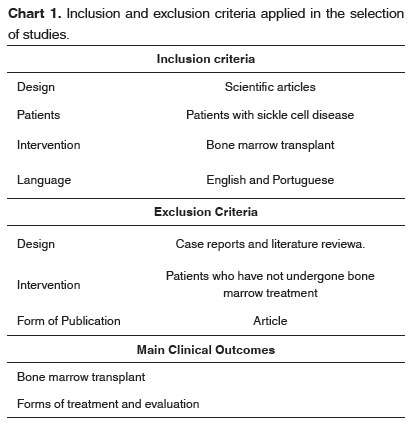
For the selection of studies, the inclusion and exclusion criteria presented in Chart 1 were applied.
RESULTS
Several studies involving bone marrow transplantation in sickle cell disease were identified. After reading the articles found, four articles involving the topic were selected for analysis and inclusion in the scope of this review. Figure 1 presents the flowchart used to select the articles analyzed.
META-ANALYSIS
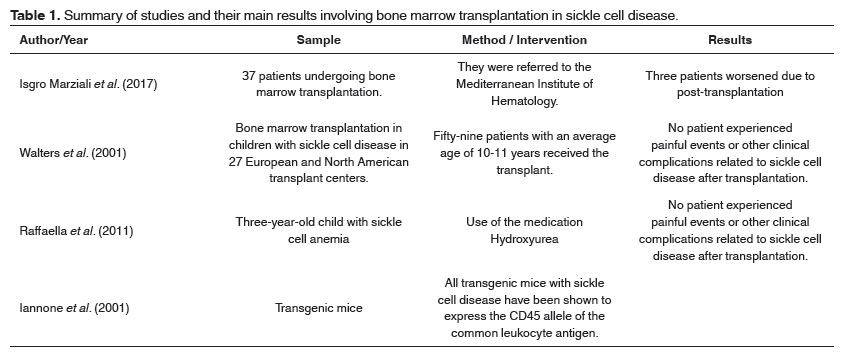
Only four of the ten studies included in this review provided sufficient data to analyze bone marrow transplantation, as shown in table 1.
The discussion about Bone Marrow Transplantation (BMT) for people with sickle cell disease is increasingly occupying space in academic and political settings. Despite the disease having been studied since 1910, we still have many gaps that must be exhaustively analyzed, one of which is associated with the new form of curing the disease, transplantation(9).
For this research, articles were evaluated with people of different ages undergoing Bone Marrow Transplantation (BMT), who seek the same objective, the cure of the disease(10-1-12-13).
Isgro analyzed 37 patients who underwent Bone Marrow Transplantation, the donors being identical brothers born between 2010 and 2015. The patients were referred to the Mediterranean Institute of Hematology to undergo bone marrow transplantation(10). The average age of the patients was 10 years. All 37 patients had sustained engraftment after transplantation. After 3 to 6 months after the procedure, no changes were found in spirometry values. Four of the nine patients’ respiratory patterns remained unchanged. Three patients worsened post-transplant due to infectious complications and pulmonary complications(10).
According(11) to the multicenter investigation of bone marrow transplantation in children with sickle cell disease, in 27 European and North American transplant centers, fifty-nine patients with an average age of 10-11 years, received a bone marrow transplant from identical siblings between September 1991 and April 2000. No patient presented painful events or other clinical complications related to sickle cell disease after transplantation(11). Sickle cell patients who develop persistent mixed hematopoietic chimerism after transplantation experienced a significant improvement effect(11).
The author Rafaella(12) described an article about sickle cell anemia in three-year-old children with recurrent SCA, hypoperfusion of the left lung, mild hemolysis, and perceived elevation of TRV. The use of the drug Hydroxyurea used to treat sickle cell disease, increased hemoglobin and reduced the number of crises caused by the disease. No patient experienced painful events or other clinical complications related to sickle cell disease after transplantation.
According to the author(13), all patients did not experience painful events or other clinical complications after transplantation. Walter et. al. performed an investigation of bone marrow transplantation in children with sickle cell disease at 27 European and North American transplant centers; fifty-nine patients with a mean age of 10 years received bone marrow transplants from identical siblings between September 1991 and April 2000(13). According to a study(14) with patients with sickle cell anemia, bone marrow transplantation obtained a positive result. Bone marrow transplantation has become one of the promising effective alternative treatments for patients with sickle cell anemia. It presents advantages and disadvantages to patients, but it is the only means that can enable a cure. However, the number of patients already transplanted has a cure rate of 77% and only 23% deaths(14). The only curative treatment for patients with sickle cell disease is hematopoietic stem cell transplantation (HSCT). Myeloablative transplants with an HLA-identical donor provide 80%-85% disease-free survival in patients with advanced and severe disease(14). Non-myeloablative transplants have lower treatment-related toxicity when compared to myeloablative ones, but they have a higher rate of graft rejection and disease recurrence. Unrelated transplants using umbilical cord blood can be an alternative for severely affected patients who do not have a related donor(14). As long as the risk factors for a more severe progression of the disease are not defined, in addition to the absence of prospective and randomized studies comparing hydroxyurea, chronic transfusion, and Bone Marrow Transplantation, the treatment is still individualized and decisions must be shared with patients and family members regarding their preference for a certain therapy(14).
When we work with data on people with sickle cell disease, this statistic can become more worrying, since, according to data from the Ministry of Health, around 30 thousand people have sickle cell disease and it is estimated that, according to the Neonatal Screening Program, 3,500 children are born with sickle cell disease each year. Using basic mathematics, we can say that at least 350,000 bone marrow donors are needed each year so that BMT can be performed on these children(15). For those who have not found a compatible donor, there is always the possibility, although small, of using hematopoietic stem cells. Several studies have shown this use to be beneficial, with survival rates similar to those of BMT and with much lower risks of developing related diseases(16). There is still the possibility of adapting the conditioning for transplantation, but this alternative is still being discussed in research groups that seek to use the variants in each case as a hypothesis of hope for other people(16).
Given this reality, it is necessary to perform an individual analysis of each patient, studying his history and the possibility of preventing making hasty decisions(16). Furthermore, more research groups need to be committed to develop an improvement in the survival of people who will possibly undergo transplantation(13-14-15-16).
With all these important points that define the possibility of successful treatment, we also have the new decision from the Ministry of Health which, as of February 9, 2018, through Ordinance No. 298, expanding the age range of people with sickle cell disease to be candidates for transplantation(17). In one of the most recent studies performed by Dr. Ricardo Helman, from 2010 to 2016, nine transplants were performed, resulting in 7 cured patients and only 2 deaths. In percentage terms, there is a greater chance of achieving complete effectiveness in the transplant than the occurrence of factors predisposing to complications or death(18).
CONCLUSION
Bone marrow transplantation has become one of the most effective alternative treatments for patients with sickle cell anemia. Like all treatment methods, it has advantages and disadvantages for the patient, but based on several studies, it is the only method that can provide a cure. In a short time, it became accessible to the SUS (Unified Health System), but it still faces a serious problem, which is finding a compatible donor to perform the transplant.
REFERENCES
1. Nuzzo DVP, Fonseca SF. Anemia falciforme e infecções. J Pediatr 2004; 80(5):347-54.
2. Hermiston ML, Mentzer WC. A practical approach to the evaluation of the anemic child. Pediatr Clin North Am 2002; 49(5):877-91.
3. Santos JL, Chin CM. Anemia falciforme: desafios e avanços na busca de novos fármacos. Quim Nova 2012; 35(4)783-90.
4. Zago MA, Costa FF, Ismael SJ, Bottura C. Enfermedades drepanocíticas en una población brasileña. Sangre 1983; 28:191-8.
5. Galiza Neto GC, Pitombeira MS. Aspectos moleculares da anemia falciforme. J Bras Patol Med Lab 2003; 39(1):51-6.
6. Vichinsky E, Hurst D, Earles A, Kleman K, Lubin B. Newborn screening for sickle cell disease: effect on mortality. Pediatrics 1988; 81(6):749-55.
7. Steinberg MH, Barton F, Castro O, Pegelow CH, Ballas SK, Kutlar A, et al. Effect of hydroxyurea on mortality and morbidity in adult sickle cell anemia: risks and benefits up to 9 years of treatment. JAMA 2003; 289(13):1645-51.
8. Ministério da saúde. Portaria nº 30, de 30 de junho de 2015. Avaiable from: URL: http://bvsms.saude.gov.br/bvs/saudelegis/sctie/2015/prt0030_30_06_2015.html. Accessed October 19, 2019.
9. Isgro A, Marziali M, Paciaroni K, De Angelis G, Alfieri C, Ribersani M, et al. Spirometric Evaluation of Pulmonary Function in Nigerian Children underwent Bone Marrow Transplantation for Sickle Cell Anemia. Mediterr J Hematol Infect Dis 2017; 9(1):e2017030.
10. Iannone R, Luznik L, Engstrom LW, Tennessee SL, Askin FB, Casella JF, et al. Effects of mixed hematopoietic chimerism in a mouse model of bone marrow transplantation for sickle cell anemia. Blood 2001; 97(12):3960-5.
11. Colombatti R, Varotto E, Ricato S, Nardo D, Maschietto N, Teso S, et al. Tricuspid regurgitant velocity elevation in a three-year old child with sickle cell anemia and recurrent acute chest syndromes reversed not by hydroxyurea but by bone marrow transplantation. Hematol Rep 2011; 3(2):e12.
12. Walters MC, Patience M, Leisenring W, Rogers ZR, Aquino VM, Buchanan GR, et al. Stable mixed hematopoietic chimerism after bone marrow transplantation for sickle cell anemia. Biol Blood Marrow Transplant 2001; 7(12):665-73.
13. Pacheco DF, Pereira LFF, Paiva JL. Bone marrow transplantation in patients with sickle cell anemia. Avaiable from: URL: https://www.fef.br/upload_arquivos/geral/arq_5ad0b780d333d.pdf. Accessed October 19, 2019.
14. Felix AA, Souza HM, Ribeiro SBF. Aspectos epidemiológicos e sociais da doença falciforme. Rev Bras Hematol Hemoter 2010; 32(3):203-8.
15. Costa LJ, Domínguez AGD, Montagner MI, Montagner MA. Transplante de medula óssea em pessoas com doença falciforme: uma revisão bibliográfica. Hegemonia 2019; (27)30:74-104.
16. Ministério da Saúde. Portaria nº 298, de 9 de fevereiro de 2018. Avaiable from:URL: https://bvsms.saude.gov.br/bvs/saudelegis/gm/2018/prt0298_19_02_2018.html. Accessed October 19, 2019.
17. Helman R. Transplante de medula óssea em anemia falciforme. Palestra do XX Congresso da Sociedade Brasileira de Transplante de Medula Óssea. Avaiable from: URL: https://youtu.be/tBeFXIAb6wU. Accessed Oct 19, 2019.