INTRODUCTION
With quick access to everything, traditional education becomes a great challenge since it has characteristics that do not match the reality of current students, such as the process of knowledge through books, blackboards, and notebooks. Technology plays a fundamental role in making learning more enjoyable, as data is obtained quickly through research tools and other technologies. However, for this form of teaching-learning to be beneficial, students and teachers must be familiar with the technology so that knowledge can be transmitted in the most dynamic way and without barriers, in the educational context(1).
The implementation of digital resources in learning Dentistry has been increasingly frequent in several countries, which seems to generate greater stimulus for the search for knowledge on digital research platforms and greater interaction of the professional future with technological tools such as electronic mail (e-mail), textual tools(2), resulting in greater learning from sources that can encourage critical thinking in future professionals, in addition to making them more independent in the technological area and in the search for knowledge. The use of information and communication technologies (ICT) in the teaching-learning of the course makes the future dental surgeon more responsible for building his knowledge and with higher research quality, in addition to exploring individual technological skills.
However, the success of this implementation of resources depends on the training of teachers in ICT skills, which is essential for motivation and training to ideally transmit knowledge to students and encourage them to make the use of technologies habitual, not only in college (as research tools), but also in the job market (in medical records, communication tools), resulting in faster, more simplified and dynamic service(3).
The acquisition of knowledge in the area of computing, if well explored, can encourage the future dental surgeon to adopt a behavior so that the management of patients and the office itself revolves around digital technologies, providing greater quality in the provision of services, increasing its efficiency and ensuring greater safety. Despite digital dentistry being implemented little by little and the existence of barriers in system compatibility and acceptance by professionals and companies, it has numerous advantages in terms of quality of care, professional practicality, and as evidence in the event of any legal complications. Since the 1990s, with the Brazilian Consumer Defense Code (CDC) legislation coming into force, significant changes have been occurring in patients’ behavior toward healthcare professionals, including dental surgeons. Patients who are aware of their rights seek the return of their financial investments for possible damages caused during dental treatment, thus making legal actions by these patients against the professional increasingly frequent. To resolve these conflicts, dentists must prove that they worked within the principles recommended by dental science using the dental record, which must be complete, well-prepared, organized, and signed by the patient. However, storage was a major problem, but with technological advancement and the popularization of information technology, electronic files, and digital images began to be used to replace conventional paper documents(4).
The printed form of dental records was for many years the only means of storing patient data, but with technological advances and these patients becoming more and more demanding, the virtual way of storing data and perpetuating them are increasingly in demand, as gives the patient greater interaction with the professional’s proposal and the dentist greater ease in maintaining, adding and retrieving data when necessary. Therefore, the dental record is the document responsible for recording all dental treatment performed, allowing the continuation of care and checking the patient’s progress. It consists of clinical records, photographs, x-rays, and plaster models, and, in addition to its clinical relevance, it can be used as evidence in the event of litigation and as a tool in human identification tests(5). The electronic patient record (EPR) is a technological and current means of storing patient data, it came to break the culture of traditional medical records and favor great advances in the provision of health services to patients, such as easy access to clinical records, with previous exams, diagnoses, and treatments, no longer characterized by difficult-to-understand paper forms that brought discomfort to both the professional and the patient(6).
Among so many means of access, care, and technological support in the professional environment of dental surgeons, it is necessary to investigate whether students and professionals are aware of these digital tools in their dental routine and whether they are aware of the advantages they can offer the patient and themselves, such as better service and greater security, providing differentiated, fast and safe care, making it worthwhile to give up routine cultural customs for more qualified care(7).
Although we have many discoveries in the technological sector, we found a large number of dental surgeons who still depend on old systems based on paper files. There are many obstacles to be faced for technological advancement to be fully used in dental practices. These obstacles can be physical, lack of practitioner knowledge, software incompatibility, costly government regulations, and patient privacy(8).
Therefore, understanding the perceptions and attitudes of dentistry students towards electronic and digital technologies is, in general, a predictor of acceptance of the implementation of these digital technologies in everyday clinical practice.
METHODS
This study is a qualitative-quantitative cross-sectional observational research. The sample consisted of applying a questionnaire to students in the 7th and 8th periods of Dentistry at the Faculty of Medical and Health Sciences of Juiz de Fora - SUPREMA. Of the 87 students enrolled, in the seventh and eighth periods, 72 students responded to the proposed questionnaire.
The inclusion criteria were: Dentistry students from the Faculty of Medical and Health Sciences - SUPREMA, studying the 7th and 8th periods. Students from the 1st to 6th periods and students from other institutions and areas and those students who did not complete the questionnaire in its entirety were excluded.
The data collection technique was a questionnaire, containing questions addressing aspects of Dentistry. The questionnaire consists of 13 questions: initially, the person being investigated was invited to fill in the period in which they are studying, their age and gender, and then to answer some knowledge questions regarding digital dentistry and related topics; data collection was performed from September to October 2018. Initially, students from the specific aforementioned periods were addressed and they were invited to participate and fill out the questionnaire, which took place after accepting and signing the Free and Informed Consent (FICF).
The data were evaluated and compared to verify whether the perception and attitudes of Dentistry students in the 7th and 8th periods, towards electronic and digital technologies, are in line with the teaching-learning tools available on the market and their acceptance and probabilities of implementation in their future dental clinic routine.
The categorical data (multiple choice answer, period in which the student is present, and gender) obtained will be described using frequency and percentages. Quantitative data (age) will be described by: mean, minimum, maximum, and standard deviation.
RESULTS
Of the 87 students enrolled, 72 volunteers in the present study responded to the questionnaire. The average age of the sample was 22.7 years (with a minimum of 20 years and a maximum of 28) following the distribution according to Figure 1. Using Figure 2, we check the distribution, by period in the sample. Regarding gender, it was distributed as follows, according to Figure 3.
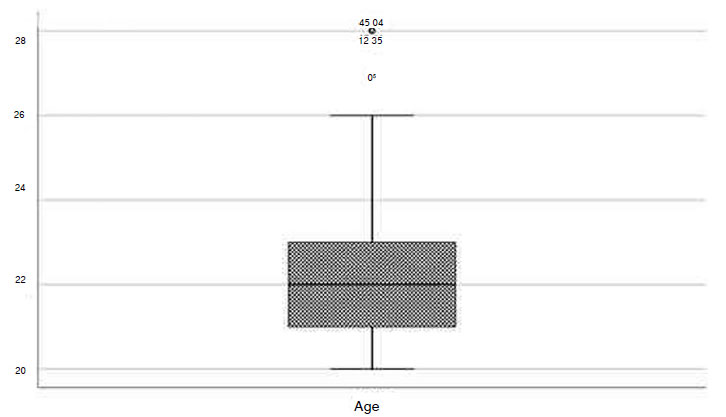
Figure 1. Distribution of students, by age, in the sample.
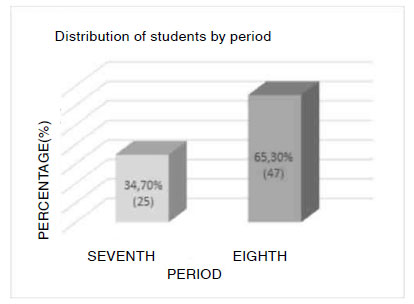
Figure 2. Distribution graph of students, by period, in the sample.
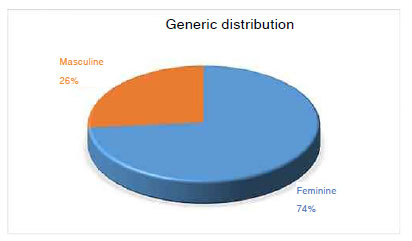
Figure 3. Distribution of students by period Percentage.
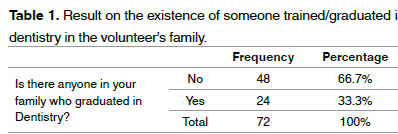
When asked if there is someone in their family who graduated/graduated in Dentistry, the distributions of responses are expressed in Table 1.
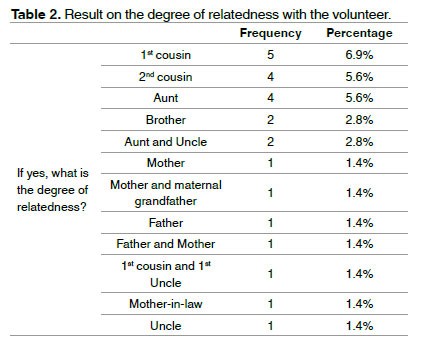
Of the 33.3% (24) students who have relatives who are dentists, the degree of relatives was distributed according to Table 2.
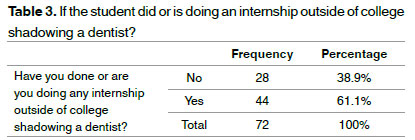
When the student was asked if he did or is doing an internship outside of college shadowing a dentist, it was shown in Table 3.
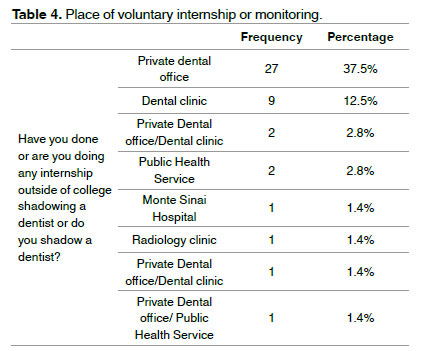
Of the 61.1% (44) students who did or are doing an internship outside of college shadowing a dentist, the internships were divided as follows: Table 4
According to the survey, when asked: “Which dental specialty do you like the most/or feel an affinity for?”, the results obtained were expressed as frequency and absolute values. We observed that the dental specialty with which the volunteers most identify are, as follows: prosthesis with 30.5%, 13.80% endodontics, and surgery, respectively. (Figure 4).
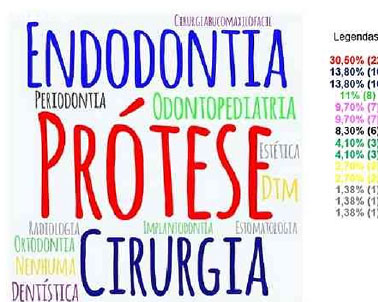
Figure 4. Dental specialty that you like the most/or feel an affinity for.
According to the data, 55.6% of volunteers know some type of digital means that have applicability in Dentistry (Table 5), with the best known being the CAD/CAM system with 23.60%. (Figure 5).
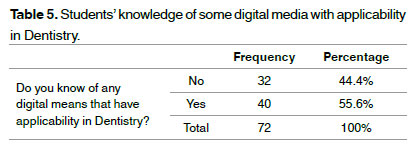
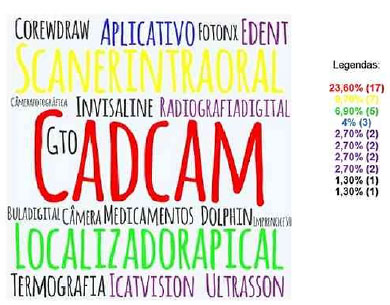
Figure 5. Digital means that the academic likes most/or feels affinity with.
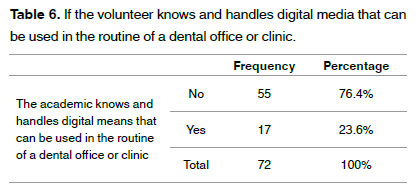
According to our study, 76.4 of the volunteers know and handle the digital media used in the daily routine of a dental office or clinic (Table 6), and 98.6% of the volunteers believe that a software can facilitate the management of information in practice dental. (Table 7).
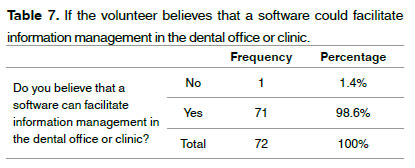
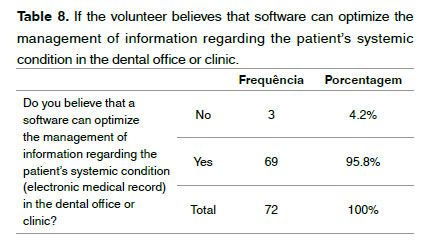
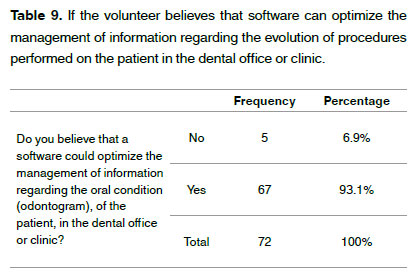
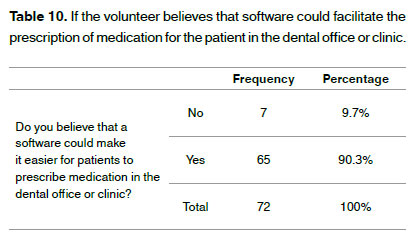
It is noted that the majority of students believe that software can help in their day-to-day dental practice. According to our research, 95.8% of students (Table 8) believe that the software can improve the management of information about the systemic condition of patients and the evolution of procedures performed with 93.1% (Table 9). Furthermore, 90.3% state it would make medication prescription easier. (Table 10)
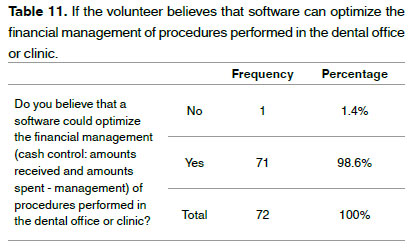
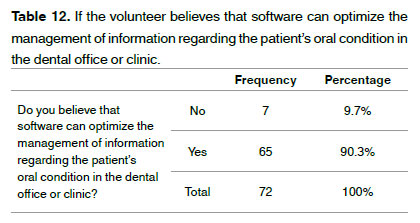
According to the data obtained, 98.6% of volunteers believe that using the software can help manage the office’s financial information (Table 11) and 90.3% believe it improves the management of information about the oral condition of each patient care. (Table 12)
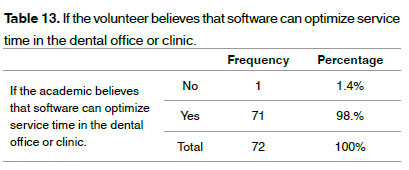
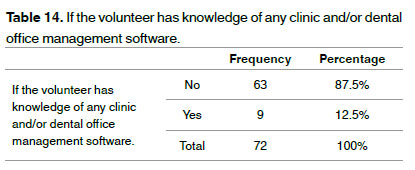
According to the data obtained, 98.6% of volunteers believe that a software can optimize service time at the dental clinic (Table 13), but 87.5% are not aware of any management software used in dental clinics (Table 14).
DISCUSSION
The use of digital information and communication technologies has changed society, the popularization of information technology has enabled dentists to use these resources in their work environment(8). Dental software is an application that enables complete, easy, and practice of clinical and administrative tasks in dental offices or clinics(9). In the present study, we found that 55.6% of Dentistry students know some digital means with applicability in the area, which differs from the literature, where the vast majority of professionals did not have any type of knowledge about IT within Dentistry in their undergraduate course (74.38%)(10). Another variable analyzed was the average number of students who know any clinic management software, which is 58.4 %, in agreement with the literature average, which identifies that 56% of dental surgeons have heard of or know some type of digital software(11).
According to Amit A et al.,(12) more than two-thirds of respondents stored administrative information such as expense reports, insurance details, patient consultation, patient accounting, and billing entirely on computers. In the present study, 98.6% of the students interviewed believe that a program can facilitate the management of information in the office or clinic, and also, with the same statistics, 98.6% of those interviewed believe that a program could facilitate and optimize the management financial aspects of the procedures performed in the office.
Regarding the software, it can facilitate the management of information regarding the patient’s systemic condition (electronic medical record), 95.8% of those interviewed believe that the program facilitates such management, which is in agreement with the literature, which has shown that managing large volumes of paper information is expensive and often inefficient(13).
In a study performed by Perondi et al in 2008(14), it was observed that after the installation of electronic medical records in a pediatric emergency room, the average length of stay for patients was two hours less than in the period prior to installation, there were no records lost, and 1.2% more patients were hospitalized. Of the students interviewed in this survey, 98.6% believe that a software could optimize service time also in the dental office, which brings benefits to the patient and the dentist, such as reducing waiting times of the patient and increasing the number of appointments for the professional.
According to Machado RPA et al(15), administrative management software is an important resource in rationalizing the activities of health professionals and the implementation of information technology in the teaching of Dentistry is extremely important for the training of new professionals. This is an important factor, but still not widely used, as shown by the research results, where only 23.6% of dentistry students responded that they have knowledge and use digital media that can be used in the routine of a dental office or clinic.
A feasible alternative for solving the problems generated by the use of common medical records, such as the need for physical storage spaces, as well as the difficulty in accessing the data available in the medical records, arises from the possibility of including digital medical records(16). We note, in this study, that 93.1% of students believe that software facilitates the management of information regarding the evolution of procedures in the dental office or clinic. This can be justified, as the electronic medical record provides tools, not available with the paper system, that directly affect the quality of patient care and services(17).
The advancement of programs (software) in Dentistry is already a reality, in the research performed by Benedicto EM et al.,(18) in a college in the master’s degree course, 41.76% of the dentists interviewed have digital files of their patients. Given the enormous range of application systems available for dental use, the dentist must be aware of the criteria necessary to choose the software most appropriate to his needs(19).
The insertion of ICTs in the academic environment, despite being slow, is already being performed. According to Pereira TA et al., the computer, as a tool to support the teaching and learning process, especially the internet, favors the development of interdisciplinary and cooperative proposals and encourages an investigative stance in relation to knowledge(20). To adapt to the mediatized communication of knowledge, teachers need to recognize the role of technology as a learning resource and increasingly understand themselves as a guide and collaborator of the student in the construction of knowledge through multimedia mediation(21).
Information, Communication, and Education Technology represent a successful union in the places where they were used, due to the ability to unite the traditional with the modern(22). In the didactic dimension, it is important for teachers to explore this progress, and employ these new technologies in their classes. techniques and the use of these instruments by students is very common. This makes it easy and natural to use to expand learning. In healthcare, ICTs are gaining ground and ensuring better performance for professionals, who can meet greater demand from patients with great efficiency through these innovations(23).
CONCLUSION
After analyzing data from the present study, it was found that, although dentistry students know the importance and numerous benefits of using digital technologies in dental offices and clinics, both for management and improvement in dental care, they do not have contact with such devices during graduation.
For the implementation of information and communication technologies to be performed more frequently in dental offices and clinics, future dental surgeons need to have contact with them in an academic environment, but for this to happen, greater preparation is required from Dentistry teachers to adapt digital means and familiarize these students, in addition to colleges needing to be prepared to deal with this advance, which despite being great is undeniably advantageous.
REFERENCES
1. Lopes RT, Pereira AC, Silva MAD. Comparative Analisys of the Familiarity and Use of ICT by Dental Students. R. Rev Bras Edu Med. 2016;40(2):254-60.
2. Antonarakis, GS. The European computer driving licence and the use of computers by dental students. Eur J Dent Educ. 2009;13(1):66-7.
3. Levine AE, Bebermeyer RD, Chen JW, Davis D, Harty C. Development of an interdisciplinary course in information resources and evidence-based dentistry. J Dent Educ, 2008;72(9):1067-76.
4. Almeida SM, Carvalho SPM, Radicchi R. Legal aspects of dental records: a review about legality, privacy and acceptance in the legal environment. Rev Bras Odontol Leg RBOL. 2017;4(2):55-64.
5. Saraiva AS. The importance of dental records- with emphasis on digital documents. Rev. Bras. Odontol. 2011;68(2):157-60.
6. Carvalho RB, Pacheco KTS, Eskórci BPS, Fiorott BS, Rasseli RCS. Informatização na área da saúde/odontologia: prontuário único e eletrônico do paciente. Rev Bras Pesq Saúde. 2012;14(3):58-67.
7. Mota FRL. Prontuário eletrônico do paciente e o processo de competência informacional. R. Eletr. Bibliotecon. 2006;11(22):53.
8. Holanda DA, Mello VVC, Zimmermann RD. Documentação Digital em Odontologia. Odontol. Clín.-Cient. 2010;9(2):111-3.
9. Viola ACMONV, Dotta EAV. Informatização do consultório odontológico. Rev.bras. Odontol. 2010;67(1):56-9.
10. Dotta EAV, Serra MC. Conhecimento e Utilização da Informática pelo Cirurgião-Dentista como Ferramenta de Trabalho. RGO. 2006;54(2):99-102.
11. Lolli LF, Kadowaki LM, Lolli MCGS, Marson FC, Freitas KMS, Oliveira RCG. Documentos digitais em odontologia: aspectos de legalidade, conhecimento e utilização por cirurgiões-dentistas. UNINGÁ Review. 2011;8(2):112-21.
12. Acharya A, Schroeder D, Schwei K, Chyou PH. Update on Electronic Dental Record and Clinical Computing Adoption Among Dental Practices in the United States. Clin Med Res, 2017;15(4):59-74.
13. Silva GA et al. Documento eletrônico: aspectos técnicos e regulamentação legal. UNB Labredes MFE. 2006;18(1):89-93.
14. Perondi MBM, Sakano TMS, Schvartsman C. Utilização de um sistema informatizado de atendimento em pronto-socorro pediátrico com sistema de escore clínico de triagem. Einstein. 2008;6(1):31-6.
15. Machado RPA, Scherma AP, Pisa IT. Uso da informática na odontologia. Clipe Odonto - UNITAU. 2012;4(1):31-7.
16. Fonsêca GS, Azevedo ACS, Diniz DSOL, Menezes FS, Silva MLCA, Musse JO et al. Aspectos legais da utilização de Prontuário Digital na Odontologia. RBOL. 2014;1(1):69-77.
17. Zanetta S, Wolynec E, Madeira W. 12 anos de PEP: um relato de uso do prontuário eletrônico na saúde pública brasileira, do mainframe à WEB. Disponível em:.
18. Benedicto EN, Lages LHR, Oliveira OF, Silva RHA, Paranhos LR. A importância da correta elaboração do prontuário odontológico. Odonto. 2010;18(36):41-50.
19. Kubo CS, Adolfi Junior MS. Os sistemas aplicativos (softwares) no consultório odontológico. Revista Internacional de Aprendizaje y Cibersociedad. 2014;18(2):60-77.
20. Pereira TA, Areco KCN, Tarcia RML, Sigulem D. Uso das Tecnologias de Informação e Comunicação por Professores da Área da Saúde da Universidade Federal de São Paulo. Revista Brasileira de Educação Médica. 2016;40(1):59-66.
21. Hack JR, Negri F. Escola e tecnologia: a capacitação docente como referencial para a mudança. Ciências & Cognição 2010;15(1):89-99.
22. Oliveira Júnior JK, Silva MAD. As tecnologias de informação e comunicação como ferramenta complementar no ensino da histologia nos cursos odontologia da Região Norte. J. Health Inform. 2014;6(2):60-66.
23. Silva AF, Pauferro BCS, Cruz GM, Trezena S, Batista RWC. O uso das Tecnologias de Informação e Comunicação no Ensino em Odontologia. RV ACBO. 2019;8(1)-33-39.