
Nursing, through care practices and the production of scientific knowledge, has contributed to the process of building a nursing care increasingly directed towards the search for quality in a general scope and humanized patient care.
However, there is no way to effectively intervene in order to provide a humanized without seeking excellence in understanding the various features that make up the symptoms and therapies, inherent to the various pathologies that are part of daily nursing care, especially in relation to intensive care in pediatrics, which requires agility, as well as skilled and specific care. Although only 50-10% of hospitalized patients require intensive care, most hospital acquired infections occur in this unit1 and the rate of hospital infection in intensive care unit (ICU) is 5-10% and up to double this number.2
The defense mechanisms of the respiratory system may show decreased efficiency during hospitalization. This reduction occurs as a result of conditions caused by the pathology itself or by an invasion of the body, crossing natural barriers and also by changes in drug therapy.3
Seriously ill patients requiring prolonged intensive care are most at risk of acquiring infections. Factors that contribute to the high infection rate and mortality in ICUs are possibly associated with the severity of the underlying disease, invasive procedures, the prolonged duration of hospitalization and use of antibiotics, especially those of broad spectrum, favoring the emergence of multidrug-resistant bacteria, which complicates therapy.4
In ICUs, pneumonia is the most frequent infection in Europe and the second most diagnosed infection in U.S. hospitals. The high mortality rates observed in hospital pneumonia largely reflect the factors related to the patient, the institution and regional characteristics. Because many patients with pneumonia also have other underlying pathologies, such as immunosuppression, altered level of consciousness and/or cardiopulmonary dysfunction, the rapid start of adequate antimicrobial therapy is crucial for therapeutic success.4
Pneumonia, together with surgical infections, sepsis and urinary tract infections, is the leading cause of death among hospital-acquired infections, accounting for approximately 10% of all hospital infections. Its prevalence in ICUs is 10-65% and its lethality is 13-55%.5 As for the length of the stay of the patient, it increases on average nine days, considerably increasing hospital costs.6,7. Pneumonia involves distal inflammation of the lung caused by infection by microorganisms and is histologically characterized by the accumulation of neutrophils in the distal bronchioles, alveoli and interstitium.8
Mechanical ventilation constitutes a great progress in intensive care, formulated as a method of artificially ventilating patients incapable of breathing spontaneously, reducing the work of breathing and preventing progressive circulatory failure secondary to increased production of CO2. Often considered a method of support that has saved the lives of critically ill patients, it is also associated with risks, side effects and complications. Many of these problems are not directly related to the use of the ventilator itself, as is the case of nosocomial pneumonia, which results from a series of factors which include intubation. Patients submitted to invasive mechanical ventilation, which have the first lines of defense against infection altered, are patients who are at higher risk for nosocomial pneumonia.8
Ventilator-Associated Pneumonia (VAP) generally develops 48 hours after placement, being an inflammatory host response to the uncontrolled multiplication of microorganisms invading the distal airways. It is the most common nosocomial infection in intensive care units.(5, 9-10) The incidence of VAP is high, ranging between 6 and 52% depending on the population studied, type of ICU, and the type of diagnostic criteria used. This is because despite it being an extremely important infection, it is one of the most difficult to be diagnosed in a seriously ill patient.11 Thus, promoting quality of life in an intensive care environment becomes a difficult issue, because at such a critical time the utmost concern is the fight against death, making use of all invasive procedures required. Endotracheal intubation is between the countless procedures used.9
The risk factors for the development of VAP can be classified as modifiable and non-modifiable. Non-modifiable risk factors are: age, severity score upon admission to the ICU and the presence of comorbidities (heart failure, chronic obstructive pulmonary disease, diabetes, neurological diseases, cancer, trauma and post-operative recovery). Modifiable factors relate to the environment (microbial flora) in the ICU. Thus, recognition of the most frequent germs in the unit is crucial.12
In this context, studies seeking to establish care guidelines in order to systematize and streamline service tend to contribute to the quality of care.13
Many of the considerations when selecting the most appropriate empirical treatment for serious infections in adults and children are very similar and include: presence and type of infection focus, severity, the patient's immune status, age, community or hospital-acquired.14:16
The diagnosis and management of infections in hospitalized patients in the ICU is a challenge because one third of patients who are admitted present fever without focus at some time during hospital stay. This situation often results in prolonged hospitalization, requests for multiple laboratory tests and, on occasions, inappropriate use of antibiotics. Moreover, approximately 20-30% of patients with sepsis do not show clear clinical focus. This is compounded because the possibility of documenting infections in a pediatric intensive care unit (PICU) is a complex task, since only about 30% have positive blood cultures when the focus is not endovascular (bacteremia associated with central venous catheters). The late start of antibiotic treatment is related to increased mortality associated with these infections, which is why early and appropriate treatment is essential.15 It is estimated that the incidence of VAP in adults exceeds 10%. The incidence in children, estimated by the National Nosocomial Infections Surveillance System (NNIS) is 20%.16: 30
Based on these considerations, this study aims at an integrative literature review and to increase knowledge on the subject of research to improve nursing care to pediatric patients in the ICU with VAP due to nosocomial causes.
Thus, the general aim of this study was to evaluate how the literature presents VAP in pediatric patients in the ICU, checking if there are national care protocols or guidelines in this area.
The issue sparked interest, and the aim was to observe how this pathology is managed when it occurs in a pediatric patient with VAP, and to promote prevention of this nosocomial disease.
METHODOLOGY
To achieve the general goal, we used the method of integrative literature review. This method makes it possible to summarize research already completed, and to draw conclusions from a topic of interest. A well conducted integrative review requires the same standards of strictness, clarity and replication used in primary studies.17
An integrative literature review, as well as providing a synthesis of the knowledge produced about a certain topic, also allows one to see of gaps in evidence in professional practice and provides context in a particular topic.18
A study from 2007 mentions, based on Broome, that "the integrative review is defined as a review of previous studies that are summarized by means of an extraction of the findings of many studies".19:36
For the development of this integrative review, the following steps were followed: establishment of the issues for review, determination of inclusion and exclusion criteria for articles (sample selection), definition of information to be extracted from selected articles, analysis of results, presentation of results and discussion.
The following databases were used to select the articles: Biblioteca Virtual de Saúde (BVS-BIREME), favoring the databases LILACS, SCIELO and BDENF (Base de Dados da Enfermagem). The choice of three different databases aimed to minimize, in extent possible, biases that may arise in this type of research.
Inclusion criteria for articles were: articles in electronic media, with abstracts available in the selected databases and with available information about goals, methods, results and conclusions of the study.
The period considered was 1999-2007. Articles that describe procedures, interventions or nursing guidelines for VAP were included. The proposed descriptors for the study were: VAP, ventilator-associated pneumonia, nosocomial pneumonia, Pediatric ICU. To filter through the BVS, the following descriptors were associated: pediatric ICU nosocomial pneumonia, infection pediatric ICU, pediatric ICU VAP.
The search was conducted by online access. For the analysis and subsequent synthesis of the articles that met the inclusion criteria, a summary table built especially for this purpose was used, with the following aspects considered relevant: the name of research, authors' names; recommendations/conclusions.
To develop the analysis articles on conceptual aspects, diagnosis and pediatric VAP management were selected, in order to review and quantify those articles that contain features that meet the objectives proposed for the study.
Results and discussion of the data obtained are descriptively presented, allowing the reader to evaluate the applicability of the integrative review prepared, and also to achieve the goal of this method, i.e. positively impact the quality of nurse practice, providing support for nurses to act and contribute to the optimization of care for pediatric patients affected by VAP, also having in mind further studies to create care protocols.
The representation of this quantification is presented in the next chapter, Results.
RESULTS
Of the initial sample of 34 references in Lilacs, 4 in Scielo, 1 in BDENF and 208 in "google scholar", totaling 247 literatures, filtering was conducted according to the inclusion criteria listed in the method, thus obtaining, after excluding repeated articles (39), a total of 12 items (abstracts and full texts), of which 8 corresponded to the goals.
It is noteworthy that during the analysis of selected texts, two additional cited literatures were found in the articles reviewed, to which electronic access was obtained, and they were added to the research. With this, a total of 10 articles met the objectives proposed.
The proposed objective for the present study was resumed, which was to "evaluate how the literature presents VAP in pediatric patients in the ICU, so as to verify if there are national protocols or guidelines in this context for assistance". It was found that the literature, according to the adopted approach can be categorized as follows: risk factors, incidence / prevalence, mortality, diagnosis approach and treatment. As for whether or not care protocols or guidelines are in place, the authors found only one article addressing the guidelines subject. The tables below present the distribution of literature according to the categories proposed.
Risk Factors
For risk factors, one article was found, as presented in Table 1.
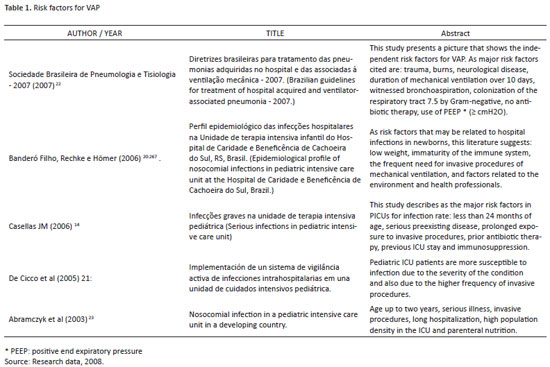
As shown in table 1, five studies discuss the risk factors for infections in pediatric ICU and the need for invasive procedures, especially mechanical ventilation, is a factor cited in all selected studies as a predisposing factor for the occurrence of infection. Another factor cited as important is the severity of the patient's condition. Age below 24 months or up to two years is another important factor cited in two studies.23,24 Previous antibiotic therapy is cited as a risk factor in the study of the Sociedade Brasileira de Pneumologia e Tisiologia22 however, in the study by Casellas,23 previous antibiotic therapy is highlighted as a risk factor, thus showing a controversial point that indicates the need for further studies.
Incidence and prevalence
Reference to the incidence and prevalence was found in 7 articles as presented in Table 2.
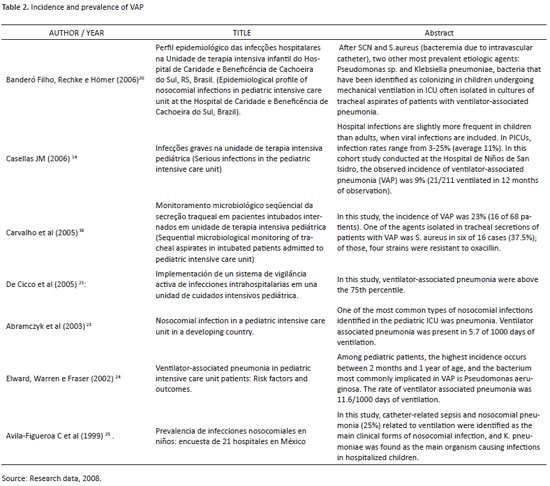
The incidence and prevalence of significant ventilator-associated pneumonia is reported in most studies found in this review. The study by De Cicco et al 21 reports that pneumonia associated with ventilation was above the 75th percentile. The study by Carvalho et al 16, reports prevalence of 37.5% of VAP.
Bacteria in discussed in three studies20, 24, 25 as prevalent were Pseudomonas spp and Kebsiella pneumoniae, and there are also references to S. aureus.16 According to Casellas et al,14 nosocomial infections are somewhat more frequent in children than in adults, and in PICUs, infection rates range from 3-25% (average 11%).
Mortality
Two articles that studied mortality, as shown in Table 3.
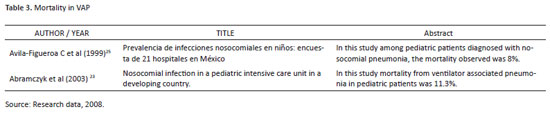
The two studies above were conducted in the pediatric ICU and showed a significant mortality rate, ranging from 8 to 11.3% thus indicating the need for specific studies in this population due to its frailty, in order to identify patterns for the development of specific guidelines.
Diagnostic approach
Oropharynx and tracheobronchial contamination by microorganisms is frequent in patients on mechanical ventilation 26:30. However, the relationship between colonization and lung infection is not yet clear.
In this study, we found four articles that deal with the diagnostic approach, as shown in Table 4.
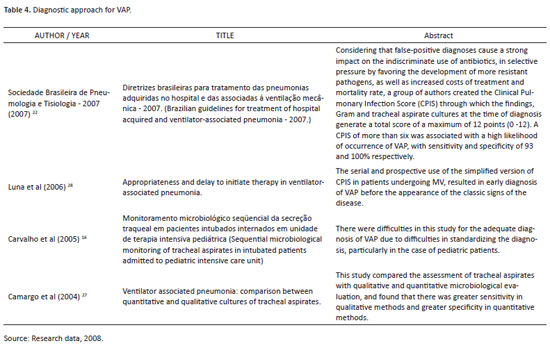
The national guideline of the Sociedade Brasileira de Pneumologia e Tisiologia proposes the use of the Clinical Pulmonary Infection Score (CPIS) proposed and researched by Pugin et al,29 which generates a total score of 12 points maximum (0 -12). This guideline clarifies that CPIS greater than six was associated with a high likelihood of occurrence of VAP, with sensitivity and specificity of 93 and 100% respectively. The study of Luna et al28 indicates that CPIS resulted in early diagnosis of VAP, before the appearance of the classic signs of the disease.
This score, in principle considers the general population, however, it is apparent through this review that the study by Carvalho et al 16 discusses the difficulties of proper diagnosis of VAP because of the difficult diagnostic standardization for pediatric patients.
Therefore, the authors understand that further studies using the CPIS specifically for pediatric patients may bring clearer evidence for studies of VAP in pediatric patients.
Treatment
Two articles addressed treatment, as shown in Table 5.
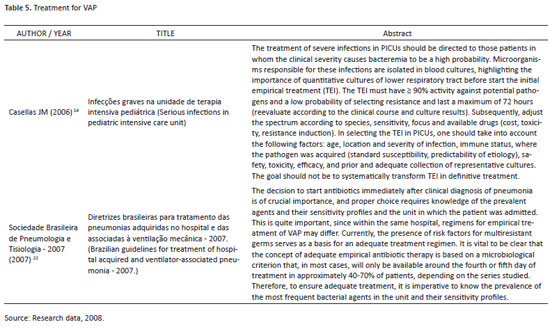
A key point highlighted in the choice of treatment is to be aware of the presence of risk factors for multi-resistant germs, and then treat with VAP with appropriate antibiotic therapy since this is considered the "gold standard" treatment for this type of pathology.
The concept of adequate empirical antibiotic therapy is based on a microbiological criterion that, in most cases, will only be available around the fourth or fifth day of treatment in approximately 40-70% of patients, depending on the series studied 22:14.
Through literature, one sees that the identification of the causative agents of VAP is crucial, as only then will their sensitivity profiles be understood, creating an appropriate empirical antibiotic therapy. It is possible to say that each case requires specific treatment.
Now, to resume an adjacent approach of this study, the authors sought to check whether there are national care protocols or guidelines in this area.
The literature review identified a national guideline of the Sociedade Brasileira de Pneumologia e Tsiologia, published in 2007.22 This guideline states that several studies presented evidence that initial treatment with an appropriate antimicrobial regimen results in lower mortality rates. The guideline emphasizes that its goal is to provide the basis and information that can assist in the preparation of empirical treatment regimens guided by the risk of potentially resistant pathogens as shown in Figure 1.
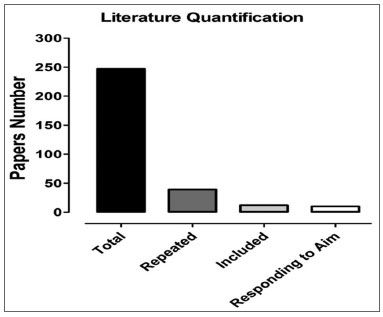 Figure 1. Results of research
According to research conducted for this study, the determination of an appropriate empirical antibiotic regimen for VAP should consider the following key points:
Development of appropriate empirical antimicrobial regimens reduces mortality. (Grade B). In patients with high pre-test probability of pneumonia, a delay to start treatment increases the risk of death. (Grade B). The impact on reducing mortality resulting from changes in antimicrobial therapy after culture results is not clear. However, the etiological investigation should always be performed, since its results provides information on the patterns of bacterial resistance, help to reduce costs and provide data on the local epidemiology. (Grade B).22:14
It should be clarified that these basic points mentioned in the study of the Sociedade Brasileira de Pneumologia e Tsiologia are based, as identified on the quote, in grade B evidence, which are cited as from a "limited database", being based on:
Intervention studies that include only a limited number of patients, post-hoc or subgroups ERCs analysis, or meta-analysis of ERCs. In general, the "B" category is appropriate when there are few randomized trials, when they are small in size, when they are conducted in a population that differs from the recommended target population, or when the results are somehow inconsistent.22: 1.
It is noted that:
It is not recommended that one of the options presented be simply chosen for treatment, it should serve as the basis for a broad discussion within each hospital, including pulmonologists, intensive care physicians, general physicians and infection control professionals when developing their own empirical treatment protocols. Among the functions of the Hospital Infection Control, which are mandatory in Brazilian hospitals according to the Ministry of Health (Decree 2616, May 12, 1998), the most prevalent pathogens and their antimicrobial susceptibility profile must be known and systematically informed, and from there treatment protocols should be developed.22: 12
It is noteworthy, however, that this study did not find any specific reference to treatment in pediatric patients. On the other hand, according to data already shown in Table 4, which represents studies that reported data on diagnostic approach, according to a study by Carvalho et al16, diagnostic standardization for pediatric patients is difficult. Therefore, this evidence indicates that future more specific and better targeted studies, perhaps randomized controlled trials conducted with the pediatric ICU population affected by VAP, can bring more specific evidence for the development of protocols and guidelines aimed at such a fragile population.
Randomized controlled trials are recommended because, according to data from the Sociedade Brasileira de Pneumologia e Tisiologia, evidence based on this type of study are well delineated and "provide a consistent model of findings in the population for which the recommendation is made. Category A requires substantial numbers of studies involving an adequate number of participants".22:1
FINAL CONSIDERATIONS
One can consider that there are yet few studies addressing pediatric VAP. It is felt that invasive procedures, mainly MV, are risk factors for infection in pediatric ICU. As these factors usually cannot be changed because, aside from the VM, the patient's age and the use of antibiotic therapy are also considered, there is an increased incidence and significant prevalence of VAP, with children presenting hospital infection more often and significant mortality rate.
Microorganisms colonizing the bronchial tree and oropharynx are often responsible for contamination of patients undergoing MV. To start treatment, literature recommends that the bacterial agents be identified by creating an appropriate empirical antibiotic therapy. It should be taken into account that there are few studies mentioning pediatric patients, highlighting that further studies must be conducted to produce more evidence, which could contribute to the development of protocols and guidelines directed at the pediatric population, helping to reduce these high rates of infection and mortality in children.
It was observed that the literature discusses risk factors, incidence/prevalence, mortality, diagnostic approach and treatment, and that further studies using CPIS (Clinical Pulmonary Infection Score) specifically for pediatric patients may help to establish more clear evidence.
Regarding the existence of guidelines or care protocols, there is a national guideline of the Sociedade Brasileira de Pneumologia e Tisiologia, which does not include specific data for pediatric patients, once again highlighting the need for further studies with pediatric patients.
REFERENCES
1. Moraes, AAP, Santos, RLD. Infecção em UTI geral de um hospital universitário. Revista Brasileira de Terapia Intensiva. [internet] v.15,n.4,out./dez.2003. [Acesso em 2006 jul. 30] Disponível em: