
INTRODUCTION
Coronaviruses are a huge family of viruses common in many species of living beings, such as MERS-CoV and SARS-CoV, capable of causing different types of infections. However, in the literature over the years, manifestations in humans were rarely described, until, recently in December 2019, there was the transmission of a new type of coronavirus (SARS-CoV-2), which was identified in Wuhan, China, and has since become known worldwide as the cause of COVID-19(1), due to the pandemic scenario. This disease, COVID-19, was spread rapidly and transmitted from a person infected with the virus to another uninfected person, through close contact with droplets of saliva, sneezing, coughing, phlegm, shaking hands, contaminated objects and surfaces, until reaching the pandemic scenario(2) and becoming a source of attention with worldwide consequences.
COVID-19 has a varied clinical spectrum, which may be related to previous comorbidities, socio-environmental factors, and genetic susceptibility (3). Furthermore, the infection can range from asymptomatic to severe clinical conditions, which may require hospital care(2,3). In this regard, musculoskeletal pain stands out, a symptom of high incidence that can occur in different regions of the body and can cause great suffering to the patient(2). Therefore, as the months passed during the pandemic, more and more evidence emerged showing that COVID-19 is associated with myalgia, referred pain, and hyperalgesia, in addition to that, the so-called “COVID era” favors the psychosocial model of pain, which is multifactorial, involving the biological, psychological and social damage of each individual. All of this, causes severe impacts on the quality of life and daily activities of many people affected by the disease(3).
Therefore, more and more investigations are needed into different aspects related to COVID-19, to understand more about this global disease with the aim of minimizing the impacts of symptoms on the health and quality of life of people affected by the virus. Therefore, this research emerged aiming to evaluate the incidence and epidemiology of musculoskeletal pain in patients hospitalized with a diagnosis of COVID-19, aiming to contribute with data capable of helping to understand the clinical effects of this new disease.
METHODS
This is a longitudinal observational study, performed in the ward of the COVID-19 sector of the Hospital Municipal José de Carvalho Florence in São José dos Campos (HMJCF) - SP, starting in September 2021 and ending in December 2021. The project was approved by the Research Ethics Committee of the Anhembi Morumbi University (Opinion: 4,961,046). The research inclusion criteria are patients admitted to the ward with a positive diagnosis of COVID-19, of both genders, aged 18 years or older, and with symptoms of musculoskeletal pain. In turn, the exclusion criteria are patients who do not present musculoskeletal pain, that is, if the infected patient interviewed did not present the target symptom of the research, he/she would be excluded from the study, in addition to not detriment of cognitive capacity to respond to questions. assessment questions also asked of patients with suspected infection or even having symptoms, but who tested negative for COVID-19.
To perform this research, weekly visits were made to the HMSJC COVID-19 ward in an active search for patients who had the symptoms of musculoskeletal pain associated with coronavirus infection, which was performed through the application of an assessment form developed for the data collection with the topics: gender, age, occupation, comorbidities, length of hospital stay, need for admission to the Intensive Care Unit (ICU), intensity of pain reported using the Visual Analogue Scale (VAS), subjective characteristic of pain, location of pain and general symptoms associated with hospitalization. These collected data were organized through Excel tabulation, extraction of epidemiological data, means, and standard deviation. All participants were interviewed after signing the informed consent form.
RESULTS
In front of all interviewed participants (80 patients), it was observed a 25% incidence of musculoskeletal pain (20 patients), (Figure 1). The average age of participants with musculoskeletal pain was 50 years, with 75% (15 participants) being male and 25% female (five participants). The average length of hospital stay was five days and two patients with the target symptom (10%), after worsening their respiratory condition, required admission to the Intensive Care Unit (ICU) and died (Table 1). The intensity of pain, assessed by the Visual Analogue Scale (VAS), had an average value of seven out of a total of 10 points and the region where the highest incidence of pain was observed was in the legs, with eight of the total cases recorded. Of the remaining participants with the target symptom, seven had back pain and six of these seven individuals reported the lumbar portion as the main painful point. Two other patients reported generalized muscle pain not associated with fever and only one reported pain in the plantar region, with another individual complaining of pain in the back of the head (Figure 2).
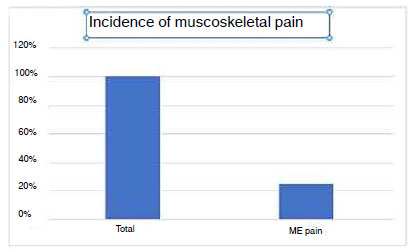
Figure 1. Total number of patients interviewed, with the percentage of patients who presented the target symptom of the research, muscoskeletal pain.
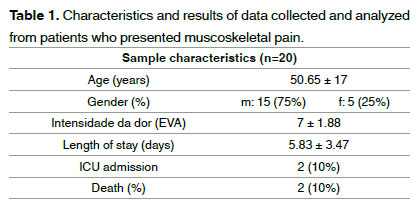
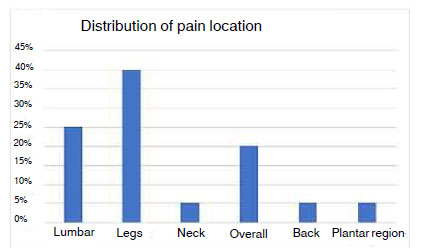
Figure 2. Anatomical arrangement of skeletal muscle pain reported by patients with the percentage of incidence of the symptom by body location.
DISCUSSION
After more than two years of the pandemic, researchers are seeking to increase understanding of the symptoms related to COVID-19 infection. In a meta-analysis (4) published in 2020, information shows that the prevalence of musculoskeletal pain was 19% and that this myalgia, as it is a lesser-known symptom related to possibility of COVID-19, is often not noticed by people, who think they do not have the disease(4). Data from our longitudinal observational research demonstrate a similar prevalence to the aforementioned meta-analysis, and dissociation of body regions was also performed for a more specific analysis of musculoskeletal pain and the site of greatest involvement. The region with the highest incidence of myalgia was the back, which is similar to what the literature has shown.
Other significant data from a different study that followed 3762 patients over seven months show that, of these, 1747 (46%) still had some persistent symptom, with muscle pain being present in more than 50% of cases with chronic myalgia(5).
Huang et.al.(6) published in 2021 a follow-up of post-COVID-19 patients and 628 (63%) of the individuals evaluated out of a total of 997 had persistent fatigue and 239 (24%) - after undergoing a test of 6 minutes of walking -performed with a distance below the lower limit of the expected result, which is alarming for the patient’s prognosis and musculoskeletal pain is one of the main causes of this decrease in the ability to perform the walking test. Furthermore, many of the participants in this research (Huang et.al.)(6) still had myalgia, close to the time of hospital discharge, which makes it necessary to monitor these individuals for a longer period as this portion of the population will need future assistance in primary health care to control this persistent condition. Therefore, this level of health care needs to be qualified and prepared to efficiently absorb and meet this patient demand.
There is also another relevant study to combine analyzes with our research that, through follow-ups of patients with post-COVID-19 musculoskeletal pain, its outcomes show that 12% of the total number of individuals had not yet returned to work(7), an alarming data, as there is a significant impact on the lives of patients and the economy of a country.
CONCLUSION
Musculoskeletal pain, especially in patients post-infected with SARS-CoV-2, is important in clinical practice and needs to be diagnosed and treated as soon as possible, as it can progress to chronification, generating a direct impact on individuals’ quality of life.
Accordingly, and because it is a new disease compared to others known in the literature, further studies are still needed regarding the general pathophysiology and musculoskeletal pain associated with COVID-19. This knowledge becomes extremely important, given its ability to have a long-term impact on the society and economy of a country, with the potential to become a serious problem, especially in primary health care.
Additionally, failure to return to work and activities of daily living before suffering from the disease due to musculoskeletal pain has a great potential impact on the quality of life of these individuals, as it can generate new problems for the patient, whether physical, social, or psychological.
REFERENCES
1. Yüce M, Filiztekin E, Özkaya KG. COVID-19 diagnosis -A review of current methods. Biosens Bioelectron. 2021 Jan 15; 172:112752. doi: 10.1016/j.bios.2020.112752.
2. Umakanthan S, Sahu P, Ranade AV, et al. Origin, transmission, diagnosis and management of coronavirus disease 2019 (COVID-19). Postgrad Med J. Dec 2020;96(1142):753-758. doi:10.1136/postgradmedj-2020-138234.
3. El-Tallawy SN, Nalamasu R, Pergolizzi JV, Gharibo C. Pain Management During COVID-19 Pandemic: A Review. Pain Ther. 2020 Dec; 9(2): 453-466 doi:10.1007/s40122-020-00190-4.
4. Abdullahi A., Candan S. A., Abba M. A., Bello A. H., Alshehri M. A., Afamefuna V E., et al. Neurological and musculoskeletal features of COVID-19: A systematic review and meta-analysis. Front.Neurol. 2020 Jun 11:687 doi:10.3389/fneur.2020.00687.
5. Davis HE, Assaf GS, McCorkell L et al. Characterizing long COVID in an international cohort: 7 months of symptoms and their impact. EClin. Med. 2021 Jul https://doi.org/10.1016/j.eclinm.2021.101019.
6. Huang C, Huang L, Wang Y. 6-month consequences of COVID-19 in patients discharged from hospital: a cohort study. Lancet. 2021 Jan 16;397(10270):220-232. doi: 10.1016/S0140-6736(20)32656-8.
7. Huang L, Yao Q, Gu X, Wang Q, 1-year outcomes in hospital survivors with COVID-19: a longitudinal cohort study. Lancet. 2021 Aug 28;398(10302):747-758. doi: 10.1016/S0140-6736(21)01755-4. Erratum in: Lancet. 2022 May 7;399(10337):1778.