
INTRODUCTION
Urinary incontinence, according to the international Continence Society (ICS) is defined as any involuntary loss of urine1. Stress urinary incontinence is the involuntary loss of urine synchronic to the effort as sneezing or coughing, urgent incontinence is the involuntary loss of urine associated with or immediately preceded by voinding urgency and mixed urinary incontinence is the involuntary loss of urine associated with urgency and also with the effort1.
Urinary incontinence is a condition that affects millions of people of all ages and both genders, especially women in menopause and post-menopause2. Its prevalence varies according to age and population observed3,4,5,6. It is estimated that around 17 million U.S. women have some type of urinary incontinence6. It is considered that one in four women aged between 30 and 59 years have experienced an episode of incontinence3. Prevalence rates of involuntary loss of urine are between 8 and 58% in the general adult female population6,7.8. In a study performed in norway in women over 20 years of age, the prevalence of urinary incontinence was 25%, and in women between 80 and 89 years this percentage was 46%2. Data relating to population, although still incipient point prevalence of urinary incontinence among women with 26.2% and 43%5,9,10,11.
The investigation of patients with urinary incontinence begins with history and gynecological examination, which should reproduce and characterize the urinary loss8,12. One in nine women may be unnecessarily operated when the diagnosis is based only on clinical propaedeutic8. Thus, the exams should always be part of the evaluation of diagnosis8. The analysis of urinary sediment and urine culture are mandatory, since urinary tract infection may be the cause of the symptoms, as well as urodynamic studies, which by analysis of abdominal pressure, bladder and urethral in the phases of filling and emptying of the bladder, allows more precise and objective characterization of the urinary disorder, being also useful for guiding treatment and monitoring of patients6,8,12.
Risk factors related to urinary incontinence include age, parity, menopausal status, use of medications and some comorbidities (diabetes mellitus, stroke, obesity)2,5,6,13,14,15.
Treatment will depend on the type and causes of urinary incontinence. It can be behavioral, pharmacological, physiotherapy or surgical6,12,15,16,17.
In Brazil, there are few studies on the prevalence of urinary incontinence, risk factors, level of knowledge of women about incontinence and percentage of women seeking medical attention complaining of urine loss10,18. However, in recent years, several studies have assessed the quality of life of incontinent women. When compared to continent women, those with urinary incontinence have poor quality of life with negative impact on sexual, social and professional aspects4,7,19,20,21.
The percentage of women seeking medical attention complaining about urine loss and the percentage of those who have urine leakage regularly or sporadically have shown divergent10,22. Rates of demand for medical care found in different studies are 4%, 6%, 11% and 14%7,22. Many women with mild and moderate incontinence do not seek medical care because they believe that urinary incontinence is a normal process and result from aging process7,23. Other common reasons for not seeking treatment is the fact that incontinent women are embarrassment in talking about their problem, low expectations on the benefits of treatment and lack of knowledge of where to seek such treatment7,23.
From this point of view, we became interested in assessing the level of knowledge about urinary incontinence in both groups of women of different socioeconomic levels, one constituted by attending private clinics and another consisting patients enrolled in outpatient public service, as well as the prevalence of urinary incontinence and seeking for treatment in both groups.
METHODS
Cross-sectional study was performed at the Clinic of Gynecology, University Hospital, Federal University of Sergipe (HU-UFS) and two private clinics with care in the field of gynecology and obstetrics of the city of aracaju, state of Sergipe, after project approved by the research ethics Committee for Human research of the institutions.
We included 197 women over age 40, waiting for care in the period from March to May 2009, and 93 from the HU-UFS (Public Sector), and 104 private clinics (Private Sector). All signed a written informed consent after being informed about the purpose of research.
A questionnaire consisting of two parts. Initially, it was reviewed sociodemographic data (age, race, education, marital status, family income), personal history, gynecological and obstetric as number of pregnancies, parity, menopausal status, presence of comorbidities, previous gynecological surgeries, presence of involuntary urine and treatment seeking. Then the women were asked to answer the Quiz on Urinary incontinence developed by Branch et al24 based on the recommendations of the AHCPR ( Agency for Health Care Policy and research) and the experience of the authors in the management of patients with urinary incontinence, which consists of 14 statements about urinary incontinence that participants could answer "agree", "disagree" and "do not know". Six of the 14 statements were true, and should be answered with "agree" and 8 were false and should be answered with "disagree".
The statements are grouped into four categories: treatment and effects of urinary incontinence, and three were true (Statements 4,5,6) and three were false ( Statements 11,13, 14); causes of urinary incontinence with three true ( Statements 3,8,10) and a false (Statement 12), the relationship between age and urinary incontinence with two false statements (Statements 1 and 2) and doctor-patient discussion about urinary incontinence, also with two false statements (Statements 7 and 9).
After collecting the information, the data were stored in spreadsheets using Microsoft office excelr, version 2007 for Windowsr. Statistical calculations were performed by using SPSS (Statistical Package for Social Sciences) version 15.0.
Numerical variables were described as mean and standard deviation. As for categorical variables simple and relative frequencies were used for summarizing them and confidence interval for 95% where applicable. We used the Shapiro-Wilk test for assessing the assumption of normality. For the relative hypotheses test concerning categorical variables we used the chi- square test or Fisher's exact test when appropriate.
The comparison between groups (public sector and private sector) was performed using Student's t test for independent samples. The confidence level was 0.05 for α error and 0.80 power and tests were assumed as two-tailed tests.
RESULTS
There was no significant difference between the mean age of patients in groups (Public Sector: 52.8, private sector: 51.6, p=0.3) (Table 1).
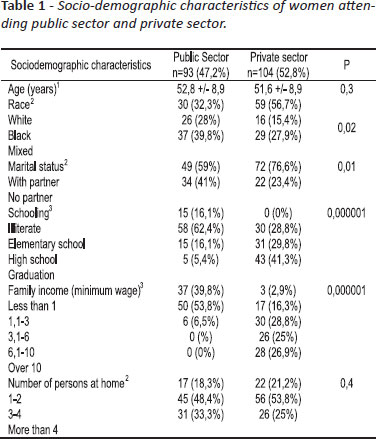
In relation to marital status, there was a higher prevalence of women with partners in the private sector (76.6%) than in the public sector 59% (p=0.01) (Table 1).
There was a significant difference (p< 0.0001 ) in the level of education between the two groups, registering a higher prevalence of illiterate (16.1%) and women with a high school education (16.1%) and fundamental (62.4%) in the public sector. In the private sector, there was a higher prevalence of secondary education (29.8%) and graduation (41.3% ) (Table 1).
Income distribution also differed significantly (p < 0.0001) between the public and private sectors and we observed a higher prevalence of women with incomes less than one minimum wage (39.8%) and between 1 and 3 minimum wages (53.8%) in the public sector, and higher wages than three minimum wages (80.7%) in the private sector (Table 1).
With regard to personal, gynecological and obstetric history there was significant difference (p=0.05) in the number of pregnancies between the two groups. In the public sector, 51.6 % had between 3 and 6 children, while in the private sector, 49 % had 0-2 children. There was no difference in the amount of normal deliveries between the two groups (p=0.05). In the public sector, 46.3% had three or more normal births, whereas in the private sector this percentage was 31.7%. The prevalence of having at least one cesarean section was 28% in the public sector and 39.4% in the private sector (p=0.09) (Table 2).
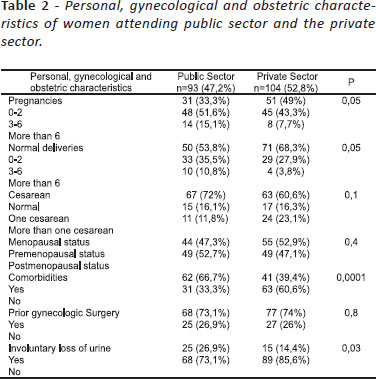
There was no significant difference in menopausal status among women in the two groups, 52.7 % of the public sector and 47.1 % of the private sector were postmenopausal (p=0.4 ) (Table 2).
History of pelvic surgery was reported by 73.1% of women in the public sector and 74% of women in the private sector (p=0.8) (Table 2).
Urinary incontinence was reported by 20.3% of participants, with a higher occurrence of episodes of urine loss among women in the public sector (26.9%) than among women in the private sector (14.4%) (p=0.03) (Table2).
When asked about the time of urine loss, 37.5 % reported lose urine less than one year. Of incontinent women, 55 % stated they had sought medical care. Among the 25 women with urinary incontinence in the public sector, 13 (52%) sought treatment for urinary incontinence, and in the private sector, of 15 women with urinary incontinence, 9 (60%) sought treatment (p=0.7).
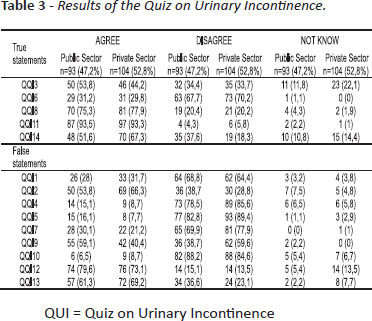
Nine of the 14 statements in the Quiz on urinary incontinence were answered correctly by more than half of the women interviewed in the two groups (Table 3).
Regarding statements approaching treatment and effects of urinary incontinence, 31.2% of women in the public sector and 29.8% of private sector agreed with the statement that most people who have involuntary loss of urine lives a normal life (Statement 6). The Statement 13, which states that surgery is the best treatment for involuntary loss of urine, was answered correctly by 36.6% of women in the public sector and 23.1% of the private sector (p =0.04). In the Statement 14, about which there are exercises that can help control the loss of urine when a person coughs, laughs or sneezes, 51.6% of respondents from the public sector and 67.3 % of private sector responded correctly (p = 0.01). The Statement 4, which states that in addition to absorbent, diapers and probes, little can be done to treat or cure the involuntary loss of urine, was answered correctly by 78.5% of women in the public sector and 85.6% of private sector (p=0.3). Of the women interviewed, 93.5% of the public sector and 93.3% in the private sector (p=0.7 ) correctly agreed with the statement that many people who have involuntary loss of urine can be cured and almost all significantly improve (Statement 11). The statement 5, which states that once people begin to lose control over urine and this is repeated on a regular basis, they can often never regain complete control, 82.8% women in the public sector and 89.4 % private sector (p=0.1) answered correctly (Table 4).
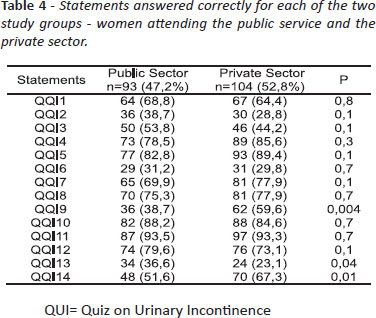
Regarding the statements that deal with the causes of urinary incontinence, a large percentage of women in both groups, 88.2% of the public sector and 84.6% in the private sector (p=0.7), disagreed with the statement that urinary incontinence can be caused by only one or two conditions (Statement 10).
In the statement 3, 53.8% of women in the public sector and 44.2 % of the private sector (p= 0.1) agreed that drugs can cause urine leakage. The statement 8 states that women are more likely to develop urinary incontinence than men and the 12 states that the involuntary loss of urine can be caused by various medical conditions easily treated, and both were answered correctly by the majority of women (75.3% of the public sector and 77.9% of the private sector, p=0.7%) (Statement 8), and (79.6% of the public sector and 73.1% of the private sector, p=0.1) (Statement 12) (Table 4).
With respect to statements that relate to the relationship between age and urinary incontinence, most women in both groups (68.8% in the public sector and 64.4% in the private sector, p=0.8) responded correctly when they disagree with the statement 1, which states that the involuntary loss of urine is a result of normal aging. However, a minority of women in both groups, 38.7% of the public sector and 28.8% in the private sector (p=0.1), disagreed with the statement 2 that most people lose control of urine regularly when they reach age 85 (Table 4).
As for the statements that deal with the relationship between doctor and patient, they correctly answered the Statement 7 that disagreed that most physicians ask for their older patients if they have problems with bladder control, 69.9% of women in the public sector and 77.9% of private sector (p=0.1). Among the women interviewed, 38.7% of the public sector and 59.6 % in the private sector (p=0.004) disagreed with the Statement 9, which states that most people with involuntary urine loss mention it to their doctors (table 4).
DISCUSSION
The urinary incontinence is a condition that significantly affects the quality of life of women8,12. Such influence varies according economic, social and cultural data8,12. Many women with urinary incontinence and impaired quality of life do not seek care7,25. The aim of this study was to determine whether social and educational factors could influence the recognition of involuntary loss of urine as a disease.
The groups showed significant difference with regard to education and family income, demonstrating real socioeconomic difference.
The results of this study show that the prevalence of urinary incontinence in women above 40 years of age was 20.3%. Data slightly lower than in other studies in our population (26.2% to 43%)5,9,10,11. But higher than the prevalence of 16.4% of women with involuntary loss of urine found in a study of 213 women with a mean age of 44.3 years in Campinas, São Paulo7.
In the public sector, 26.9% had urinary incontinence and in the private sector, 14.4% (p=0.03), although some authors have shown no difference in the risk of urinary incontinence in relation to the socio-economic level10. This finding may be explained by the difference in the number of pregnancies between the two groups, as well as the amount of vaginal deliveries. The pregnancy itself is considered a risk factor for urinary incontinence14. Urinary incontinence occurs in approximately one third to half of all pregnant women, believed to be caused by a combination of hormonal and mechanical factors10, 25.
When compared with nulliparous women, both vaginal delivery and caesarian showed increased risk for urinary incontinence2,14.20. However, the vaginal delivery alone is not the cause of urinary incontinence but rather when associated with injuries and traumas of pelvic floor2,14,20.
In our study, among incontinent women in the public sector, 52% sought medical care and in the private sector, 60%. Low prevalence, as well as found in two different studies in Campinas, state of São Paulo (34.3%7and 58.8%19).
More than half of women in both groups correctly agreed or disagreed with the statements of the questionnaire covering knowledge about urinary incontinence, as treatment and effect, causes, relationship between age and urinary incontinence and doctor/patient relationship. This shows that regardless of socioeconomic level, the level of knowledge about urinary incontinence is equivalent. In another study performed in Massachusetts (USa), however, noted that younger individuals, women or those who had higher formal education responded more correctly the questionnaire24.
In a study performed in the city of São Paulo, lack of knowledge, negative attitudes and misinformation about various aspects of urinary incontinence were identified11. It was reported that from the 14 statements contained in the questionnaire on urinary incontinence, the majority of the study population correctly agreed or disagreed in only three stetaments11. In our study, the selected population responded correctly nine from the 14 statements.
In a study performed in Hong Kong showed that among a population group with a predominance of higher education level, 78.3% of participants did not know that urinary incontinence was a disorder, and 60.6% thought that the urine leakage was a normal aging process26.
In workers women in Denmark showed that a third of those who were incontinent believed that urinary incontinence is a major problem to solve, 46% said that this problem needed steps, approximately 40% responded that they did not know how to alleviate the problem and 10% could not improve it, 81% requested more information on the causes, diagnosis, treatment and management of urinary incontinence27.
The questionnaire on urinary incontinence in a group of 117 women from a rural community, with over 55 years found that more than half indicated incorrectly that incontinence is a normal result of advanced age28. Almost a third of participants believed incorrectly that most people become incontinent when they reach over 85 years old28. In our study, more than half of women in both groups correctly disagreed the fact that incontinence is a normal result of old age. However, the minority disagreed that most people become incontinent when they reach over 85 years of age.
This study focused on two groups of women with socioeconomic differences, in northeastern Brazil that showed knowledge of incontinence greater than similar studies11,26,27,28. It should be noted that the sample size of each group was small compared to other studies11,26,27,28, and that the population of public service assessed, where one would expect a lower level of knowledge, came from the University Hospital where there are several students and health professionals used to provide guidance to patients. Perhaps, then, a larger sample of patients and the assessment of patients from basic health center from more peripheral regions of the city might have shown a difference.
It is stimulated, thus more studies with larger samples and more diverse population to best approach this issue that so affects the quality of life of women.
REFERENCES
1. Haylen BT, Ridder D, Freeman RM, Swift SE, Berghmans B, Lee J et al. An interntional urogynecological association (IUGA)/International continence society joint report on the terminology for female pelvic floor dysfunction. Neurourol Urodyn 2010; 29:4-20
2. Higa R, Moraes Lopes MHB, Reis MJ. Fatores de risco para incontinência urinária na mulher. Rev Esc Enferm USP. 2008; 42(1):187-92.
3. Overview: Urinary Incontinence in Adults, Clinical Practice Guideline Update. Agency for Health Care Policy and research (AHCPR), Rockville, MD. March 1996. Disponível em:http://www.ahrq.gov/clinic/uiovervw.htm
4. Dedicação AC, Haddad M, Saldanha MÊS, Driusso P. Comparação da qualidade de vida nos diferentes tipos de incontinência urinária feminina. Rev Bras Fisioter. 2009;13(2):116-122.
5. Tamanini JTN, Lebrão ML, Duarte YAO, Santos JLF, Laurenti R. Analysis of the prevalence of and factors associated with urinary incontinence among elderly people in the Municipality of São Paulo, Brazil: SABE Study (Health, Wellbwing and aging). Cad. Saúde Pública. Ago, 2009;25(8):1756-1762.
6. Shaban A, Drake MJ, Hashim H. The medical management of urinary incontinence. Autonomic Neuroscience: Basic and Clinical. 2010;152:4-10.
7. Silva L, Lopes MHBM. Incontinência urinária em mulheres: razões da não procura por tratamento. Rev Esc Enferm USP. 2009;43(1):72-8.
8. Feldner Jr PC, Bezerra LRPS, Girão MJBC, Castro RA, Sartori MGF, Baracat EC, et al. Valor da queixa clínica e exame físico no diagnóstico da incontinência urinária. Rev Bras Ginecol Obstet. 2002; 4(2):87-91.
9. Silva APM, Santos VLCG. Prevalência da incontinência urinária em adultos e idosos hospitalizados. Rev Esc Enferm USP. 2005;39(1):36-45.
10. Guarisi T, Neto AMP, Osis MJ, Pedro AO, Paiva LHCP, Faúndes A. Incontinência urinária entre mulheres climatéricas brasileiras: inquérito domiciliar. Rev Saúde Pública. 2001;35(5):428-35.
11. Blanes L, Pinto RCT, Santos VLCG. Urinary incontinence Knowledge and attitudes in São Paulo. Ostomy Wound Manage. Dec 2001,47(12):43-51.
12. Feldner Jr PC, Sartori MGF, Lima Gr, Baracat eC, Girão MJBC. Diagnóstico clínico e subsidiário da incontinência urinária. Rev Bras Ginecol Obstet. 2006;28(1):54-62.
13. Luft J, Vriheas-Nichols AA. Identifying the risk factors for developing incontinence: can we modify individual risk? Geriatric nursing. 1998;19(2):66-71.
14. Peyrat L, Haillot O, Bruyere F, Boutin JM, Bertrand P, Lanson Y. Prevalence and risk factors of urinary incontinence in young and middle-aged women. BJU International. 2002; 89, 61-66.
15. Gomelsky A. Urinary incontinence in the elderly female. Annals of Long Term Care.Oct, 2009;17(10):41-45.
16. Figueiredo EM, Lara JO, Cruz MC, Quintão DMG, Monteiro MVC. Perfil sociodemográfico e clínico de usuárias de Serviço de Fisioterapia Uroginecológica da rede púbilca. Rev Bras Fisioter. 2008;12(2):136-42.
17. Gray M. Stress Urinary Incontinence in Women. Clinical Pratice, may 2004;16(5):188-197.
18. Lopes MHBM, Higa R. Restrições causadas pela incontinência urinária à vida da mulher. Rev Esc Enferm USP. 2006;40(1):34-41.
19. Abreu NS, Baracho ES, Tirado MGA, Dias RC. Qualidade de vida na perspectiva de idosas com incontinência urinária. Rev Bras fisioter. São Carlos, Nov-dez 2007,11(6):429-436.
20. Higa R, Lopes MHBM, Turato ER. Psychocultural meanings of urinary incontinence in women: a review. Rev Latino-am Enfermagem. 2008 jul-ago; 16(4):779-86.
21. Honório Mo, Santos SMa. Incontinência urinária e envelhecimento: impacto no cotidiano e na qualidade de vida. Rev Bras enferm. 2009 jan-fev; 62(1):51-6.
22. El-Azab AS, Shaaban OM. Measuring the barriers against seeking consultation for urinary incontinence among Middle eastern women. BMC Women's Health. 2010; 10:3.
23. Higa R, Lopes MHBM. Porque profissionais de enfermagem com incontinência urinária não buscam tratamento. 2007 set-out; 60(5):503-6.
24. Branch LG, Walker LA, Wetle TT, DuBeau CE, Resnick NM. Urinary incontinence knowledge among community-dwelling people 65 years of age and older. J Am Geriatric Soc. 1994;42:1257-1262.
25. Guarisi T, Pinto-Neto AM, Osis MJ, Pedro AO, Costa-Paiva LHS, Faúndes A. Procura de Serviço Médico por mulheres com incontinência urinária. Rev Bras Ginecol Obstet. 2001;23(7):439-443.
26. Wong T; Lau BY; Mak HL; Pang MW; Cheon C; Yip SK. Changing prevalence and knowledge of urinary incontinence among Hong Kong Chinese women. Int Urogynecol J Pelvic Floor Dysfunct. 2006 Nov; 17(6): 593-7.
27. Fitzgerald S, Palmer MH, Berry SJ, Hart K. Urinary incontinence. Impact on working women. AAOHNJ. 2000;8(3):112-8.
28. Keller SL. Urinary incontinence: occurrence, knowledge, and attitudes among women aged 55 and older in a rural Midwestern setting. JWOCN. 1999; 26:30-38.
1. Mestrado (Professora assistente da Universidade Federal de Sergipe) 2. ACADEMICA MEDICINA (ACADEMICA DE MEDICINA) 3. ACADEMICA DE MEDICINA (ACADEMICA DE MEDICINA)
Universidade Federal de Sergipe
Daniela Siqueira Prado Av. Franklin de Campos Sobral, 1580, apto 1502, Bloco B. Bairro Grageru Aracaju-SE CEP: 49027-000